
Hear from Our Customers
A pool that fits your yard, holds up through South Georgia summers, and doesn’t come with a list of problems six months after the water goes in. That’s the baseline. What you get beyond that depends on who builds it and how seriously they take the work.
Cordele homeowners on larger properties, especially those out in unincorporated Crisp County or near Lake Blackshear, often have yards with real site considerations clay-heavy soil, drainage grades, equipment access routes that aren’t straightforward. When those factors are accounted for before excavation starts, you end up with a pool that performs the way it should for 25 to 30 years. When they’re ignored, you find out about it later in ways that are expensive to fix.
The swim season here runs roughly eight to nine months. That’s a long time to use a pool hard, and it’s also a long time for a poorly built one to show its problems. Gunite construction the method we use is built for that kind of sustained use. It’s not a pre-manufactured shell pulled off a truck. It’s custom-shaped to your property, structurally sound, and resurfaceable when normal wear eventually happens. You’re not replacing it. You’re maintaining it.
We were founded in Douglas, Georgia in 2014 not by someone who saw a market opportunity, but by a builder who spent years watching South Georgia families get burned by contractors who collected deposits and didn’t deliver. That’s the actual reason we exist. And it’s the reason every project is run the way it is.
Our founder has over 30 years of hands-on pool construction experience in this region. That means we’ve worked in Crisp County soil, navigated the Crisp County Planning and Zoning office, and built pools throughout South Georgia including right here in Cordele and the surrounding area that are still standing and performing the way they should. Douglas is about an hour south of Cordele. We’re not a metro Atlanta company reaching into a market we don’t know. We’re a South Georgia builder who’s been doing this work in this environment for decades.
When you hire us, the same team that evaluates your site, designs your pool, and pulls your permits is the team that builds it. No handoffs. No subcontractors who’ve never seen your yard. One crew, one contact, one contractor responsible from the first conversation to the day the water goes in.
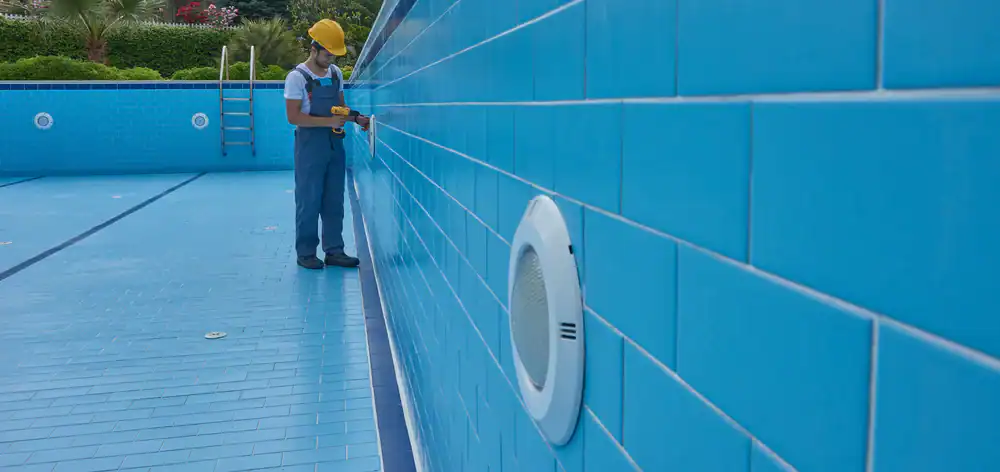
It starts with a site evaluation before any money changes hands, before any design work begins. We assess your property for soil conditions, drainage, utility locations, equipment access, and anything else that could affect the build. If you’re near Lake Blackshear or in a low-lying part of Crisp County, flood zone considerations get factored in at this stage too. No surprises after the excavator arrives.
From there, the design is built around your specific yard and how you actually want to use the space. Once the design is finalized, we handle the permit process entirely the Crisp County Swimming Pool form, the plan review submission, the electrical permit, and inspection scheduling. You don’t navigate county offices or track down paperwork. That’s handled.
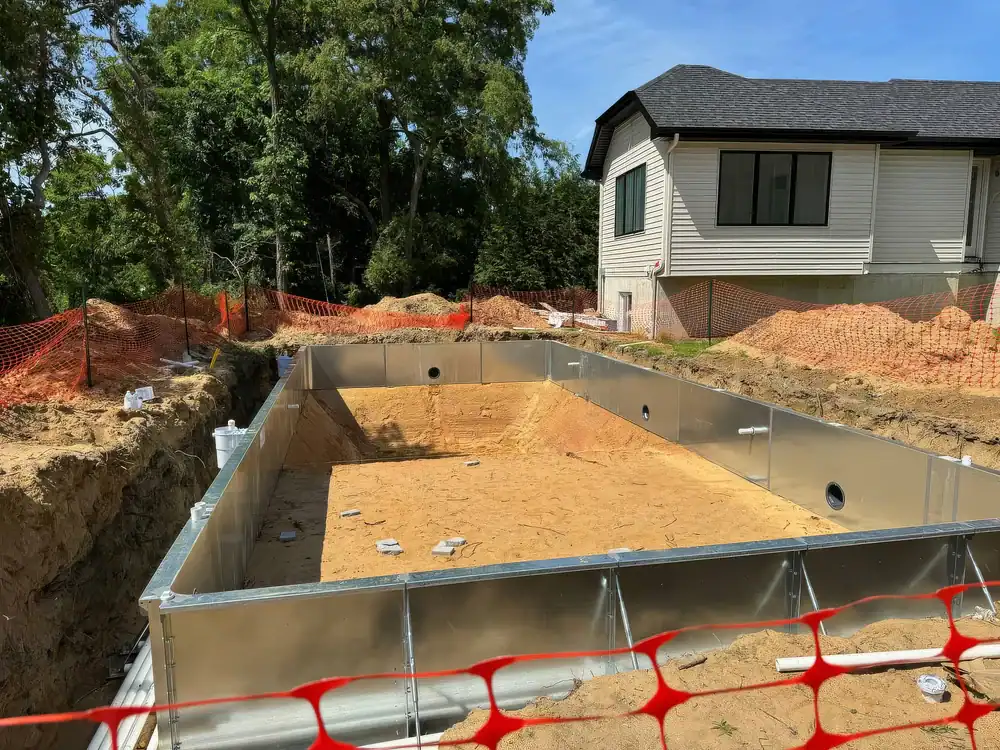
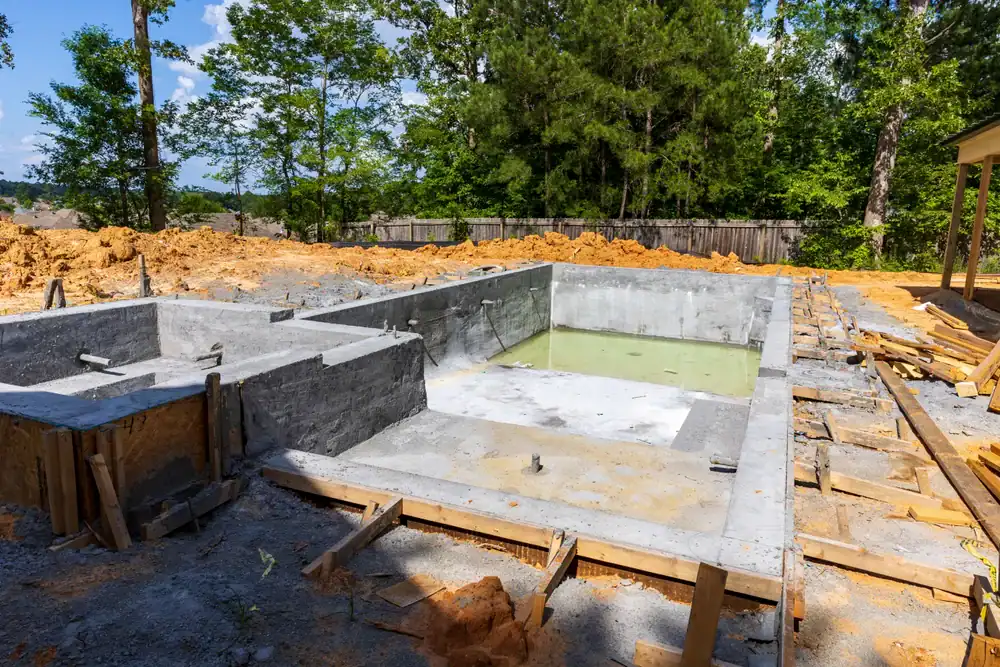
Excavation comes next, followed by the steel reinforcement cage, gunite shell application, plumbing and filtration installation, electrical work, and deck construction. Every phase is executed by our team, sequenced efficiently so the project moves without waiting on outside crews to show up. The average residential build runs six to eight weeks from excavation to water. That timeline holds because the process is managed in-house from start to finish not dependent on a rotating cast of subcontractors with their own schedules.
Ready to get started?
Our build covers the full scope: site evaluation, custom pool design, permit acquisition and management, excavation, gunite shell construction, swimming pool plumbing with quality materials, full electrical installation, filtration system setup, and pool deck installation. That’s not a list of add-ons it’s what every project includes because a pool that’s missing any one of those pieces isn’t finished.
The deck work matters more than most people realize upfront. In a climate like Cordele’s, where heavy summer rain is routine, deck slope and drainage aren’t aesthetic decisions they’re functional ones. A deck that doesn’t drain properly creates standing water, accelerates surface wear, and becomes a safety issue. We design and pour the deck as part of the overall build, not tacked on at the end by a different crew.
Cordele homeowners building in unincorporated Crisp County should know that all outdoor pools require a barrier fence complying with county code sections 305.2.1 through 305.8 and that pool houses or other associated structures each require a separate permit. If you’re building in the city limits, the permit process runs through Cordele’s Community Development office rather than the county. We know the difference, manage both, and make sure your build is fully permitted and inspection-ready before the project closes. What you end up with is a documented asset not a liability that complicates a future sale.
Yes and it’s more involved than a single form. Crisp County requires a Swimming Pool permit with affidavit, submitted through the Crisp County Planning, Zoning, and Codes office. The application goes through a plan review process, and the timeline for that review depends on how complete and accurate the submitted information is. On top of that, a separate electrical permit is required for all pool-related electrical work, and there are multiple inspections that have to be passed before a Certificate of Completion is issued.
If you’re building within Cordele’s city limits rather than unincorporated Crisp County, the permit application goes through the City of Cordele’s Community Development office a different jurisdiction with its own process. Most homeowners don’t realize there’s a distinction until they’re already mid-project. We manage the entire permit process in-house, including knowing which office handles which jurisdiction, so nothing gets submitted to the wrong place or stalls out waiting on a correction.
For a standard residential gunite build, the timeline from excavation to water runs about six to eight weeks. That estimate holds when the project is managed by a single team handling every phase in sequence excavation, steel cage, gunite shell, plumbing, electrical, and deck without waiting on outside subcontractors to coordinate their own schedules.
Where timelines slip in pool construction is almost always a coordination problem, not a technical one. When different crews handle different phases and no one is accountable for the whole project, gaps open up between stages. We don’t operate that way. Our team moves through each phase, which keeps the build on track. Weather can create brief delays South Georgia summer thunderstorms are real but they’re short interruptions, not project-derailing events. If you’re planning to be swimming by a specific date in Cordele, the honest answer is to start the conversation earlier than you think you need to.
Fiberglass pools are pre-manufactured shells that get dropped into an excavated hole. They install faster and have lower chemical demand upfront, but you’re limited to whatever shapes and sizes the manufacturer offers, and you’re working with a shell that has a functional lifespan of roughly 15 to 25 years before significant repairs become necessary. If the shell doesn’t fit your yard perfectly, it doesn’t fit there’s no adjusting it.
Gunite is pneumatically applied concrete that’s custom-shaped to your specific property. It can be built to any dimension, any depth, any configuration your yard and lifestyle call for. When wear happens after 25 or 30 years of South Georgia use, you resurface it you don’t replace the structure. For homeowners on larger properties in Crisp County, or anyone who wants a pool that actually fits their yard rather than the other way around, gunite is the better long-term investment. The upfront cost is higher than vinyl liner and comparable to fiberglass, but the 30-year math is straightforward.
Possibly, but it requires a closer look at your specific parcel before anything else. Properties near Lake Blackshear and low-lying areas throughout Crisp County may fall within FEMA-designated flood hazard zones. Crisp County maintains flood hazard data through the National Flood Insurance Program and enforces a specific Flood Damage Prevention Ordinance that applies to construction in those areas. Building in or near a flood zone doesn’t automatically disqualify you from having a pool, but it does add regulatory steps and may affect how the project is designed and sited.
This is exactly why a site evaluation happens before any design work begins. If your property has flood zone considerations, those get identified upfront not discovered after excavation starts. We’ve worked on properties throughout South Georgia with varying site conditions, and the evaluation process is built to surface these issues early so the design and permitting approach accounts for them from the start.
For a custom gunite pool in the Cordele area, a realistic starting range is roughly $55,000 to $85,000 for a standard residential build, with larger or more feature-heavy projects running $100,000 or more. What moves the number up or down is pool size and shape, deck material and square footage, equipment and filtration choices, and any site-specific factors like access challenges, soil conditions, or grading work that affect the complexity of the build.
One thing worth understanding: in a market like Cordele, where a pool can represent a significant portion of your home’s total value, the cost transparency of your contractor matters as much as the number itself. A detailed, itemized quote that explains what each line covers gives you something to evaluate. A single bottom-line number with no breakdown doesn’t. We provide quotes that show exactly what’s included, so you’re not discovering what was left out after the build is done. A properly permitted gunite pool in Crisp County also adds documented equity to your property typically in the range of 5 to 8 percent of home value in warm-climate markets like this one.
Start with the basics: a valid Georgia contractor’s license, general liability insurance, and workers’ compensation coverage. Any legitimate pool builder should be able to provide documentation for all three without hesitation. If a contractor makes that information hard to get, that tells you something.
Beyond licensing, ask specifically who will be on your property and who they’re accountable to. In pool construction, a lot of problems trace back to projects where the company that sold the job handed it off to subcontractors who had never met the homeowner and had no stake in the finished product. Ask whether the builder manages permitting in-house or passes it to you. Ask to see completed pools in South Georgia communities not stock photos, but actual finished projects you can look at or talk to homeowners about. And ask what the process looks like if something needs to be addressed after the build is complete. A contractor who’s been building pools in this region for decades and has a local reputation to protect will answer those questions differently than one who’s working the market from a distance.