
Hear from Our Customers
If your Blackshear pool keeps turning green, smells like chemicals, or clouds up after every summer storm you’re not doing it wrong. You’re working with incomplete information. A test strip tells you whether you’re somewhere in a range. Digital water analysis tells you exactly where you stand, down to the number, for every parameter that matters. That’s the difference between guessing and actually solving the problem.
Blackshear’s municipal water pulls from the Upper Floridan Aquifer deep limestone wells that naturally produce hard, mineral-rich water. When you fill or top off your pool with that water, you’re starting with elevated calcium from the jump. Without precise calcium hardness testing, that mineral load quietly builds up on your pool surface and equipment over time. It doesn’t announce itself until the scaling is already significant and expensive to deal with.
Then there’s the pollen. Pierce County is surrounded by pine forest, and every spring that means a heavy yellow-green film coating your pool water. That organic load spikes your chlorine demand fast meaning your chlorine gets consumed fighting pollen instead of sanitizing the water. Your strip reads fine. Your pool isn’t fine. Professional chemistry analysis catches what the strip misses, so you stop treating symptoms and start fixing the actual problem.
We’re based in Douglas, about 30 miles from Blackshear on US-84 the same road most Pierce County residents already travel for work and services. This isn’t a coastal company treating Blackshear like a distant add-on to a service route. We’re a South Georgia operation that understands the specific conditions your pool deals with every season.
Our team has over 30 years of hands-on experience building and servicing gunite and shotcrete pools across this region. That matters for water testing because the pools in Blackshear’s established neighborhoods the brick ranch homes and traditional properties built from the 1950s through the 1990s are exactly the surface types that require precise chemistry management to hold up long-term. Aging gunite surfaces don’t forgive imbalanced water the way newer finishes might.
Licensed, insured, and built on a straight-forward standard: no shortcuts, no guesswork, no chemicals pushed on you that don’t address the real issue.
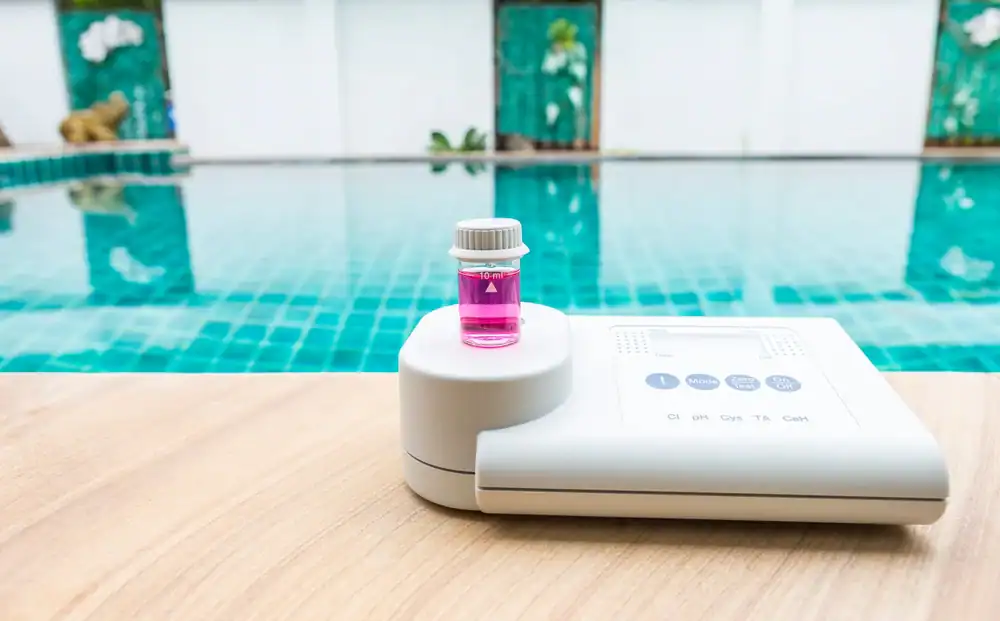
It starts with a water sample from your pool. Not a strip dipped in and held up to the light a proper sample analyzed with digital testing equipment that returns precise numerical readings for every key parameter: free chlorine, total chlorine, combined chlorine, pH, total alkalinity, calcium hardness, cyanuric acid, and metals including iron.
That last one matters more in Blackshear than most people realize. Deep well water from the Floridan Aquifer system can carry elevated iron, and iron in pool water causes brown staining on surfaces and equipment that basic testing completely overlooks. If you’ve ever had rust-colored deposits show up on your pool walls and couldn’t figure out where they came from, this is likely why.
Once the analysis is complete, you get a plain-English breakdown of every reading what it means, why it matters for your specific pool, and what needs to happen first. Not a bag of chemicals and a hope. A clear, prioritized list of corrections in the order they should be made, with the reasoning behind each one. South Georgia summers move fast. August in Pierce County averages more than 26 rain days. Your pool chemistry can shift significantly between Monday and Thursday after a storm rolls through. Knowing exactly where you stand after a rain event is the difference between staying ahead of the problem and chasing it.
Ready to get started?
Professional water testing from us covers the full picture not just the two or three readings a test strip can approximate. pH level balancing is where most pool problems quietly start. When pH drifts above 7.8, your chlorine loses roughly half its sanitizing power. That means a pool can test “normal” for chlorine and still be barely protected. Getting pH dialed in is step one, and it changes how every other chemical in the water performs.
Total alkalinity works as the buffer that keeps your pH from swinging wildly especially important in Blackshear during summer when heavy rain events and intense UV exposure are both pulling your chemistry in different directions at once. Calcium hardness testing is especially critical here given the mineral content of Floridan Aquifer fill water. Left unchecked in either direction, calcium imbalance either etches your pool surface or coats it in scale. Cyanuric acid levels the stabilizer that protects chlorine from South Georgia’s intense summer UV are also measured precisely, because years of stabilized tablet use can push CYA into a range where it actually blocks chlorine from working rather than protecting it.
Every test includes a metals check for iron and copper, a full chlorine breakdown separating free from combined chlorine, and a clear correction plan written for your pool not a generic recommendation off a shelf.
This is the most common frustration we hear from pool owners across Pierce County, and the answer almost always comes down to one of a few underlying chemistry problems that test strips can’t accurately detect. The most frequent culprit is cyanuric acid buildup. If you’ve been using stabilized chlorine tablets for several years, your CYA level has likely climbed into a range where it’s actively blocking your chlorine from sanitizing the water even when your chlorine reading looks fine. It’s called chlorine lock, and it’s invisible to a basic strip test.
The other common cause is pH drift. When pH rises above 7.8, chlorine effectiveness drops by roughly half. You can have what looks like a normal chlorine level and still have a pool that’s barely sanitized. Add in Blackshear’s summer heat which accelerates algae growth dramatically and a small chemistry imbalance can turn into a green pool within 24 to 48 hours. A full digital water analysis identifies exactly which parameter is off so the fix actually works, instead of adding more chemicals to a problem you haven’t correctly identified yet.
Blackshear’s municipal water comes from three deep wells drilled between 618 and 812 feet into the Upper Floridan Aquifer, a limestone-based system that naturally produces hard, mineral-rich water. When you fill or top off your pool with that water, you’re introducing elevated calcium levels from the start. Over time, without regular calcium hardness testing and adjustment, that mineral load builds up on your pool’s surface, at the waterline, and inside your equipment. It starts as a cosmetic issue and becomes a structural one.
For pool owners on private wells in the rural parts of Pierce County outside city service, the variability can be even greater. Well water chemistry isn’t uniform iron content, hardness, and mineral concentrations can differ significantly from one property to the next. A professional baseline test when you first fill a pool, and again at the start of each season, gives you an accurate starting point so you’re not adjusting chemistry against numbers you’re only guessing at.
That strong chlorine smell the one that burns your eyes and lingers on your skin isn’t caused by too much chlorine. It’s caused by too little effective chlorine. When free chlorine reacts with organic material in the water, like swimmer waste, sunscreen, and the heavy pine pollen load that settles on Pierce County pools every spring, it forms combined chlorines called chloramines. Chloramines are what smell. They’re also what irritate eyes and skin. And they’re a sign that your free chlorine is being overwhelmed, not that you have too much of it.
Professional water testing measures both free chlorine and total chlorine separately. The difference between those two numbers is your combined chlorine level. When combined chlorine climbs above 0.5 ppm, the pool needs a breakpoint chlorination treatment a targeted shock that burns off the chloramines and restores effective sanitation. Adding more regular chlorine without understanding this distinction usually makes the smell worse, not better, because you’re feeding the same reaction without breaking it.
In a climate like Blackshear’s, more often than most people think. The combination of intense UV exposure, high summer heat, frequent rainfall, and heavy pollen seasons means your pool chemistry can shift significantly in a matter of days not weeks. August alone averages more than 26 rain days in this region. Every significant rain event dilutes your chemicals, lowers your pH, and introduces organic debris that spikes chlorine demand. A pool that was balanced on Monday can be measurably out of range by the following weekend.
At minimum, a professional water test at pool opening in spring, once mid-summer, and before closing in fall gives you accurate benchmarks at the most critical points in the season. If you’re dealing with recurring algae, persistent cloudiness, or you’ve recently had a major rain event or heavy pollen week, that’s a signal to test sooner rather than later. Catching a chemistry problem early when a correction is simple is significantly less expensive than treating the damage after it’s had time to develop.
Cyanuric acid, or CYA, is the stabilizer added to most chlorine tablets and some granular chlorines. Its job is to protect chlorine from being destroyed by UV light which matters a lot in South Georgia, where summer sun can deplete unprotected chlorine by up to 90% in under two hours. So CYA serves a real purpose. The problem is that it accumulates in your pool water over time and doesn’t leave on its own. Every tablet you add brings more stabilizer, and there’s no chemical that removes it the only real solution is dilution.
When CYA climbs too high generally above 80 to 100 ppm it starts interfering with chlorine’s ability to sanitize, even when chlorine levels look normal. This is one of the most common reasons pools in South Georgia stay green or cloudy despite regular chemical additions. Test strips either can’t read CYA accurately at high levels or give such a wide range that the reading is almost meaningless. Digital testing gives you the exact number so you know whether your stabilizer is protecting your chlorine or working against it.
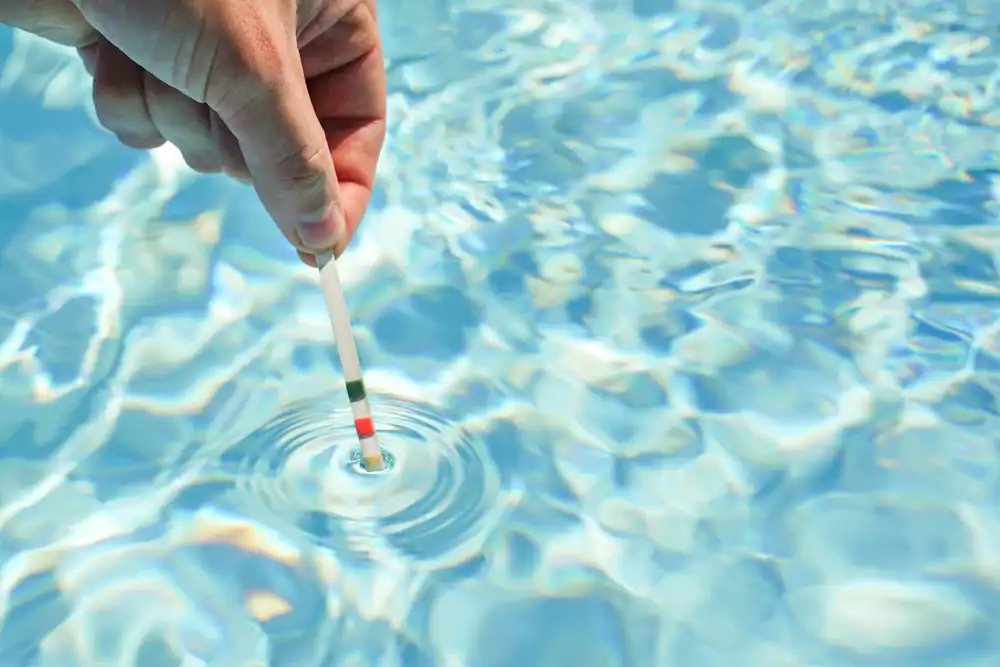
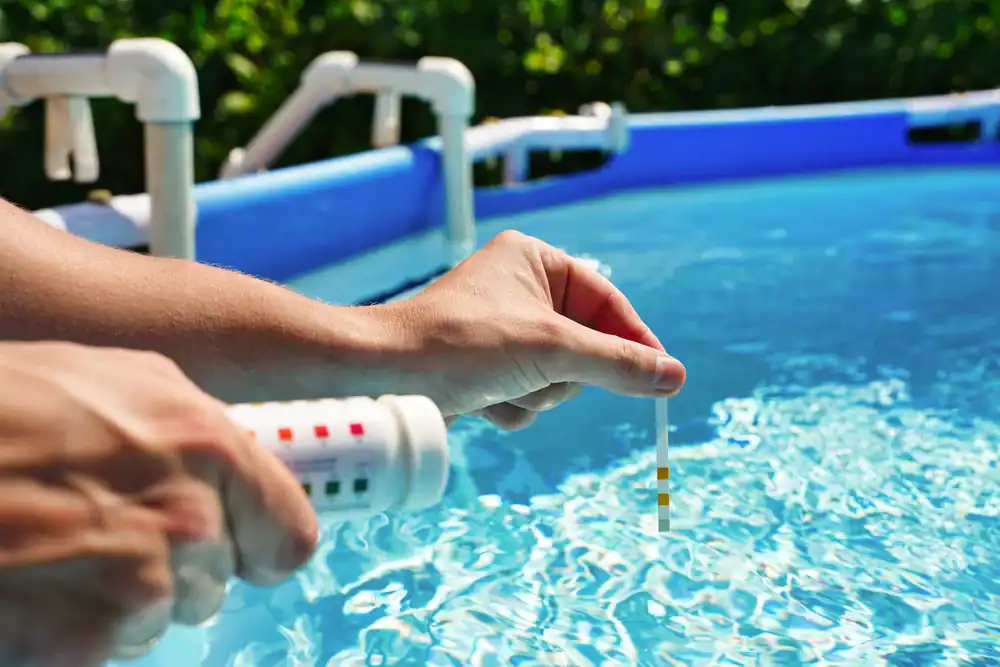
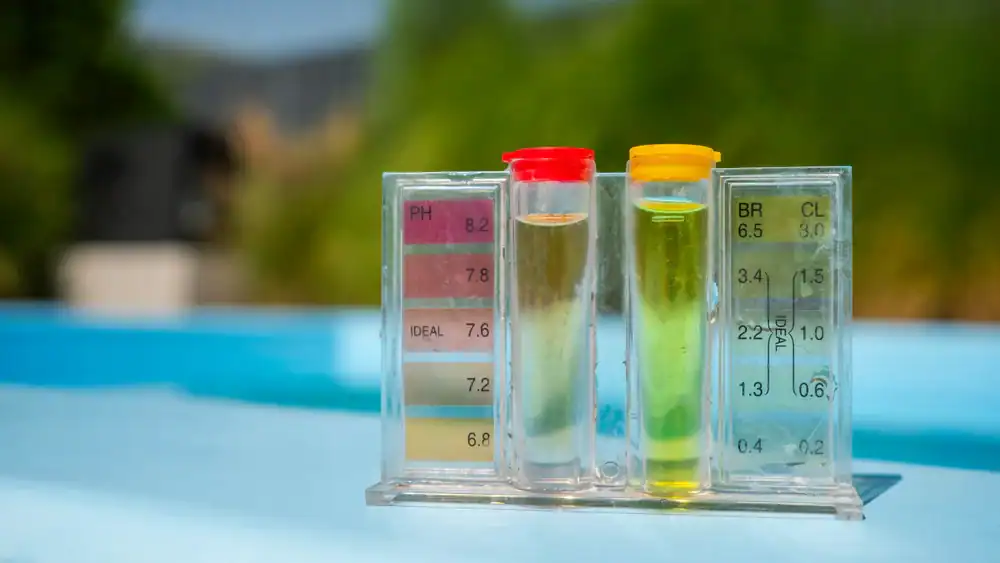
Home testing has its place it’s useful for quick checks between professional visits. But there’s a real gap between what a test strip or basic drop kit can measure and what digital professional analysis covers. Most home test kits check three or four parameters and give you a color range, not a precise number. They can’t accurately measure cyanuric acid at elevated levels, they don’t test for metals like iron and copper, and they don’t separate free chlorine from combined chlorine in a way that’s actually actionable.
For Blackshear pool owners dealing with hard Floridan Aquifer fill water, seasonal pine pollen loading, and South Georgia’s intense summer chemistry swings, that gap matters. The cost of a professional test is a fraction of what one algae treatment costs and a small fraction of what surface etching or calcium scaling costs to correct once it’s progressed. If you’ve been testing at home and still fighting the same problems season after season, the issue isn’t how often you’re testing. It’s what the test is actually telling you and right now, it probably isn’t telling you enough.