Hear from Our Customers
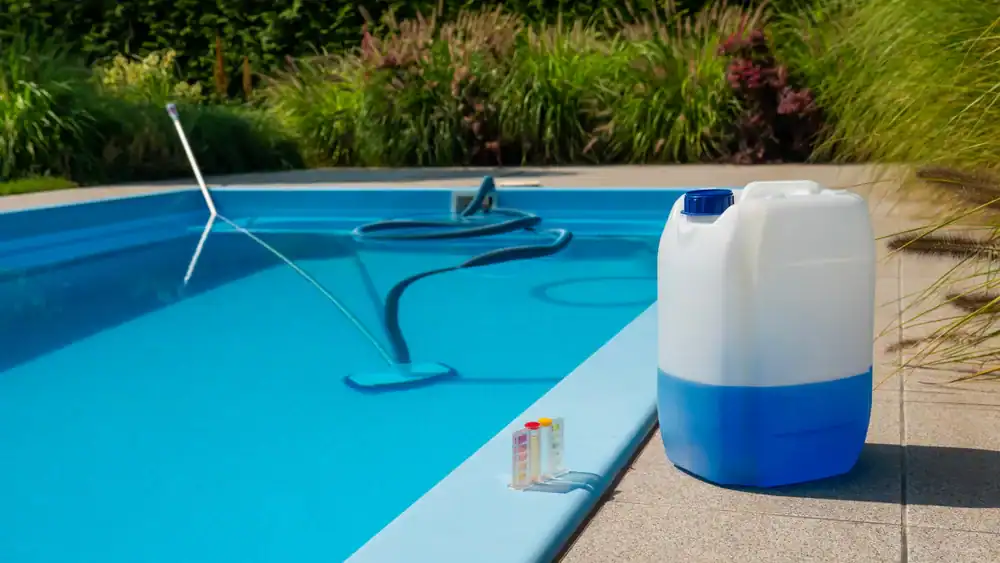
Most pool problems in Cordele don’t start with the wrong chemical they start with not knowing what the water actually contains. You add chlorine, the pool still looks off. You adjust pH, nothing changes. That cycle usually means something upstream is out of range, and a test strip isn’t going to find it.
Cordele’s municipal water draws from the Ocala, Limestone, and Clairborne Aquifers, and it arrives at your pool already carrying elevated calcium carbonate. Through a South Georgia summer where temperatures regularly push into the low 90s and evaporation doesn’t stop that calcium concentrates. If it climbs past 400 ppm, you start seeing white scaling on tile lines, rough patches on pool walls, and strain on your equipment. If it drops below 200 ppm after a heavy rain dilutes the pool, the water turns corrosive and starts eating at plaster and gunite surfaces from the inside out.
Then there’s the UV factor. Cordele’s summers are relentless, and unprotected chlorine can lose up to 90% of its effectiveness within a couple of hours of direct sunlight. If your cyanuric acid level isn’t dialed in, you’re adding chlorine and watching the sun burn it off before it does anything. Our professional water tests catch all of this calcium hardness, pH, total alkalinity, free and combined chlorine, cyanuric acid, TDS, salt level, and metals and give you a correction plan that actually addresses the root cause.
Deep Waters Pools has been doing this work across South Georgia for over thirty years. We are licensed, insured, and built on a straightforward principle: do the job right, explain what you found, and don’t leave until the customer actually understands what’s going on with their water.
That experience matters in a place like Cordele. When you’ve spent decades building and servicing gunite and shotcrete pools across this region, you understand what moderately hard municipal water does to a plaster finish over time. You know what agricultural pollen season looks like in a pool surrounded by watermelon and cotton fields. And you know that a pool near Lake Blackshear whether it’s on city water or pulling from a private well has different starting chemistry than a pool in a purely suburban neighborhood.
There’s no call center, no franchise handbook, and no technician who just learned what cyanuric acid is last month. When we come to your property in Crisp County, you get someone who has worked in this environment long enough to know what to look for before we even pull out the testing equipment.
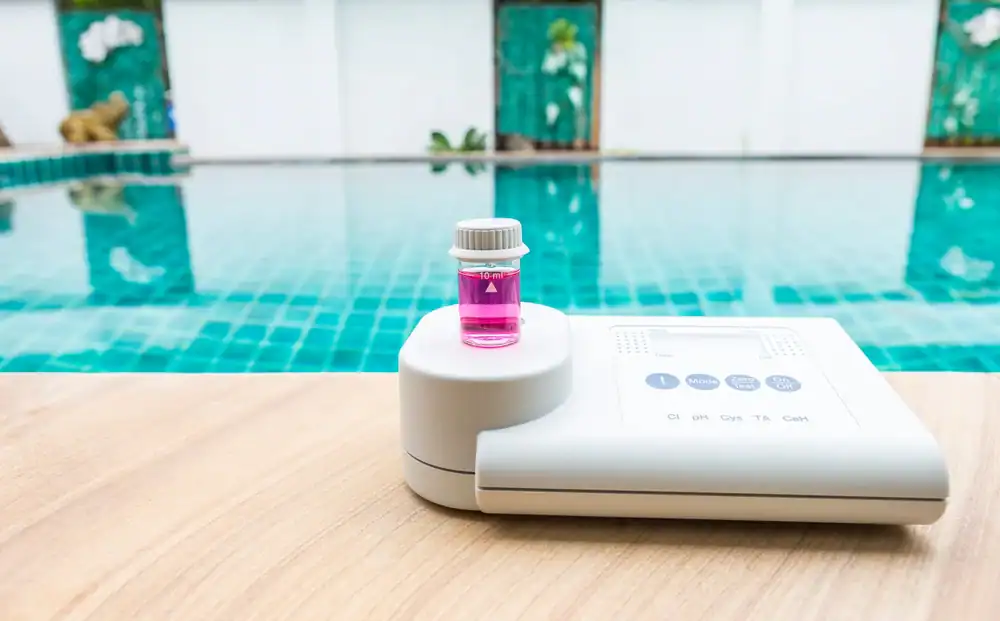
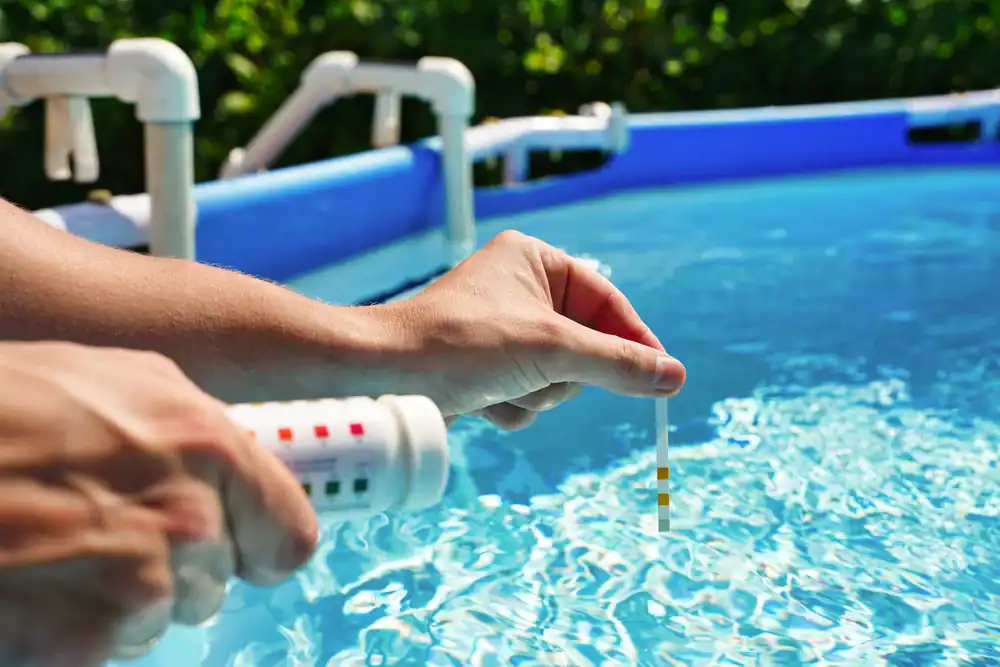
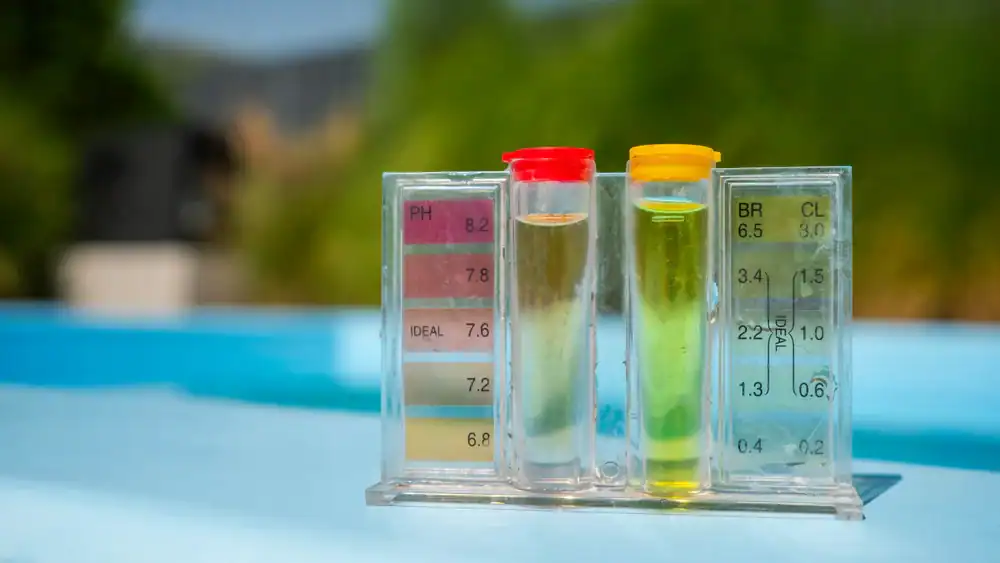
It starts with a water sample pulled directly from your pool not from the surface, but from elbow depth, where the chemistry is most representative of what your swimmers are actually in. From there, the sample goes through digital water analysis equipment that reads all nine key parameters to precise, decimal-level accuracy. This isn’t a color-matching test strip. It’s the same type of analysis used by certified pool operators managing public facilities under Georgia DPH standards.
Once the numbers are in, you get a written readout of every parameter free chlorine, total chlorine, pH, total alkalinity, calcium hardness, cyanuric acid, salt level, TDS, and metals including iron and copper. Each one gets explained in plain language. If your calcium hardness is elevated because Cordele’s hard fill water has been concentrating through the summer, you’ll know that specifically not just that “calcium is a little high.” If your cyanuric acid has climbed to a level where it’s locking out your chlorine, that gets flagged and addressed directly.
The correction plan that follows is based on your actual numbers, your pool’s surface material, and the current season. Cordele’s June pool season when the Watermelon Days Festival has everyone outside and pools are running hard puts different demands on chemistry than October does. The testing process accounts for that, and the recommendations reflect it.
Ready to get started?
A complete water test from Deep Waters Pools covers every parameter that actually matters: free chlorine, total chlorine (which reveals chloramine buildup the real cause of that “pool smell” most people blame on too much chlorine), pH, total alkalinity, calcium hardness, cyanuric acid, salt level for saltwater pools, total dissolved solids, and metals. Every one of those numbers tells you something, and every one of them interacts with the others.
For Cordele homeowners on city water, calcium hardness and TDS are usually the first numbers worth watching closely. The municipal supply starts moderately hard, summer evaporation concentrates it, and refilling with more hard water compounds the problem. For properties in the Lake Blackshear area or rural Crisp County running on well water from the same aquifer systems, iron and mineral variability become additional concerns and those require testing that goes well beyond what any store-bought kit can accurately measure.
The written report you receive after testing isn’t a list of products to buy. It’s an explanation of what’s off, why it matters for your specific pool surface and setup, and what needs to happen to correct it. If your pool is a gunite or shotcrete build the type we specialize in constructing the chemistry recommendations account for how those surfaces respond to water that’s either too aggressive or too scaling. You get the full picture, not a partial read designed to move product off a shelf.
That white buildup on your tile line is calcium carbonate the same mineral that makes Cordele’s municipal water “moderately hard,” as the city’s own water department describes it. When pool water evaporates through a South Georgia summer, the water leaves but the calcium stays behind. Over weeks and months, it concentrates. Once calcium hardness climbs past roughly 400 ppm, it starts depositing on any surface it can find tile grout, waterline tile, pool walls, and equipment.
The fix isn’t just scrubbing the tile. If the underlying calcium hardness level isn’t brought back into range (generally 200–400 ppm), the scaling returns. A professional water test gives you the exact calcium hardness reading, and from there you can treat the water correctly rather than just cleaning the surface repeatedly. For pools in Cordele that are filled from city supply and exposed to heavy summer evaporation, calcium hardness monitoring throughout the season is one of the most important things you can do to protect your pool’s finish and equipment.
For most pool owners in the Cordele area, professional testing at least twice per season makes practical sense once at the start of the summer when you’re ramping up use, and once mid-season when the heat, UV exposure, and bather load have had time to shift your chemistry. If you’re running a saltwater pool, dealing with a recurring algae problem, or filling from a private well rather than city supply, more frequent testing is worth it.
South Georgia’s climate compresses the chemistry timeline significantly. What might take several weeks to go wrong in a cooler, lower-UV environment can go wrong in Cordele within a few days during peak summer. High temperatures accelerate algae growth, UV intensity burns through chlorine faster than most homeowners expect, and afternoon thunderstorms can dilute your chemistry and drop pH in a single afternoon. Professional testing after a significant rain event or a period of very heavy pool use is a reasonable precaution especially if the water starts looking cloudy or you notice any irritation.
Free chlorine is the active, sanitizing chlorine in your pool the part that’s actually killing bacteria and keeping the water safe. Total chlorine includes both free chlorine and combined chlorine, which is chlorine that has already reacted with contaminants like sweat, sunscreen, and body oils and is no longer doing any sanitizing work. The difference between those two numbers is your combined chlorine level, also called chloramines.
Chloramines are what cause the sharp “pool smell” and eye irritation that most people associate with too much chlorine. It’s actually the opposite it’s a sign that your free chlorine has been consumed and what’s left is chemically spent. In Cordele during peak summer, when pools are getting heavy use and bather load is high, chloramine buildup can happen quickly. A professional test reads both numbers separately and flags the gap. Correcting it usually involves shocking the pool to break apart the chloramines and restore free chlorine to an effective level something a basic test strip won’t give you the data to do accurately.
Yes and it works in both directions. When calcium hardness is too high, which is the more common direction for Cordele pools given the moderately hard municipal supply, the water deposits calcium onto surfaces and equipment. You see it as scaling on tile, rough patches on plaster, and eventually buildup inside pipes and on heater elements. Left unmanaged over multiple seasons, it shortens the life of your equipment and degrades your pool’s finish.
When calcium hardness drops too low which can happen after heavy rainfall dilutes the pool significantly the water becomes chemically aggressive and starts pulling minerals out of whatever surface it’s in contact with. For gunite and plaster pools, that means the water essentially etches the surface over time. Resurfacing a pool is not a small expense. Catching calcium hardness drift early with a professional test is a fraction of that cost. For Cordele homeowners whose pools are exposed to both hard fill water in dry stretches and significant rain dilution during summer storm season, keeping an eye on calcium hardness is one of the most cost-effective things you can do.
The most common culprit in Cordele is cyanuric acid (CYA) that has climbed too high. CYA is a stabilizer that protects chlorine from UV degradation which is genuinely necessary in South Georgia’s sun but when it accumulates past roughly 80–100 ppm, it starts chemically blocking chlorine from working effectively. Your test strip might show a normal chlorine reading, but at elevated CYA levels, that chlorine is largely unavailable to sanitize the water. Algae grows because the chlorine isn’t actually doing its job, even though the numbers look fine on paper.
CYA accumulates over time through stabilized chlorine products tablets and granules that include stabilizer in the formula. Every time you add them, CYA goes up. The only way to bring it down is to partially drain and refill the pool with fresh water. A professional test measures your exact CYA level, which a standard test strip often cannot read accurately at elevated concentrations. Once you know where it actually stands, you can make a real decision about whether a partial drain is needed rather than continuing to add chlorine that isn’t working.
It matters quite a bit. Cordele’s city water comes from a managed municipal system with consistent treatment, so while it’s moderately hard, it’s at least predictable. Well water drawn from the same Ocala, Limestone, and Clairborne Aquifers that supply the city can have significantly more variable mineral content and it arrives at your pool with no municipal treatment applied. That means iron levels, calcium hardness, and pH can all be higher or more unpredictable than what city water brings.
Iron is the issue that catches most well-water pool owners off guard. Even low concentrations sometimes as little as 0.3 ppm can cause staining on pool surfaces when chlorine is added, turning the water brown or leaving rust-colored marks on plaster and gunite. Standard test strips don’t test for metals at all. A professional water test that includes metals screening is the only way to know whether iron or copper is present before you start adding chemicals that could make the staining permanent. For properties in the Lake Blackshear area or rural Crisp County on private well systems, metals testing isn’t optional it’s the starting point.