
Hear from Our Customers
A pool that looks clean and a pool that is clean are two different things. Cloudy water, eye irritation, and that faint chemical smell aren’t signs of too much chlorine they’re usually signs your chemistry is off in a way that basic test strips can’t catch. Getting a real, accurate read on your water means you stop guessing, stop wasting money on chemicals that aren’t doing their job, and start using your pool the way you intended.
In Leesburg, the conditions that knock pool chemistry off balance aren’t subtle. The heat alone accelerates algae growth and burns through chlorine faster than most homeowners expect. Add in the summer thunderstorms that roll through Lee County and dilute your chemical levels within hours, and a pool that tested fine on Saturday can be visibly off by Monday morning. Our professional testing accounts for all of it not just the numbers on paper, but the real-world conditions your pool is dealing with.
There’s also what’s happening beneath the surface. Leesburg’s municipal water comes from underground aquifer wells, and the mineral content of that groundwater affects your pool’s calcium hardness from the moment you fill or top it off. Left unchecked over time, that can mean scaling on your surfaces, clogged filters, or slow corrosion of equipment you’d rather not replace early. Catching it with a proper pool chemistry analysis is a lot cheaper than the alternative.
We’re based in Douglas, GA, and have been building, renovating, and servicing pools across South Georgia for over three decades including throughout the Leesburg area and surrounding Lee County communities. That construction background matters more than most people realize when it comes to water chemistry. When you’ve spent thirty-plus years building gunite and shotcrete pools from the ground up, you understand how water chemistry interacts with pool surfaces at a level that a cleaning-only company simply doesn’t have.
We’re licensed, insured, and we use digital water analysis, not color-matching strips. That means the numbers we give you are accurate, and the recommendations that follow are based on what your pool actually needs not a generic chemical checklist. Whether you’re in Quail Valley, out near Woodlake Plantation, or anywhere else in Lee County, the process is the same: we show up, test everything, and give you a straight answer.
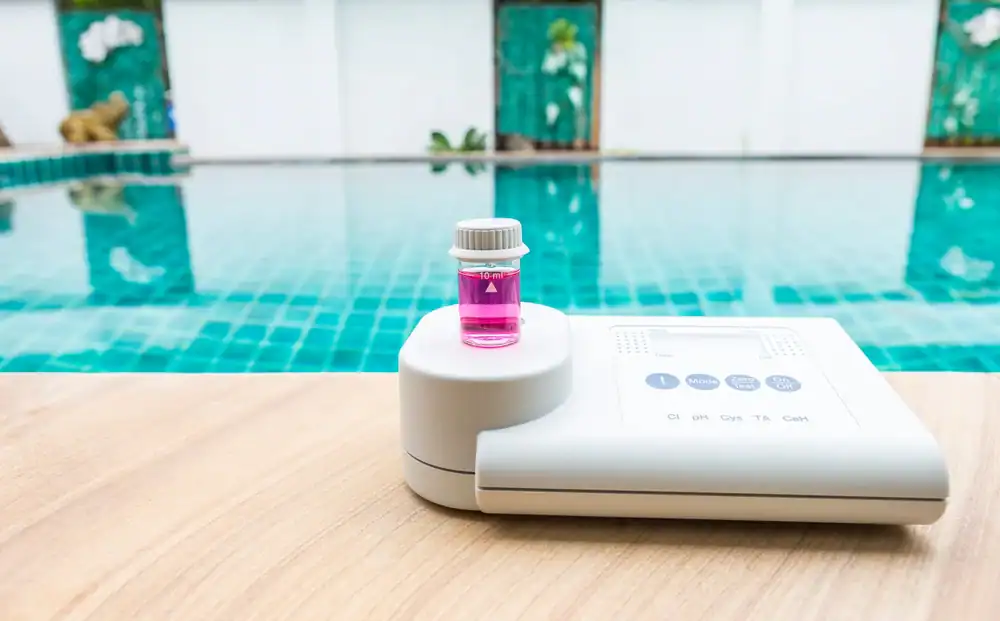
It starts with an on-site visit. We come to your pool in Leesburg no dropping off a water sample somewhere, no waiting on a mailed kit. Testing pool water accurately means testing it where it lives, because temperature, circulation, and surface conditions all factor into what the numbers mean. We collect samples from the right depth and location in your pool, then run them through digital analysis equipment that measures every critical parameter with precision.
What we’re looking at covers the full picture: free chlorine and total chlorine levels, pH, total alkalinity, calcium hardness, cyanuric acid (stabilizer), and total dissolved solids. Each one of those numbers tells a different part of the story. pH affects how well your chlorine actually works when it drifts above 7.8, you can lose half your sanitizing power even if your chlorine level looks fine. Cyanuric acid keeps chlorine from burning off under South Georgia’s direct summer sun, but too much of it and your chlorine becomes ineffective regardless of how much you add. These are the relationships that test strips miss.
Once we have the full picture, we walk you through it in plain language. Here’s what’s off, here’s why it matters, here’s exactly what needs to happen to correct it. No pressure, no upsell, no vague recommendations. You leave the conversation knowing what your pool needs and why and if you want us to handle the corrections, we can do that too.
Ready to get started?
Pool water testing with us covers every parameter that actually matters for a healthy, safe, and well-maintained pool. That means pH level balancing assessment, free and combined chlorine levels, total alkalinity check, calcium hardness testing, cyanuric acid concentration, and total dissolved solids. Each one affects the others, which is why testing one or two things and calling it done leads to the exact frustration most pool owners in Lee County have already experienced balanced on paper, still green in reality.
Calcium hardness gets particular attention here because of Leesburg’s water source. The aquifer-fed municipal supply carries dissolved minerals that accumulate in pool water over time. If your calcium hardness climbs too high, you get scaling on your plaster and tile. Too low, and the water pulls calcium directly from your pool’s surface which is how you end up with pitting and etching on a gunite finish that should last decades. This is the kind of detail that matters when the company testing your water has also built and resurfaced pools like yours.
For new pool owners in subdivisions like Hillridge or Holly Ridge, we also establish a baseline chemistry profile so you know exactly where your water stands from day one. That starting point makes every future adjustment faster, cheaper, and more accurate. Because the best pool chemistry problem is the one that never develops.
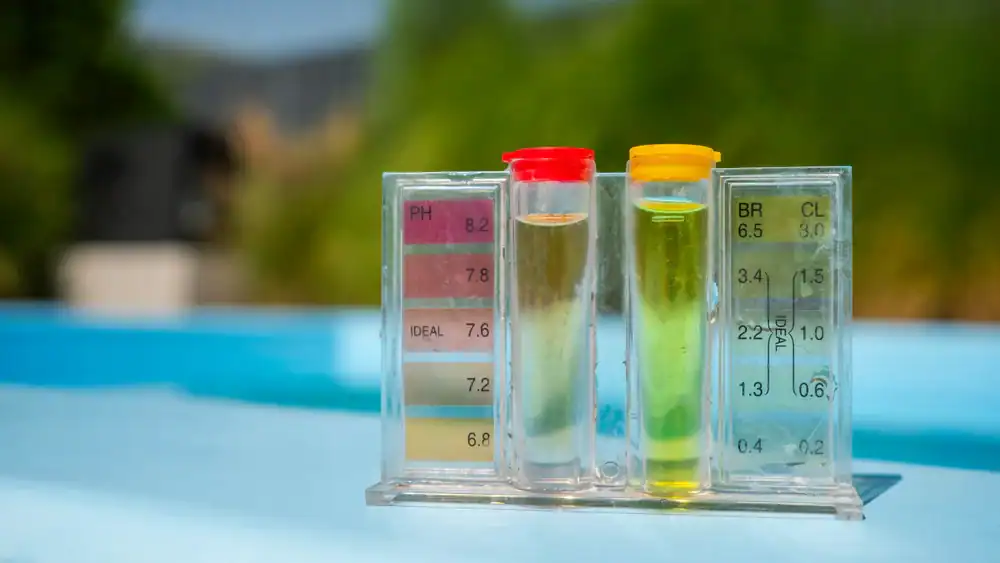
For most pools in Leesburg, professional testing at least two to three times per season is a reasonable baseline but the reality of South Georgia’s climate pushes that number higher for a lot of homeowners. When your heat index is regularly above 100°F from June through August and afternoon thunderstorms are a near-daily occurrence, your pool chemistry can shift significantly within 48 hours of a major rain event or a stretch of extreme heat. Dilution from rainfall lowers your chemical concentrations, and heat accelerates chlorine consumption and algae growth simultaneously.
A good rule of thumb: test after any significant storm, at the start and midpoint of peak season, and any time your water looks or smells off. If you’re running your pool heavily kids in it every day during Lee County’s long summer break more frequent checks make sense. DIY test strips can fill in the gaps between our professional visits, but they shouldn’t replace a full digital analysis, especially when you’re trying to diagnose a recurring problem rather than just monitor a stable pool.
This is the most common frustration we hear from Leesburg pool owners, and it almost always comes down to one of a few things that basic testing doesn’t catch. The most frequent culprit is pH drift when your pH climbs above 7.8, your chlorine loses roughly half its effectiveness even if the chlorine level itself looks fine on a strip. You’re adding product, but the chemistry isn’t cooperating, and algae takes advantage of that window fast. In Leesburg’s summer heat, algae doesn’t need much of an opening.
The other common issue is cyanuric acid buildup. Stabilizer protects chlorine from burning off in direct sunlight, which is critical in South Georgia’s UV intensity. But when CYA levels climb too high which happens gradually over a season or two of adding stabilized chlorine products your chlorine becomes significantly less effective regardless of concentration. The fix isn’t adding more chlorine. It’s a partial drain and refill to dilute the CYA back into a workable range. A full water chemistry analysis is usually the fastest way to identify which of these issues is actually driving the problem.
Total alkalinity is what keeps your pH stable. Think of it as a buffer when alkalinity is in the right range, your pH holds steady even when rain, bather load, or chemical additions try to push it around. When alkalinity is too low, pH swings wildly and becomes nearly impossible to manage consistently. When it’s too high, pH gets locked in place and resists correction even when you’re actively trying to adjust it.
For Leesburg pool owners dealing with frequent summer storms, alkalinity management is especially relevant. Every time a significant rain event dilutes your pool water, it’s not just your chlorine that drops your alkalinity takes a hit too, which then destabilizes your pH, which then undermines your chlorine’s effectiveness. It’s a chain reaction that starts with one rain and ends with a pool that’s harder and more expensive to correct. Keeping alkalinity dialed in between 80 and 120 parts per million is one of the simplest ways to make every other part of pool chemistry easier to manage through the season.
Yes, and it’s worth understanding before you assume your pool’s chemistry problems started somewhere else. The City of Leesburg draws its water supply from two underground aquifer wells and treats it with sodium hypochlorite and fluoride before it enters the distribution system. That means your fill water already contains added chlorine and carries the mineral profile of South Georgia groundwater including dissolved calcium and magnesium that contribute to your pool’s calcium hardness level over time.
This isn’t a problem by itself, but it does mean your pool’s chemistry baseline is shaped by what’s coming out of your tap, not just what you’re adding to the water. If you’re regularly topping off your pool during Leesburg’s hot, evaporation-heavy summers, that mineral load accumulates. Over a full season, it can push calcium hardness into scaling territory without any obvious single cause. A professional water test that accounts for your local water source gives you a much more accurate starting point than a generic chemistry chart designed for a different region’s water supply.
Calcium hardness measures the concentration of dissolved calcium in your pool water, and it operates within a fairly narrow range where things stay balanced. The target for most pools is between 200 and 400 parts per million. Below that range, the water becomes aggressive it’s essentially undersaturated and will pull calcium from wherever it can find it, which in a gunite or shotcrete pool means your plaster surface. That process is slow and invisible at first, but it leads to pitting, etching, and surface roughness that’s expensive to reverse.
Above the target range, you get the opposite problem: calcium starts dropping out of solution and depositing on surfaces, tile lines, and inside your equipment as scale. Both conditions shorten the life of your pool’s finish and put unnecessary wear on your pump, filter, and heater. For pools in Leesburg built with gunite or shotcrete which is the dominant pool type in this part of South Georgia calcium hardness testing isn’t optional maintenance. It’s how you protect a finish that’s meant to last twenty or thirty years.
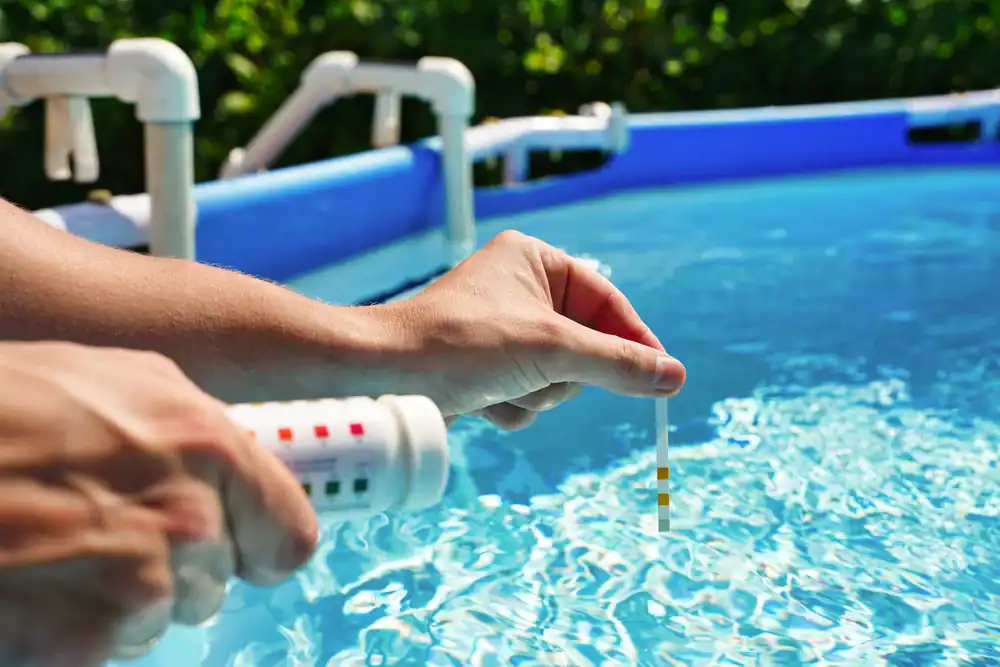
Test strips have their place they’re a reasonable way to do a quick check between our professional visits and catch obvious problems before they get worse. But they have real limitations that matter when you’re trying to actually solve a chemistry problem rather than just monitor a stable pool. Strip accuracy depends heavily on how they’re stored, how long they’ve been open, and how they’re read factors that introduce error even when you’re doing everything right. More importantly, strips can’t accurately measure cyanuric acid at higher concentrations, and they can’t distinguish between free chlorine and combined chlorine, which is the difference between chlorine that’s working and chlorine that’s already been used up.
In Leesburg’s climate specifically where heat, UV exposure, and summer rainfall are all working against your chemistry simultaneously that precision gap matters. If your pool keeps giving you problems despite what your strips say, the answer is almost always in a parameter the strips either can’t measure or can’t measure accurately. A digital water analysis gives you the full picture: every number, every relationship between those numbers, and a clear path to correction rather than another round of adding chemicals and hoping for the best.