
Hear from Our Customers
Most pool problems don’t start with the water you can see. They start with chemistry that’s quietly drifting pH creeping up, chlorine burning off faster than you can add it, calcium hardness sitting too low and slowly eating away at your plaster finish. By the time the water looks wrong, you’re already behind.
In Norman Park, that drift happens fast. Summer temperatures push well into the 90s, and South Georgia’s direct sunlight can wipe out a significant portion of your chlorine within hours of adding it. Add in the agricultural surroundings of Colquitt County where heavy rain washes nitrates and phosphates from surrounding fields into the air and eventually into your pool and you’ve got a chemistry environment that changes faster than most homeowners expect.
What professional testing gives you is clarity. You stop adding chemicals based on a guess and start making corrections based on actual data. Free chlorine, total chlorine, pH, total alkalinity, calcium hardness, cyanuric acid, TDS, metals every number measured precisely, every correction explained plainly. When you know what’s actually off, fixing it is straightforward.
We’re based in Douglas, Georgia, and have been building and servicing pools across South Georgia for over 30 years including throughout Norman Park and Colquitt County. That history matters because water chemistry and pool construction aren’t separate conversations they’re the same one. When you understand how a gunite shell is built, you understand exactly what happens to the plaster when calcium hardness drops too low. That’s the kind of knowledge that doesn’t come from a product manual.
Colquitt County’s agricultural landscape creates pool chemistry conditions that most generic service providers aren’t equipped to handle. Runoff from surrounding farmland, the specific mineral profile of Norman Park’s municipal water supply, the relentless summer heat along the US 319 corridor these aren’t abstract factors. They’re the actual conditions your pool is dealing with every week. We’ve been working in this environment long enough to know what to look for before it becomes a visible problem.
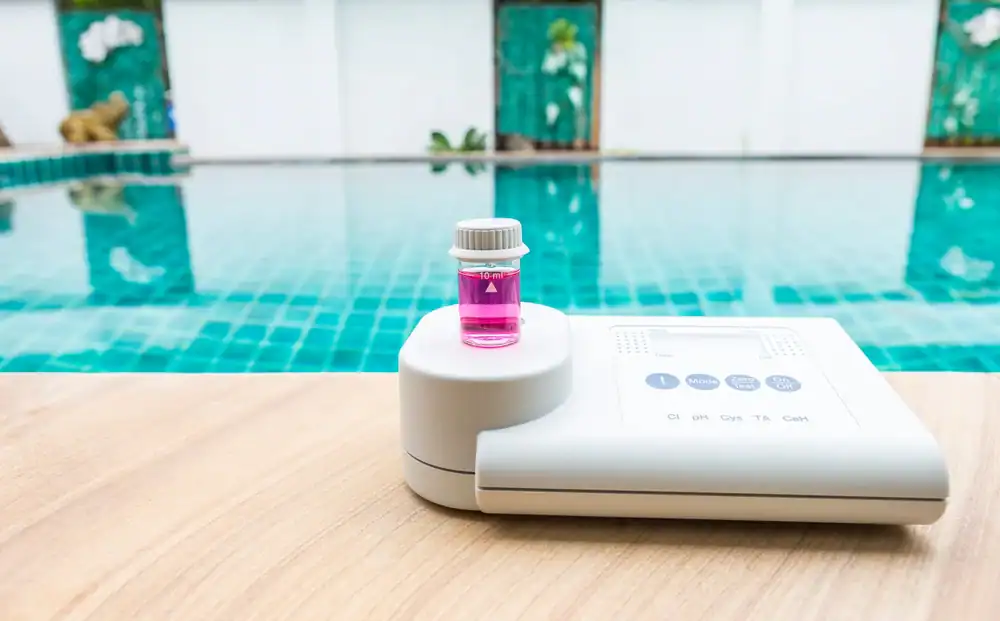
It starts with a full digital water analysis not a strip dipped in the water and held up to a color chart. We collect a sample and run it through advanced testing equipment that measures every key parameter precisely: free chlorine, total chlorine, pH, total alkalinity, calcium hardness, cyanuric acid, total dissolved solids, and metals. Each reading is documented so you have a clear picture of where your water actually stands.
From there, we review the results against the specific demands of your pool. If you have a gunite or shotcrete surface which is common throughout South Georgia calcium hardness and pH tolerances matter more than they would for a vinyl liner pool. The correction plan accounts for your surface type, your pool volume, and the local conditions that affect how fast chemistry shifts in Colquitt County’s climate. Pollen season, recent heavy rains, high bather load all of it factors in.
You leave the appointment knowing what was off, why it was off, and exactly what needs to happen to correct it. No mystery chemicals. No vague recommendations. Just a clear, honest readout and a straightforward correction plan you can actually follow.
Ready to get started?
The full water analysis covers everything that actually drives pool health: free chlorine and total chlorine levels, pH, total alkalinity, calcium hardness, cyanuric acid stabilizer levels, total dissolved solids, and metals. Each one tells a different part of the story. Cyanuric acid, for example, protects chlorine from South Georgia’s intense UV exposure but if it climbs too high, it starts suppressing chlorine’s ability to sanitize even when your chlorine readings look fine. That’s the kind of nuance a test strip simply cannot catch.
For Norman Park pool owners, the fill water source matters too. Norman Park’s municipal supply has a documented mineral profile that directly affects your pool’s baseline chemistry particularly calcium hardness and total alkalinity. If you’re topping off your pool regularly through the long South Georgia swim season and not accounting for what’s in that source water, you’re introducing variables into your chemistry that no amount of shock treatment will fix on its own.
After every test, you get a complete written breakdown of your results and a clear correction plan. We also offer ongoing maintenance services for pool owners who want consistent chemistry management throughout the season from spring opening through the fall transition and into Colquitt County’s mild winter months, when pools here rarely go fully dormant.
Rain events in Colquitt County do more than dilute your pool chemicals they introduce organic material from the surrounding agricultural landscape. Nitrates and phosphates from nearby farmland, pollen, and debris all enter your pool during and after a storm, dramatically increasing the organic load your chlorine has to fight. At the same time, heavy rain lowers your pH and dilutes whatever cyanuric acid stabilizer you had protecting your chlorine from UV breakdown. The result is a pool that looks balanced one day and green the next.
The fix isn’t just adding more shock. It’s understanding which parameters actually shifted and correcting them in the right order. If your pH is off, chlorine loses a significant portion of its sanitizing power regardless of how much you add. A professional water test after any significant storm will tell you exactly what changed and what to address first so you’re not just throwing chemicals at the problem and hoping.
In South Georgia’s climate, more often than most people expect. The combination of intense UV exposure, high summer temperatures, heavy pollen seasons, and frequent afternoon thunderstorms means your pool chemistry can shift significantly within 24 to 48 hours of a weather event. For pools in active use during the summer months, a professional test at least once a month gives you a reliable baseline and after any major storm, heavy pollen event, or period of unusually high bather load, an additional test is worth it.
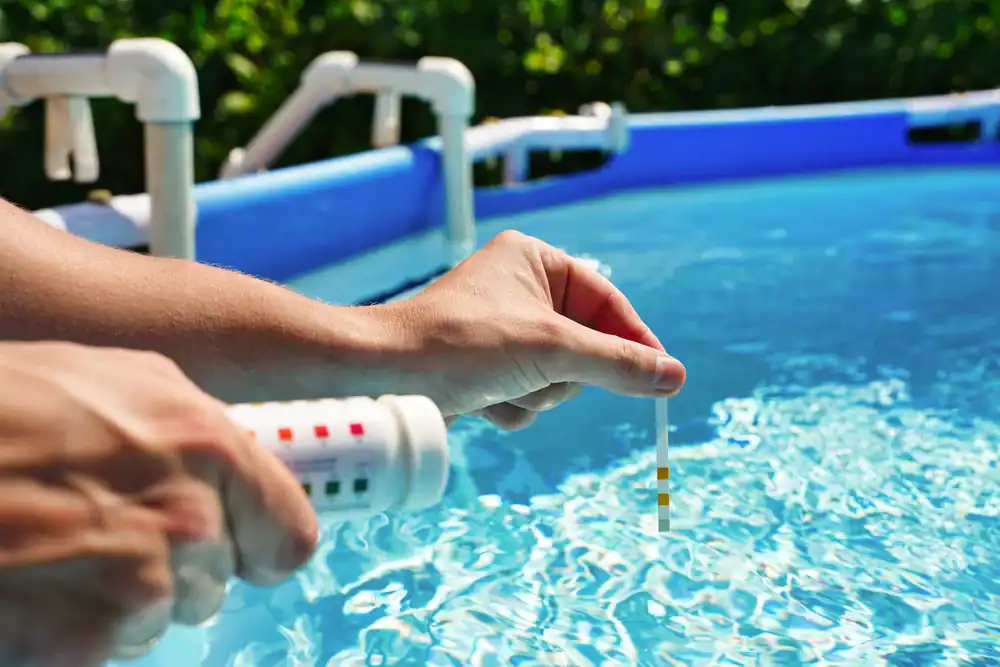
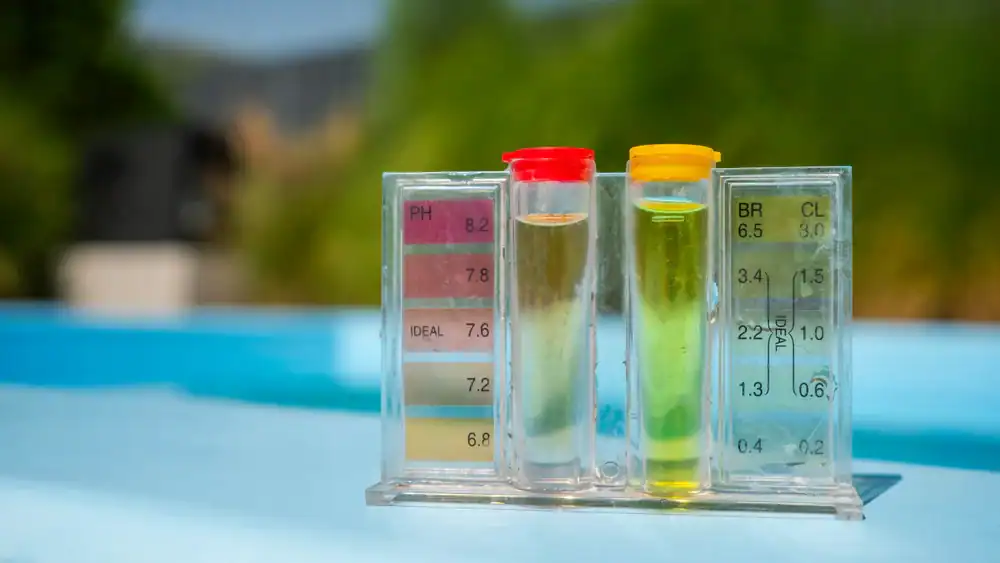
Home test strips are fine for quick daily checks, but they don’t measure everything that matters, and their accuracy degrades in heat and humidity. Professional digital testing gives you precise readings on parameters that strips either can’t measure accurately or miss entirely like combined chlorine levels, high-range cyanuric acid, and metals from your fill water source. Think of it like the difference between checking your tire pressure by feel versus using an actual gauge.
Calcium hardness is one of the most overlooked parameters in residential pool chemistry, and it’s particularly important for gunite and shotcrete pools which make up the majority of in-ground pools in South Georgia. When calcium hardness falls too low, your water becomes chemically aggressive. It will pull calcium out of wherever it can find it, including your pool’s plaster finish. Over time, that leads to surface pitting, roughness, and eventually costly resurfacing.
When calcium hardness climbs too high, the opposite happens white mineral scaling forms on surfaces, waterline tiles, and inside equipment like filters and heaters. Both extremes are damaging and both are preventable with regular monitoring. The target range for gunite pools is generally 200 to 400 parts per million, but the right number for your specific pool depends on your total alkalinity and pH as well. A professional test gives you all three numbers together so corrections can be made in the right proportion.
Cyanuric acid sometimes called pool stabilizer or conditioner protects chlorine from being destroyed by UV sunlight. In Norman Park’s summer conditions, with long days, intense sun, and temperatures regularly in the 90s, unprotected chlorine can break down rapidly. Cyanuric acid slows that process significantly, making your chlorine last longer and work more consistently between treatments.
The catch is that too much cyanuric acid creates its own problem. When levels climb above 80 to 100 parts per million, the acid starts binding to chlorine molecules in a way that reduces their ability to sanitize a condition sometimes called chlorine lock. Your chlorine test reads fine, but the chlorine isn’t actually doing its job effectively. This is one of the most common reasons pools in Norman Park stay persistently cloudy or algae-prone despite regular chemical additions. A full digital water analysis measures your cyanuric acid level precisely so you know whether you’re protected, over-stabilized, or somewhere in between.
Yes, and this is something most homeowners never think to account for. Every time you top off your pool whether it’s a slow evaporation refill or a more significant addition after a dry stretch you’re introducing the chemical profile of your source water directly into your pool. Norman Park’s municipal water supply has its own mineral content, pH baseline, and dissolved solids that influence your pool’s starting chemistry before you add a single chemical.
If your source water is naturally high in calcium, for example, your calcium hardness will climb over time even if you’re not adding anything to raise it. If it’s on the softer side, your pool may trend toward corrosive conditions more quickly than expected. Understanding your fill water source is part of getting pool chemistry right not just a one-time curiosity. We account for source water chemistry when reviewing your test results, which is why the correction plans we provide tend to hold longer than what you’d get from a generic retail recommendation.
Home testing is a useful habit, but it has real limits. Most consumer test strips and basic drop kits measure three to five parameters under ideal conditions. Professional digital analysis measures eight or more parameters with a level of precision that consumer tools simply can’t match and in Norman Park’s pool chemistry environment, the difference between “close enough” and “exactly right” is the difference between a pool that stays clear all summer and one that keeps giving you problems.
There’s also the interpretation gap. Knowing that your pH reads 7.6 is one thing. Understanding how that pH interacts with your current cyanuric acid level, your calcium hardness, and your total alkalinity and knowing which one to adjust first without throwing the others off is a different skill set entirely. Professional testing gives you the numbers and the context to act on them correctly. For a Colquitt County homeowner who has already spent money on chemicals that didn’t stick, one professional test often pays for itself by identifying the actual root cause rather than just the visible symptom.