
Hear from Our Customers
You’re not testing your pool water because you enjoy chemistry. You’re doing it because you want to know your family can swim without eye irritation, skin rashes, or worse. And you want to avoid the expensive equipment damage that comes from water that’s been off-balance for too long.
Home test strips miss half the story. They can’t measure calcium hardness, cyanuric acid, or total alkalinity with any real accuracy. That means you’re making decisions based on incomplete information.
Professional water testing gives you the full picture in about three minutes. We test for every chemical and mineral that affects your pool’s safety and longevity. You get a printed report showing current levels, ideal ranges, and exactly what to add or adjust. No guessing. No wondering if that green tint means algae is starting or if your chlorine is actually doing its job.
We’ve been serving Red Bluff and the surrounding Georgia communities for over 30 years. We’re licensed, insured, and we’ve seen every water condition this climate can throw at a pool.
Georgia’s heat, humidity, and heavy summer rains create specific challenges for pool chemistry. Afternoon thunderstorms dilute your chemicals. High temperatures burn through chlorine faster. The red clay soil common around Red Bluff affects fill water differently than other regions.
We account for all of it. And we offer this water analysis service completely free because we know that once you see how accurate and helpful real testing is, you’ll understand the difference between maintaining a pool and actually protecting your investment.
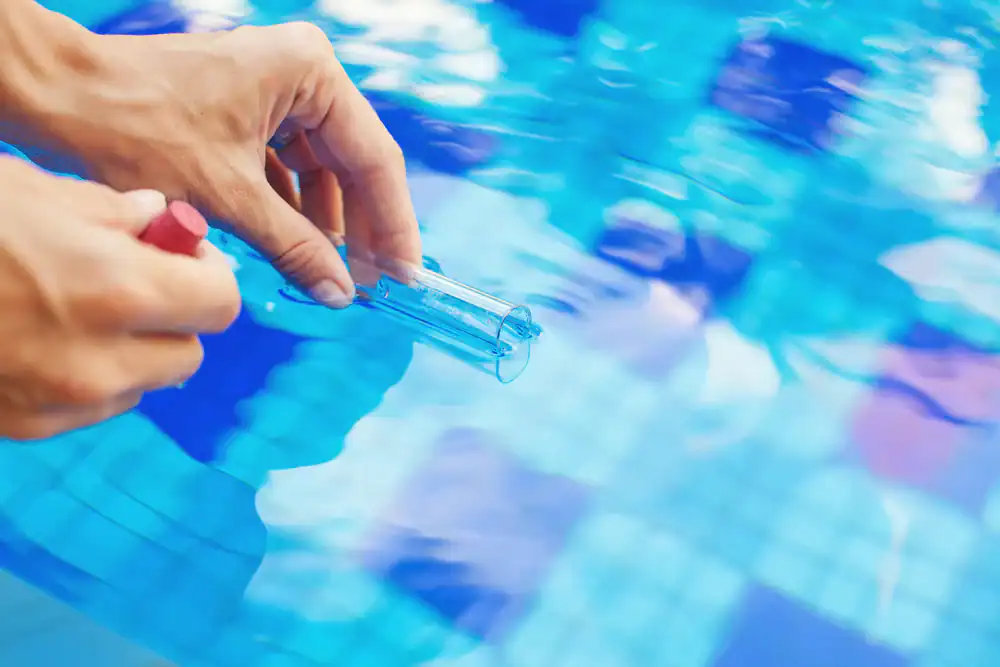
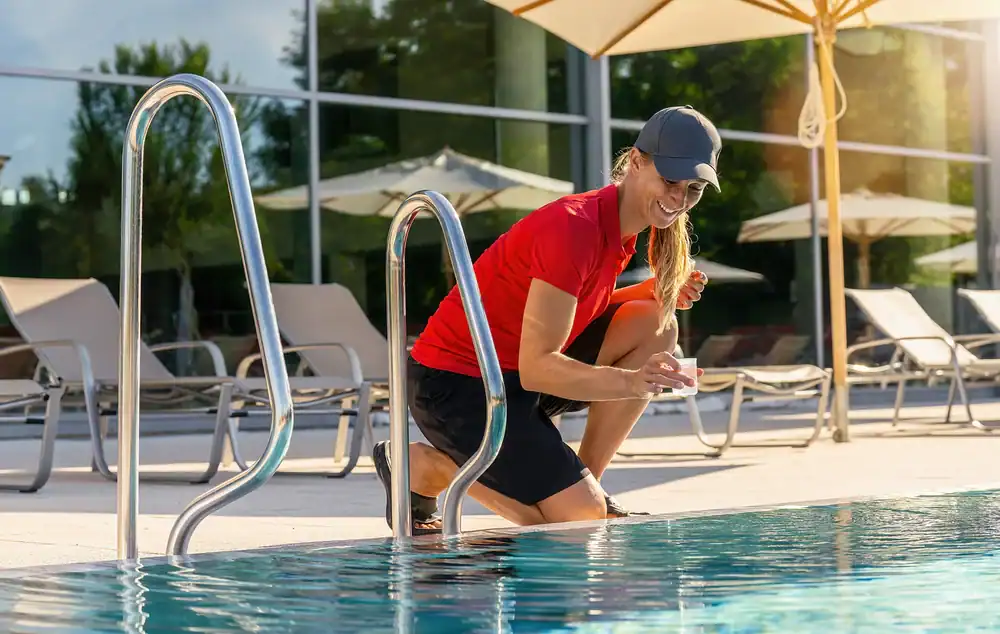
Bring us a water sample in a clean container. A standard water bottle works fine. If you can, collect it from about elbow-deep, away from return jets, after your pump has been running for at least 30 minutes. This gives us the most accurate reading of your pool’s overall chemistry.
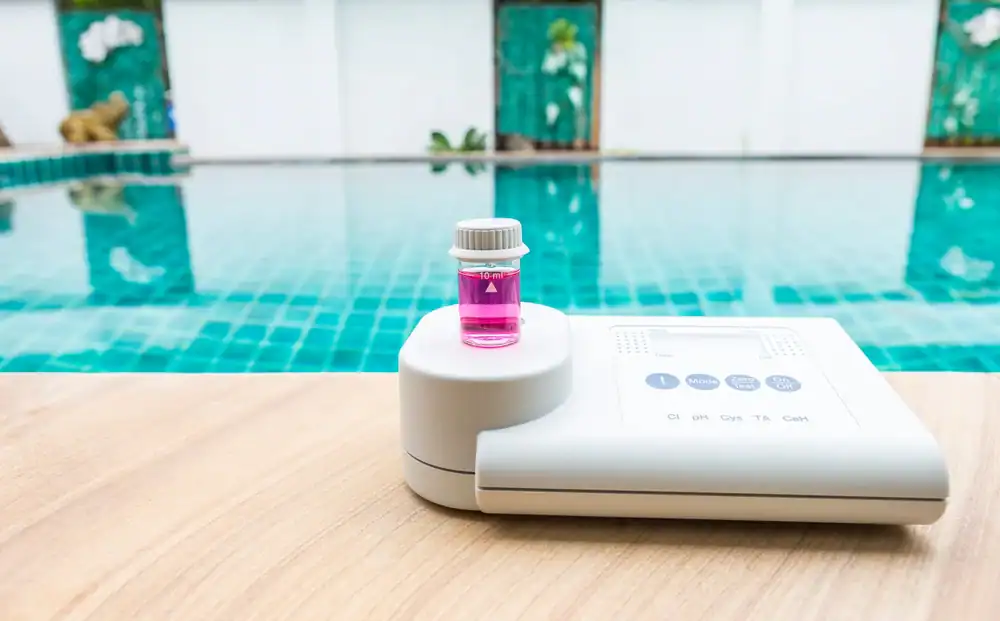
We run your sample through a LaMotte Waterlink Spin Disk system. It’s the same technology used in chemistry and medical labs, just calibrated for pool and spa water. The machine tests for free chlorine, total chlorine, pH, total alkalinity, calcium hardness, cyanuric acid, and other factors that home kits can’t measure reliably.
Results print out in two to three minutes. We’ll walk you through what each number means, what’s in range, and what needs adjustment. If your pH is low, we’ll tell you how much sodium carbonate to add. If calcium hardness is creeping up, we’ll explain why that matters and what to do about it before it starts scaling your equipment. You leave with a clear action plan and the products you need to fix it.
Ready to get started?
Every residential water test includes a full analysis of the chemicals and minerals that determine whether your pool is safe to swim in and whether it’s slowly damaging your pumps, filters, and heater. We’re checking free chlorine levels to confirm bacteria and algae can’t take hold. We’re measuring pH because even a small swing outside the 7.2 to 7.6 range causes eye irritation and makes your chlorine less effective.
Total alkalinity gets tested because it buffers your pH and keeps it stable. Calcium hardness tells us if your water is aggressive enough to corrode metal parts or saturated enough to start forming scale. Cyanuric acid levels show whether your chlorine stabilizer is protecting your sanitizer from the Georgia sun or if it’s built up so high that it’s actually blocking chlorine from working.
In Red Bluff, we see a lot of wells and rural water sources. That means higher mineral content and more variation in starting chemistry. We adjust recommendations based on your specific water source, your pool’s surface type, and how much sun exposure your backyard gets. What works for a shaded gunite pool won’t be the same as a sunny vinyl liner getting eight hours of direct heat. We account for that.
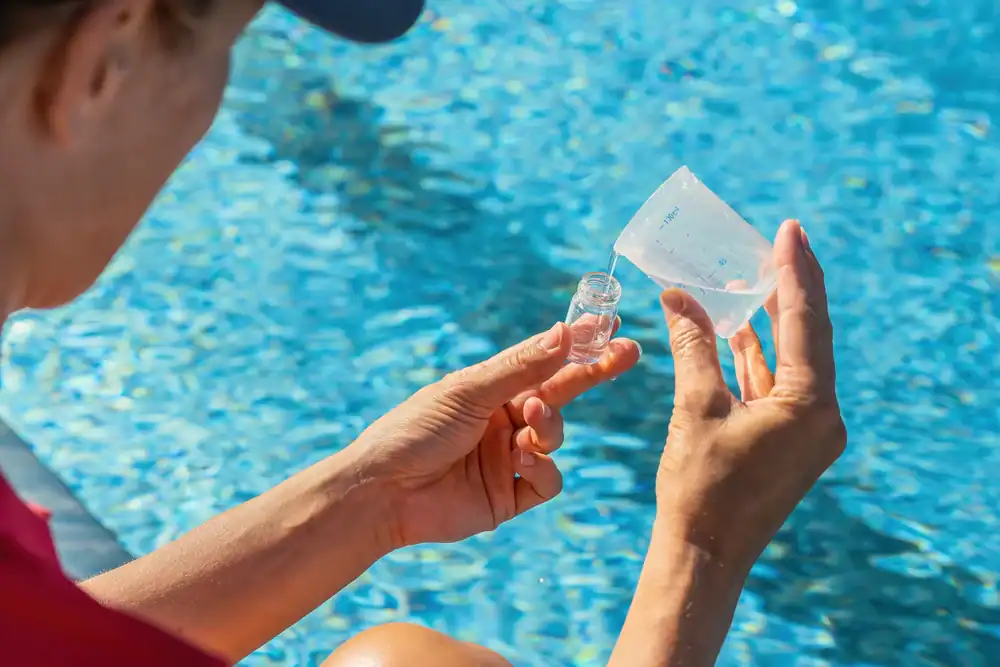
Once a week during swimming season is ideal. That’s frequent enough to catch problems before they become expensive or unsafe, but not so often that you’re wasting time.
If you’ve had heavy rain, a pool party with lots of swimmers, or you’re opening the pool for the season, test it right after. Rain dilutes your chemicals fast. A dozen people in the pool for an afternoon introduces enough contaminants to throw off your chlorine and pH. And after sitting all winter, your water chemistry has definitely shifted.
Between professional tests, check your pH and chlorine levels at home every couple of days. Those two factors change the fastest and have the biggest impact on safety. But bring a sample in weekly so we can track the trends in your calcium, alkalinity, and stabilizer levels. Those move slower, but they’re just as important for protecting your equipment and keeping water balanced long-term.
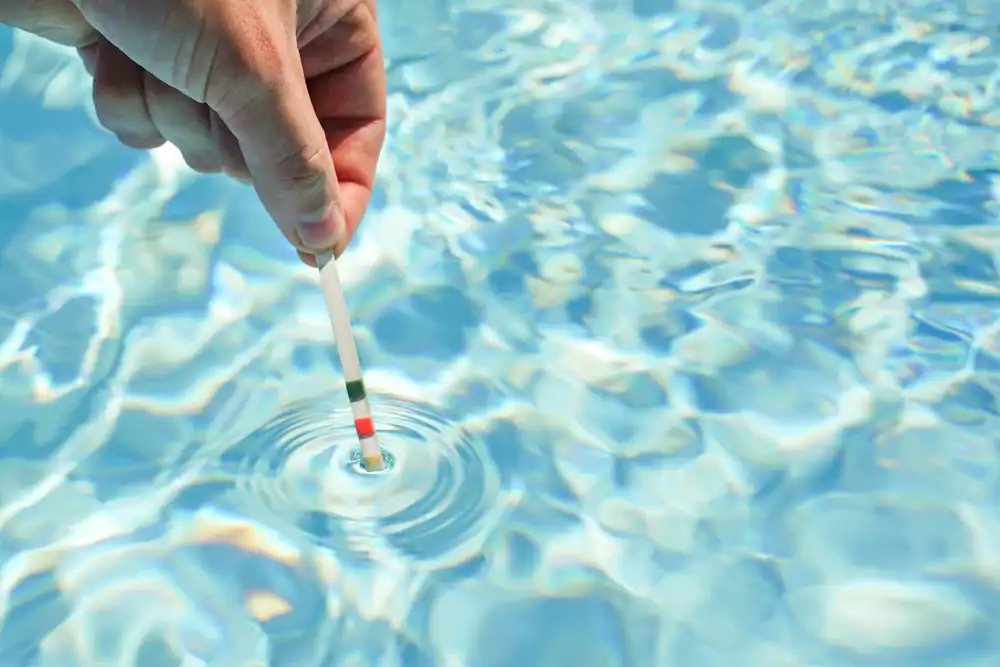
Test strips give you a rough idea of pH and chlorine. That’s useful for quick daily checks. But they’re not accurate enough to base your chemical adjustments on, and they don’t test for half the things that matter.
Strips can’t measure calcium hardness, cyanuric acid, or total alkalinity with any precision. The color matching is subjective. Lighting changes how you read them. If the strip sat in a hot garage all summer, the reagents degrade and your results are off.
Professional testing uses liquid reagents and photometric analysis. The machine reads the exact color change down to the wavelength. It’s measuring parts per million with lab-grade accuracy. You’re getting numbers, not color squares you’re trying to match under your kitchen light. And we’re testing for eight to ten parameters, not just two or three. That’s the difference between guessing your pool is fine and knowing exactly where it stands.
Free chlorine is what’s actually available to kill bacteria and algae right now. Total chlorine includes free chlorine plus combined chlorine, which is chlorine that’s already reacted with contaminants and can’t sanitize anymore.
If your total chlorine is 3.0 ppm but your free chlorine is only 1.0 ppm, that means 2.0 ppm is tied up as chloramines. Those are the compounds that cause the chlorine smell and eye irritation people associate with pools. You’ve got a sanitation problem and a comfort problem, even though your total chlorine looks fine on a basic test.
We measure both, and we calculate the difference. If combined chlorine is above 0.5 ppm, you need to shock the pool to break those chloramines apart and restore your free chlorine to effective levels. That’s something a strip test won’t catch, but it’s critical for keeping your pool safe and comfortable to swim in.
Absolutely. Low pH turns your water acidic, and acidic water corrodes metal. That means your pump seals, heat exchanger, and any metal fittings start breaking down. You’ll see pitting on ladder rails and etching on tile grout.
High pH does the opposite. Your water becomes scale-forming. Calcium falls out of solution and builds up on your heater elements, inside your filter, and along your waterline. A scaled-up heater runs inefficiently and burns out faster. A clogged filter can’t do its job.
Calcium hardness works the same way. Too low, and your water is aggressive—it’ll pull calcium from your plaster or grout to balance itself, which means surface damage. Too high, and you get cloudy water and scaling. Both extremes cost you money in repairs or resurfacing. Keeping your water balanced isn’t just about comfort. It’s about protecting the mechanical systems that cost thousands to replace.
Free chlorine should stay between 1.0 and 3.0 parts per million for residential pools. That range kills bacteria and prevents algae without causing skin or eye irritation.
Below 1.0 ppm, you’re not sanitizing effectively. Bacteria can multiply. Algae spores that blow in from the yard or get tracked in on swimsuits start to take hold. You might not see green water yet, but the problem is starting.
Above 3.0 ppm, you’re over-chlorinated. Swimmers will smell it. Eyes will sting. Skin might get dry or itchy. If you’re spiking above 5.0 ppm regularly, you’re also bleaching out vinyl liners and fading swimsuits faster than necessary. The goal is consistent free chlorine in that 1.0 to 3.0 range, tested every few days, with adjustments as needed to account for heat, rain, and swimmer load.
Heat and sunlight burn through chlorine faster. UV rays break down the chlorine molecules, which is why cyanuric acid exists as a stabilizer. But even with stabilizer, high temperatures increase the rate of chemical reactions, including the ones that deplete your sanitizer.
Summer also means more swimmers, longer swim sessions, and higher organic load. Sunscreen, sweat, leaves, pollen, and dirt all consume chlorine as it works to oxidize those contaminants. A pool that holds 2.0 ppm of chlorine steady in April might drop to 0.5 ppm by noon in July if you’re not adjusting your chlorination rate.
Georgia summers are hot. We see weeks where the water temperature stays above 85 degrees. That’s when algae blooms happen fast and chlorine demand spikes. Testing weekly through summer lets us track how much more chlorine your pool is using and adjust your routine before you end up with a green swamp after a long weekend.
Other Services we provide in Red Bluff