
Hear from Our Customers
Waresboro isn’t a subdivision. A lot of properties out here sit on larger parcels with wooded terrain, sandy coastal plain soil, and drainage patterns that shift depending on how close you are to the Okefenokee watershed. That matters enormously when you’re putting a pool in the ground. A builder who doesn’t evaluate your specific site before designing anything is setting both of you up for problems and those problems tend to show up after the crew has already left.
When pool construction is done right in this part of South Georgia, what you get is a structure that fits your land, drains properly, and holds up for decades. Gunite pools last 25 to 30-plus years with routine maintenance. That’s not a sales pitch it’s just the math on a material that gets applied and shaped on-site to match your exact property, not dropped in from a truck in a standard size.
The other thing worth saying: Ware County’s swim season runs roughly eight to nine months out of the year. That’s not a short window you’re building for. From April through November, the weather here is warm enough to use a pool regularly. When you look at it that way, a well-built inground pool isn’t a luxury it’s one of the most-used spaces on your property.
We founded Deep Waters Pools in Douglas, Georgia about 28 miles from Waresboro after spending more than 30 years building pools across South Georgia. We didn’t open Deep Waters because we saw a business opportunity. We opened it because we kept watching families in Waresboro and surrounding communities get burned by contractors who took deposits and didn’t deliver. That’s the actual reason this company exists.
The single-contractor model we operate under isn’t a marketing angle. It means the same team that walks your property is the team that digs it, shells it, plumbs it, and finishes it. No subcontractors rotating in and out, no one pointing fingers when something goes sideways. One crew, one point of contact, one person accountable from start to finish.
For a Waresboro homeowner on a larger rural property the kind where site conditions vary and access for equipment actually has to be thought through that kind of consistency isn’t just convenient. It’s what keeps a project on track.
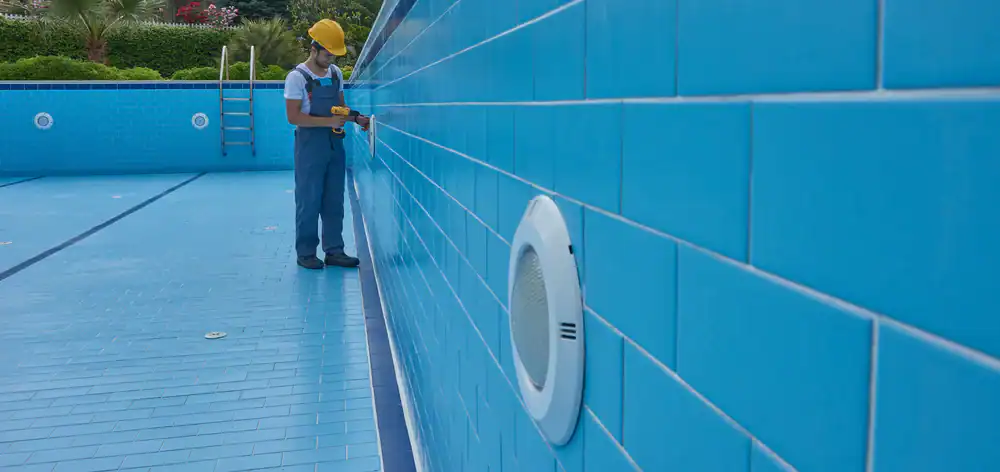
It starts with a site evaluation, and that step matters more in Ware County than it does in most places. The sandy coastal plain soils common to this part of Southeast Georgia excavate differently than red clay, and drainage conditions can vary significantly from one corner of a property to another especially on parcels near lower-lying areas. Before any design gets finalized, we look at the site. That’s not a formality. It’s how you avoid expensive surprises after excavation begins.
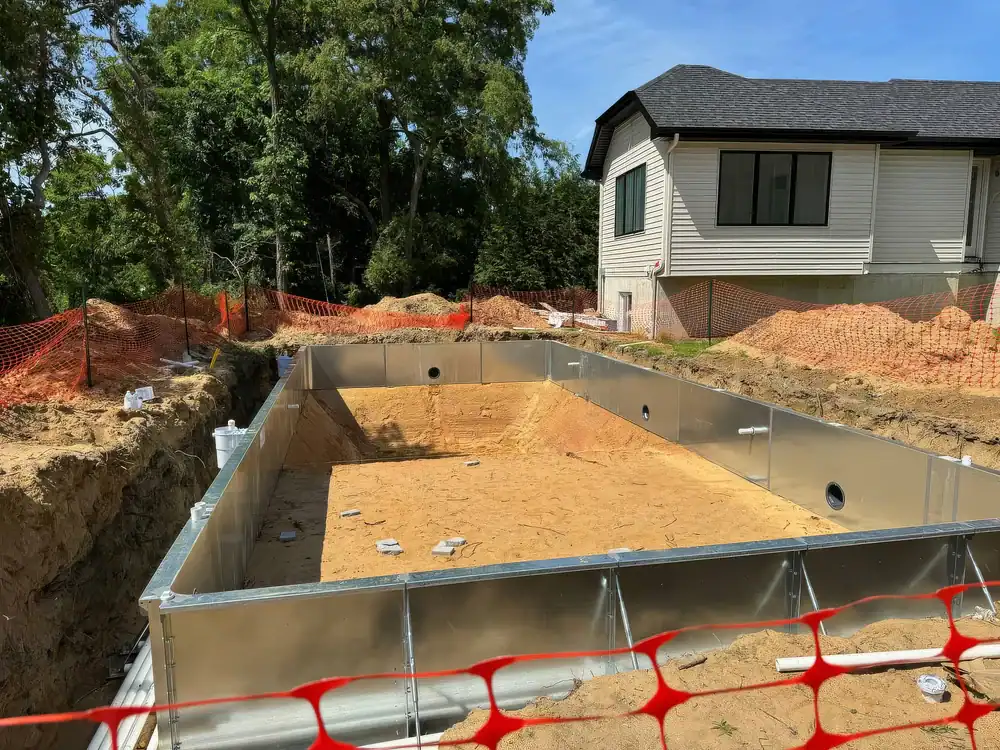
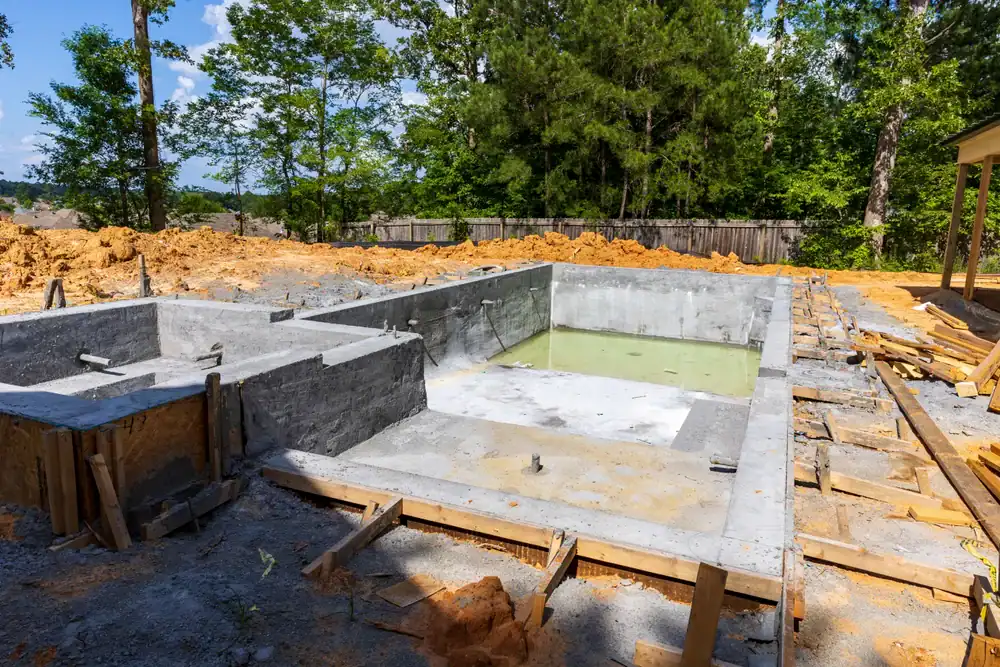
Once the site is cleared and the design is locked in, excavation on a standard residential build typically takes one to three days. After that, the gunite shell gets applied that’s a one-to-two day process where the pool’s structure is formed on-site to match your exact dimensions and shape. Plumbing and electrical run concurrently over the following week or two. Decking comes after that, usually three to five days depending on scope.
We handle the Ware County permit process entirely. That means pulling the residential pool permit through the Ware County Planning and Codes Department, managing the electrical permit, and scheduling all required inspections. You don’t navigate county offices. You don’t track paperwork. From excavation to water, a standard build runs six to eight weeks and that timeline holds because one crew is managing every phase of it.
Ready to get started?
Pool construction with us covers the full scope site evaluation, excavation, gunite shell construction, swimming pool plumbing, electrical, and pool deck installation. Nothing gets handed off. The same crew that digs your pool installs the plumbing, handles the bonding and grounding required under NEC Article 680, and finishes the deck. That matters because the most common place pool projects fall apart is at the handoff between phases when one subcontractor’s work doesn’t line up with the next one’s expectations.
Gunite is the only construction method we use, and it’s the right choice for the kind of properties common around Waresboro. If your lot has an unusual grade, a natural landscape feature you want to work around, or a specific layout in mind, gunite gets shaped on-site to fit it. A fiberglass shell comes in a fixed size and shape it either fits or it doesn’t. Gunite doesn’t have that limitation.
Every build also comes with full compliance to the Virginia Graeme Baker Pool and Spa Safety Act, which mandates anti-entrapment drain covers on all new residential pools. This isn’t optional, and it’s something every legitimate pool contractor in Georgia handles as a standard part of the build not an add-on. When the pool is finished, it’s permitted, inspected, and documented, which protects you now and at resale.
Yes and in unincorporated Ware County, that permit comes from the Ware County Planning and Codes Department, not a city building office. The county has a specific form required for residential pool permits, and there’s a separate electrical permit that has to be pulled for the pool’s wiring and bonding work. Both permits require inspections before the pool can be filled and used legally.
This process isn’t complicated, but it does require coordination and follow-through. We handle all of it the pool permit application, the electrical permit, and every required inspection. You don’t have to figure out which county office to call or what documentation to submit. When the build is complete, your pool is fully permitted and legally documented, which matters at resale and protects you from liability in the meantime. An unpermitted pool is a problem that tends to surface at the worst possible time usually when you’re trying to sell.
Sandy coastal plain soil the kind common across this part of Southeast Georgia excavates more easily than the red clay you’d find in central or north Georgia. That’s actually an advantage during the digging phase. The more important consideration is what happens after excavation: backfill compaction, drainage management around the shell, and how the water table behaves on your specific Waresboro parcel.
Properties in the Waresboro area vary. Some sit on higher, well-drained ground. Others are closer to lower-lying areas where drainage patterns are influenced by proximity to the Okefenokee watershed, and the water table can be shallower than it looks. A pool built on a high-water-table site without proper engineering will experience hydrostatic pressure issues over time shell movement, cracking, and potentially serious structural problems. That’s why site evaluation before design is not a step to skip. It’s the step that determines whether your pool holds up for 30 years or becomes a problem in five.
A standard residential gunite pool build with us runs six to eight weeks from excavation to water. That timeline breaks down roughly like this: excavation takes one to three days, gunite shell application takes one to two days, plumbing and electrical run concurrently over one to two weeks, and deck installation takes three to five days depending on the scope of the project. Inspections are scheduled as each phase is completed.
The reason that timeline holds is the single-contractor model. When one crew manages every phase of the build, there’s no waiting on a subcontractor who’s finishing another job across the county. The most common reason pool projects drag on for months sometimes close to a year is scheduling gaps between different crews who aren’t coordinating with each other. That’s a structural problem, not a bad-luck problem, and it’s one we’re set up to avoid entirely. South Georgia’s climate means you can plan a fall or winter build and realistically be swimming by spring.
Fiberglass pools are manufactured off-site in fixed shapes and sizes, delivered on a truck, and set into a hole. They’re faster to install and have a smooth interior surface, but you’re limited to whatever shapes and dimensions the manufacturer offers. If your Waresboro property has a slope, an irregular yard layout, or a specific design in mind that doesn’t match a catalog option, fiberglass can’t accommodate it.
Gunite is applied on-site and shaped to your exact specifications. There’s no standard size, no fixed shape, and no catalog to flip through. If you have a large wooded lot with a natural grade, a specific landscape feature you want to incorporate, or a pool design that doesn’t look like everyone else’s gunite is the only method that can deliver it. Gunite pools also last significantly longer: 25 to 30-plus years with proper maintenance, compared to 15 to 25 years for fiberglass before major structural work becomes necessary. For a homeowner making a long-term investment in a Ware County property, that lifespan difference is worth factoring into the decision.
A standard residential gunite pool build typically runs between $55,000 and $100,000, depending on size, shape, depth, and what’s included in the deck and finish package. More complex custom designs larger footprints, elevated decking, water features, or specialty finishes can push past $150,000. Those aren’t unusual numbers for a full custom build.
What’s worth thinking about in the context of a Waresboro property is the long-term math. Gunite pools don’t need liner replacements every eight to twelve years the way vinyl pools do. They don’t require the kind of structural repairs that fiberglass pools often need after 15 to 20 years. A pool built right the first time, in the right material, for your specific site, costs less over 30 years than a cheaper pool that needs major work by year ten. Waresboro’s cost of living runs well below the national average, which means your dollars stretch further here and a well-built pool also adds an estimated five to eight percent to your property’s resale value, which is a real equity return on top of the daily use you get out of it.
Yes and honestly, larger rural properties like the ones common around Waresboro are often easier to work with than tight suburban lots. More space means more flexibility in pool placement, better options for deck layout, and fewer setback concerns. Ware County’s zoning code classifies pools as accessory-use structures in residential areas, so setback requirements apply, but on a larger parcel those requirements are rarely a limiting factor.
What does require attention on rural properties is equipment access and site-specific drainage. Getting excavation equipment onto a wooded or partially cleared lot takes planning, and drainage management on larger parcels especially those with natural grade changes or lower-lying areas has to be thought through before the design is finalized. We evaluate all of that during the initial site visit. Properties in this part of Ware County vary enough in soil condition and drainage character that a site evaluation isn’t just a courtesy step it’s what makes the difference between a pool that performs correctly for decades and one that creates problems you didn’t see coming.