
Hear from Our Customers
South Georgia summers in Lumber City are not subtle. When temperatures push past 90°F and the humidity makes standing outside feel like a chore, your backyard either becomes a place you avoid or a place you actually want to be. A well-designed pool changes that entirely not just for a season, but for decades.
Most homes in and around Lumber City were built in the 1970s and 1980s, on generous lots that have never had a pool. That’s actually a good thing. Those older properties typically have the yard space, the setbacks, and the land character to support a custom design that newer, tighter subdivisions simply can’t accommodate. Whether your lot backs up to the tree line or sits on a larger rural parcel outside of town, there’s usually more possibility here than homeowners realize.
And because Lumber City’s winters stay mild enough to avoid hard freezes, your pool season runs longer than most of the country April through October without a heater, and potentially year-round with one. That’s not a small thing. You’re not paying for something you use three months a year. You’re building something that becomes part of how your family lives.
We’re based in Douglas, GA about 30 miles from Lumber City along US Route 23/341, the same road you’re already driving to reach most things outside of Telfair County. We’re not a company reaching into your area from Atlanta. We’re a South Georgia business that knows this region, knows these soils, and has been building in counties like yours for years.
Deep Waters Pools was founded in 2014, but the experience behind it goes back more than 30 years in concrete, plumbing, and custom pool construction. That history matters when your Lumber City property sits in South Georgia’s coastal plain where sandy topsoil over clay subsoil and proximity to river systems like the Ocmulgee create real engineering considerations that a less experienced contractor simply won’t anticipate.
Every pool we build is a custom concrete design. No fiberglass shells, no catalog shapes, no shortcuts. And every project comes with a custom safety cover included not as an upsell, but as a standard part of how we build.

It starts with a design consultation, not a sales pitch. You talk through how your family actually uses outdoor space, what your property looks like, and what you’re hoping a pool adds to your life. From there, the design process begins and before anything is excavated, you’ll see a full 3D rendering of your pool. Not a sketch, not a rough concept. A visual walkthrough of your specific backyard so you can adjust the shape, move the water features, or rethink the layout before a single shovel touches the ground.
Once the design is finalized, we handle the permit process through Telfair County’s building department in our name, not yours. Georgia’s pool permitting requirements include site plan submissions, fencing and barrier specifications, and multiple staged inspections. A licensed contractor pulls that permit in their own name and is legally accountable for every aspect of code compliance. If a contractor ever asks you to pull your own permit, that’s a serious red flag.
Construction on a concrete pool typically runs 6 to 8 weeks from excavation to completion under normal conditions. South Georgia’s mild winters mean this timeline holds across most of the year there’s no cold-weather shutdown that pushes your project into the following season. When construction wraps, the final inspection is completed, the safety cover is installed, and the pool is yours.
Ready to get started?
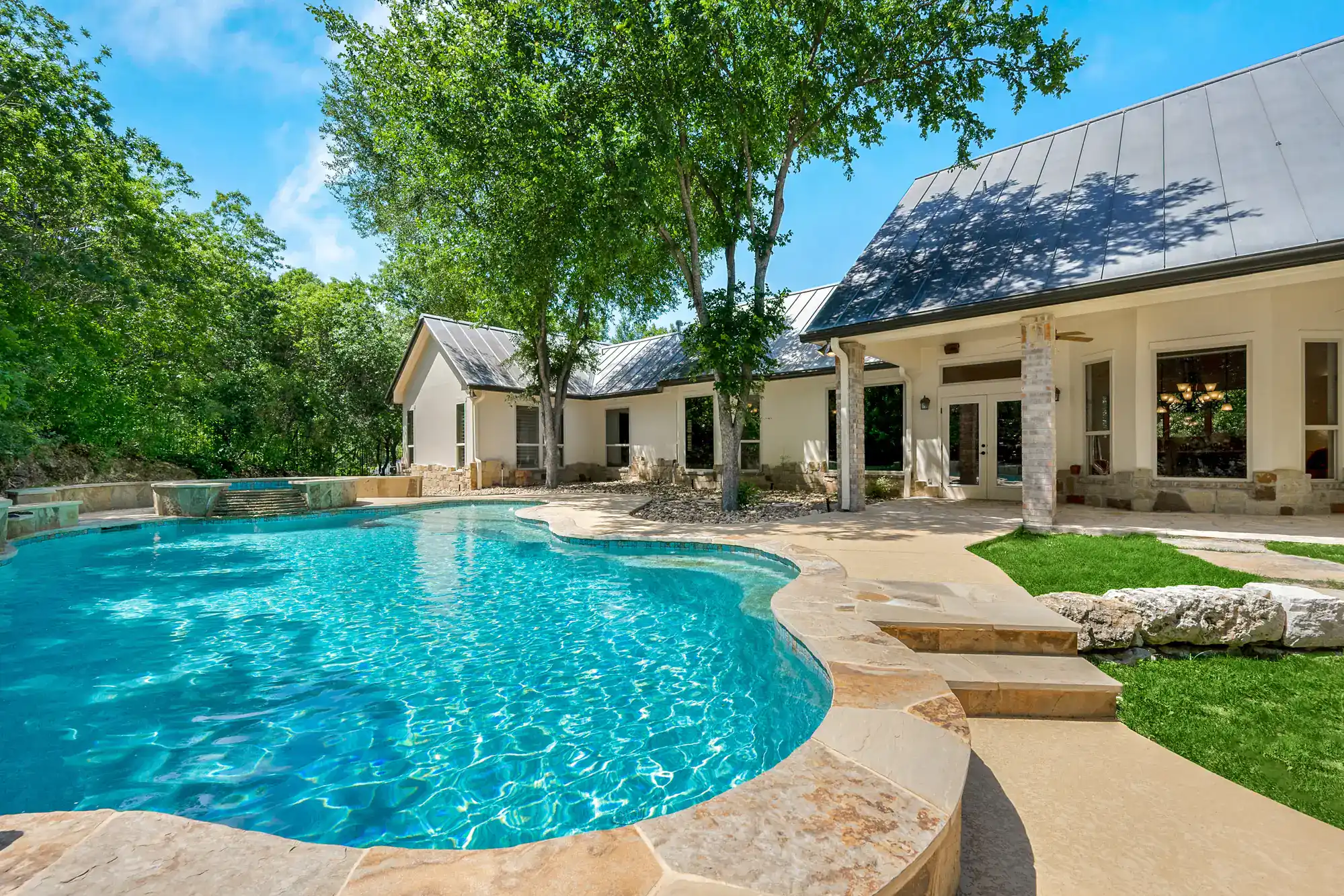
Custom pool design in Lumber City isn’t a scaled-down version of what’s available in Savannah or Macon. The same design options apply here. Infinity edge pools, custom water features, integrated spas, outdoor living spaces, fire features, landscape pool integration all of it is on the table, and because every Deep Waters pool is built from reinforced concrete, there are no limits on shape or configuration the way there are with fiberglass shells.
The 3D design process is where this gets real for most homeowners. You’re not choosing from a brochure. You’re seeing your actual backyard, your actual lot, with the pool placed and sized for your specific property. Lumber City homeowners with larger rural parcels have used this process to design pools that work with the natural grade of their land including elevated designs and landscape integration that would be impossible on a standard subdivision lot.
Beyond the pool itself, we also build patios, outdoor kitchens, and spa additions, and offer ongoing maintenance plans, repair services, and free water testing after construction. For a Lumber City homeowner who doesn’t have a local pool service company down the street, that ongoing relationship with a builder 30 miles away on US 341 matters more than it might in a larger city. You’re not left on your own after the project closes.
For a custom concrete inground pool in Lumber City and Telfair County, the realistic range is $50,000 to $85,000. Where your project lands in that range depends on the size of the pool, the features you include water features, spa, outdoor living additions and any site-specific conditions on your property.
Lumber City properties, especially older homes built in the 1970s and 1980s, can have soil conditions, drainage patterns, or grade changes that affect excavation and engineering requirements. A site evaluation before construction begins is how you get an accurate number rather than a ballpark that shifts later. We provide transparent pricing before work starts no costs that appear after the contract is signed.
Yes, a building permit is required before any pool construction begins in Telfair County. The permit goes through the county’s building department and must include a site plan, fencing and barrier details that meet Georgia’s pool safety code, and setback compliance Georgia law requires pool equipment to be placed at least 10 feet from the property line.
The permit should always be pulled by the licensed contractor, not the homeowner. When a licensed contractor pulls the permit in their own name, they are legally accountable for every inspection and code requirement throughout the build. We handle the entire permit process application, inspection scheduling, and code compliance documentation as a standard part of every project. You don’t manage any of that. If a contractor ever asks you to pull your own permit, take that seriously as a warning sign about their licensing status.
This is one of the most important questions a Lumber City homeowner can ask, and most people don’t think to ask it until a problem shows up. South Georgia’s coastal plain has a specific soil profile sandy topsoil over clay subsoil layers that behaves differently than the red clay you’d find in Atlanta or the upstate. Near the Ocmulgee River watershed, some properties also deal with higher water table levels or drainage considerations that affect how a pool is engineered.
A poorly engineered pool in these conditions can crack, shift, or experience hydrostatic pressure against the walls within just a few years. Reinforced concrete construction with proper drainage engineering is the right response to coastal plain soil and it’s the only construction method we use. Every project starts with a site evaluation specifically to identify these conditions before excavation begins, so there are no surprises once work starts.
Before any work begins on your Lumber City property, you’ll see a full three-dimensional rendering of your finished pool. This isn’t a rough sketch or a top-down diagram it’s a visual walkthrough of your specific backyard with the pool placed, sized, and detailed according to your design preferences. You can see the water features, the coping, the patio layout, and how everything integrates with your existing yard.
This step exists because the gap between what a homeowner imagines and what gets built is one of the most common sources of regret in pool construction. First-time pool buyers especially tend to look back and wish they’d added a feature, adjusted the shape, or positioned the pool differently relative to the house. The 3D design process is how you make those decisions before the concrete is poured not after. It also gives you a clear, agreed-upon reference point for the entire construction process, so there’s no ambiguity about what was promised.
Yes, and for Lumber City homeowners with larger lots which describes most properties in and around town given the older housing stock these additions are often very workable from a space standpoint. Custom water features like waterfalls and deck jets, integrated spas, outdoor kitchens, fire features, and patio construction are all part of what we design and build. None of these are afterthoughts or separate contractor relationships to manage.
Lumber City sits in a community with deep outdoor and water culture the Ocmulgee and Oconee rivers have shaped how people here spend their time outdoors for generations. A custom pool with a spa and outdoor living space is a natural extension of that. It brings the experience home, on your schedule, without the drive to the river or the public rec pool. Because every Deep Waters pool is concrete, there are no shape or feature limitations the way there are with fiberglass the design is built around what you want, not around what a manufacturer’s catalog offers.
In warm-climate markets like South Georgia, a well-built inground pool can add up to 7% to a home’s value. For a Lumber City property in the $200,000 to $300,000 range a realistic figure given current Telfair County market data, where median home sale prices rose 54.2% year-over-year in 2024 that’s $14,000 to $21,000 in added value on top of years of personal use.
The rural setting actually works in your favor here in a specific way. Lumber City doesn’t have a dense pool market where every third home has one. A well-designed custom pool on a Telfair County property stands out in a way it simply wouldn’t in a suburban Atlanta neighborhood where pools are common. Buyers relocating to the area, retirees looking for a quality-of-life property, and families looking for land with amenities all respond to a finished pool on a rural lot. And a concrete pool built to last 30 or more years means the investment compounds over time not something you’re replacing in 15 years the way you might with a vinyl liner pool.