
Hear from Our Customers
When your pool chemistry is dialed in, everything works the way it’s supposed to. Your chlorine actually sanitizes instead of just sitting in water that’s too alkaline to let it do its job. Your surfaces stay intact. Your equipment runs longer. And your family isn’t stepping out of the pool with red eyes and irritated skin wondering what’s wrong.
In Fitzgerald, that balance is harder to maintain than most people expect. Floridan Aquifer groundwater the source behind Fitzgerald Utilities’ five deep wells carries elevated calcium and mineral content that pushes calcium hardness and total alkalinity out of range faster than surface water sources do. Add in Ben Hill County’s summer heat index pushing 105 to 109 degrees, and you’ve got chlorine burning off fast, algae ready to take hold within 48 hours of a depletion event, and evaporation concentrating those minerals even further.
Getting the chemistry right means you’re not spending your summer shocking a green pool or calling around trying to figure out why the water won’t clear. It means your pool is ready when you need it which in a South Georgia summer, is basically every day from May through September.
We’re based in Douglas, Georgia about 30 to 35 miles from Fitzgerald via US-129 and US-319. That’s close enough to know this area, know this water, and show up when something goes sideways in the middle of July.
We were founded in 2014, but the experience behind us goes back more than 30 years in concrete, plumbing, and custom pool construction. That matters for water testing because chemistry doesn’t exist in a vacuum it interacts with your pool’s surface. Gunite and plaster finishes are especially vulnerable to water that’s too aggressive or too scale-forming, and Ben Hill County pools dealing with mineral-heavy aquifer fill water are at real risk on both ends of that spectrum.
We’re licensed and insured, we use digital testing equipment instead of color-matching strips, and we give you a straight answer about what your water needs not a shopping list shaped by what’s on a store shelf.
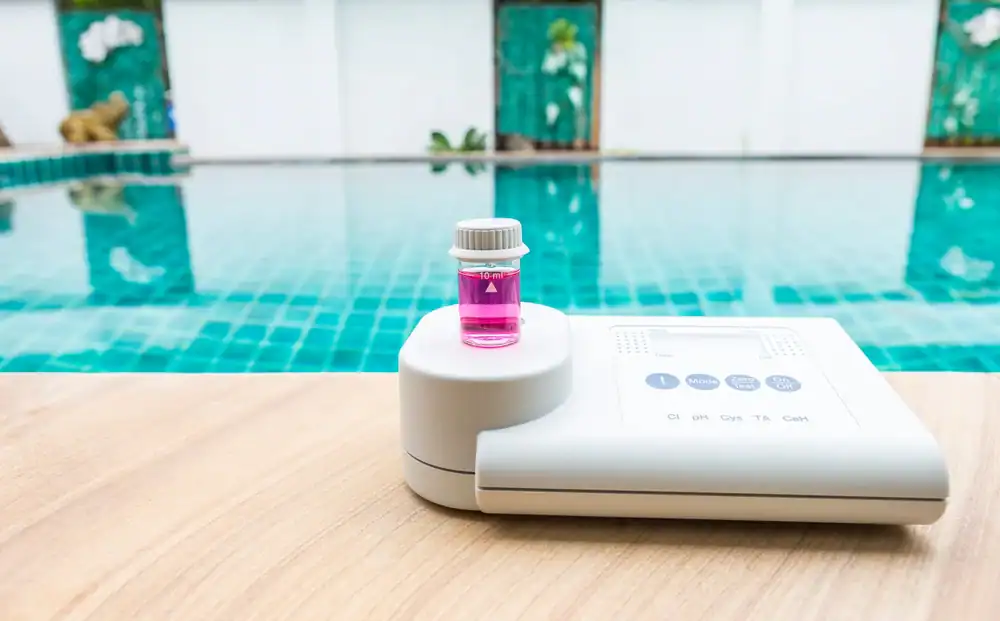
It starts with a digital water analysis. Not a test strip, not a color card actual equipment that reads your water’s chemistry across every parameter that matters: pH, free chlorine, combined chlorine, calcium hardness, total alkalinity, and cyanuric acid. In Fitzgerald, that baseline reading often tells a story that a basic strip would miss entirely, especially when aquifer water has been pushing calcium hardness higher with every fill or top-off.
Once the numbers are in, you get a clear picture of what’s off and why. If your pH is sitting above 7.8, your chlorine has already lost half its effectiveness and that’s true even if the chlorine reading looks fine. If your total alkalinity is out of range, pH becomes nearly impossible to hold stable. These aren’t isolated problems; they affect each other, and fixing one without addressing the others is why a lot of pool owners stay stuck in a cycle of adding chemicals and still ending up with cloudy or green water.
From there, we build a correction plan around your specific results not a generic formula. Fitzgerald’s summer storm pattern, with 70% rain probability during peak months, means chemistry can shift significantly after a single heavy afternoon storm. Knowing your exact baseline before and after those events is what keeps you ahead of problems instead of reacting to them.
Ready to get started?
Our professional water test covers the full picture pH level balancing, free and combined chlorine levels, total alkalinity check, calcium hardness testing, and cyanuric acid. Each one gets measured precisely, and each one gets explained in plain language. You’ll know what the number means, why it matters, and what happens to your pool if it stays out of range.
For Fitzgerald pool owners, calcium hardness testing is especially important. The Floridan Aquifer water coming through your tap already carries a higher mineral load than most surface water sources. Over time and faster in summer heat when evaporation concentrates everything that calcium builds up and starts affecting your surfaces, your equipment, and your water clarity. Catching it early with a proper test is far cheaper than dealing with scale buildup on your plaster or a filter that’s working twice as hard as it should.
The same applies to pH and total alkalinity. In a climate where afternoon thunderstorms are a regular part of summer dropping pH, diluting chlorine, and introducing organic material all at once having accurate baseline numbers isn’t optional if you want a pool that stays clean. Ben Hill County’s pollen season alone can spike chlorine demand dramatically in a matter of days. A test that tells you exactly where you stand is the only thing standing between a clear pool and a green one.
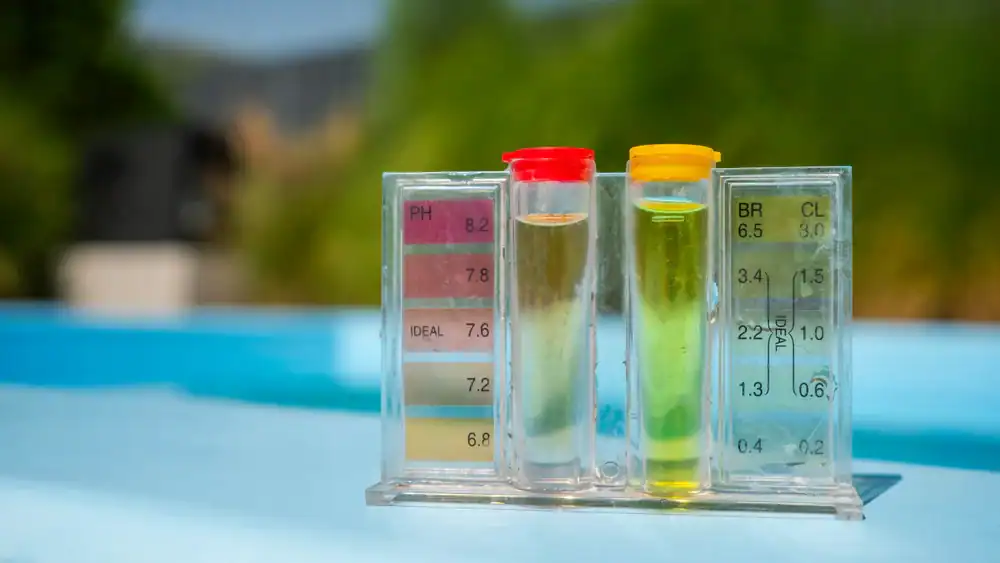
The most common reason is pH. If your pool’s pH is above 7.8 which happens quickly in South Georgia’s heat, especially with the mineral-buffering chemistry of Floridan Aquifer water chlorine loses roughly half its sanitizing power. So you can have a chlorine reading that looks fine and still have a pool that’s barely protected against algae. The strip told you chlorine was present. It didn’t tell you the chlorine wasn’t working.
The fix isn’t more chlorine it’s correcting pH first, then reassessing your chlorine demand. At 90 degrees or above, which is a routine water temperature in Fitzgerald from June through August, algae can establish within 24 to 48 hours of a chlorine depletion event. A professional water test that reads all your parameters together is what tells you which problem you’re actually dealing with, so you’re not just adding chemicals and hoping.
More often than most homeowners do. Georgia’s Department of Public Health requires certified operators managing public pools to test chlorine and pH at minimum twice daily that’s the professional standard, and it exists because pool chemistry moves fast when temperatures are high and bather load is heavy. For a residential pool in Fitzgerald, you’re not expected to test twice a day, but once a week during peak summer is the bare minimum, and after any significant event a heavy rain, a pool party, a stretch of 100-degree heat you should test again before assuming you’re still in range.
Ben Hill County’s summer storm pattern makes this especially relevant. A single afternoon thunderstorm drops pH, dilutes chlorine, and dumps organic material into your pool all at once. If you’re only testing on a weekly schedule and a storm hits on day two, you could be swimming in unbalanced water for five more days without knowing it. Staying on top of testing is what keeps small chemistry shifts from turning into a green pool or a cloudy mess.
Calcium hardness measures the amount of dissolved calcium in your pool water. The ideal range is 200 to 400 parts per million. Too low, and your water becomes aggressive it starts pulling calcium out of your pool’s plaster or concrete surface to satisfy its own chemistry, which causes etching, pitting, and surface damage over time. Too high, and you get scale buildup: that white, chalky film on your tile line, your equipment, and your surfaces.
In Ben Hill County, the too-high end of that range is the more common problem. Fitzgerald Utilities draws its water supply from five deep Floridan Aquifer wells, and Floridan Aquifer groundwater is naturally high in dissolved minerals calcium included. Every time you fill or top off your pool, you’re starting with a higher calcium baseline than pool owners in cities served by surface water. Add summer evaporation concentrating those minerals further, and calcium hardness can climb out of range faster than most homeowners expect. Regular testing is the only way to catch it before it starts affecting your surfaces or your equipment.
A pool store test is a retail tool. You bring in a water sample, they run it through their system, and the result is usually a recommendation to buy products they carry. That’s not a knock on the people working there it’s just how that model works. The test is free because it leads to a sale, and the recommendations are shaped by what’s available on the shelf.
Professional water testing is independent. Our goal is an accurate diagnosis, not a transaction. We use digital testing equipment that delivers precise readings across all your key parameters, and the correction plan you receive is based entirely on what your water actually needs not on inventory. For Fitzgerald pool owners already dealing with the chemistry challenges that come with aquifer-sourced fill water, mineral accumulation, and extreme summer heat, that distinction matters. You want someone reading your water objectively, not someone who benefits from selling you a bag of something you may or may not need.
Yes and this is one of the most misunderstood parts of pool chemistry. Total alkalinity acts as a buffer for pH. When it’s in the right range, around 80 to 120 parts per million, your pH stays relatively stable even when outside factors try to move it. When alkalinity is too low, pH bounces around constantly and becomes almost impossible to hold. When it’s too high, pH locks up and becomes resistant to correction, which is its own problem.
In Fitzgerald, where afternoon rainstorms during summer can drop pH quickly by introducing dissolved carbon dioxide, and where Floridan Aquifer fill water can push alkalinity higher than the ideal range over time, keeping total alkalinity dialed in is a foundational step not an afterthought. If you’ve ever felt like you’re constantly adjusting your pH and it never seems to stay where you put it, alkalinity is usually the first place to look. A proper total alkalinity check gives you the baseline you need to stop chasing pH and start maintaining it.
It’s worth it for any pool owner who wants to stop guessing. Georgia’s public pool regulations require certified operators and professional-grade chemistry management because the state recognizes that pool water doesn’t stay balanced on its own and the same chemistry dynamics apply to your backyard pool in Fitzgerald whether there’s a regulation behind it or not.
For residential pool owners in Ben Hill County, the math is straightforward. A professional water test costs a fraction of what you’d spend recovering from an algae bloom, replacing a pump that corroded prematurely, or resurfacing a plaster finish that low-pH water ate through over a season or two. In a market where the median home value is around $149,000, a pool represents a real percentage of your property’s worth. Keeping that investment in good shape isn’t just about clear water it’s about protecting the surface, the equipment, and the long-term value of what you’ve built. One accurate test and a solid correction plan is the cheapest insurance you can buy for your pool.