
Hear from Our Customers
Southeast Georgia doesn’t give you a short window. From April through October, you’ve got seven solid months where the heat alone is reason enough to be in the water. A pool on your property in Dixie Union isn’t a luxury add-on it’s the most-used thing in your backyard for more than half the year.
Out here, most properties aren’t small suburban lots. They’re acreage. Rural land with room to build something that actually fits the terrain, not a fiberglass shell that showed up on a truck in a shape someone else decided. Gunite is built from scratch, on your ground, in whatever footprint makes sense for your property. That matters when you’re on a multi-acre parcel north of Waycross where no two lots look the same.
And because gunite cures into a structural shell that gets stronger over time, you’re not looking at liner replacements in ten years or gel coat that fades by year eight. You build it once, you build it right, and it’s there for the long run which is exactly what a once-in-a-lifetime investment on a piece of Ware County land should be.
We’re based in Douglas, Georgia about 35 to 40 miles up US Route 1 from Waycross, the same highway that runs through Dixie Union. This isn’t a company driving down from Atlanta for a job. We’re a regional operation that knows the coastal plain terrain, knows what the soil looks like in Ware County, and has been working in Southeast Georgia since 2014 built on a founder with more than 30 years of hands-on experience in concrete, plumbing, and pool construction before the business ever had a name.
Every pool we build is handled by the same crew from excavation through deck installation. No subcontractors. The people who dig the hole are the people who install the plumbing and finish the deck. That means one point of contact, one standard of work, and nobody pointing fingers at the other crew when something needs attention.
It starts with a site evaluation. Before anything is designed or priced, we look at the property lot size, grade, drainage, and in many cases out here in rural Ware County, the location of your septic system. That last part matters more than most builders will tell you upfront. In Georgia, if your property runs on a private septic system, the county health department has to approve the pool’s placement before a building permit gets issued. We handle that step. You don’t have to figure out who to call.
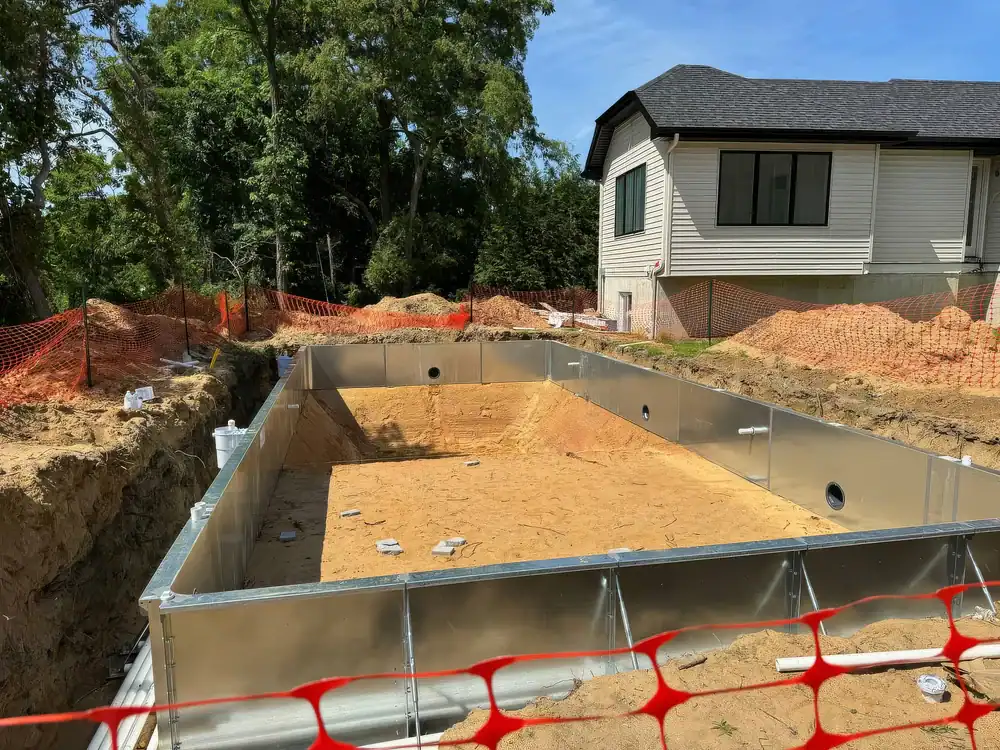
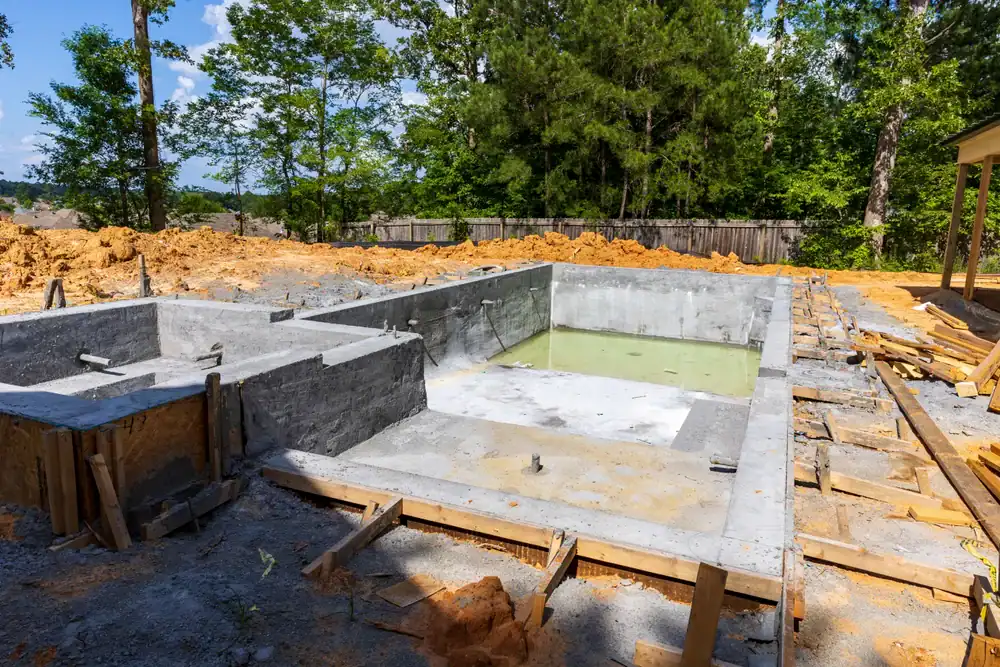
Once the design is locked and permits are pulled through Ware County’s building department, since Dixie Union has no city hall excavation begins. The rebar cage goes in next, and here’s something worth knowing: Georgia building code requires an inspection of that rebar cage before a single pound of gunite is applied. That inspection has to happen. We schedule it and don’t skip it. After gunite is applied and the shell cures, plumbing and electrical go in, the deck gets built, and your custom safety cover is installed.
The full timeline from contract to first swim typically runs three to six months when design, permitting, and scheduling are factored in. The active construction phase is usually six to eight weeks. That’s not a slow process that’s what it takes to build something that lasts 30 years.
Ready to get started?
When we build your pool, the contract covers the whole job: site evaluation, excavation, rebar, gunite shell, all pool plumbing, NEC Article 680-compliant electrical bonding and grounding, equipment installation, pool deck, and a custom safety cover. That last item isn’t an upsell it comes with every build. In a rural area like Dixie Union where properties are spread out and kids and grandkids visit regularly, an unsecured pool is a real hazard. The cover is part of the job.
The electrical work on every build meets NEC Article 680 the national code standard for bonding and grounding around swimming pools. This isn’t something to gloss over. Improper pool electrical work is one of the most dangerous and most commonly cut-corner items in residential pool construction. It gets done right here, every time, and it gets inspected.
For Ware County properties specifically, the pool deck is designed with drainage in mind. The coastal plain terrain around Dixie Union sits close enough to the Okefenokee’s sphere of influence that water management on lower-lying lots is a real consideration not a theoretical one. The deck design accounts for that. If your property has grade changes, drainage patterns, or high-ground versus low-ground variation, that gets factored into the build before the first shovel breaks ground.
Yes and because Dixie Union is an unincorporated community, that permit comes from Ware County, not a city building department. There is no city hall in Dixie Union. All pool construction permits in this area are issued through the Ware County Building Department, and the process includes a mandatory rebar cage inspection before gunite can be applied. That’s a Georgia building code requirement, not optional.
There’s also an additional step that applies to a lot of properties out here: if your home runs on a private septic system which is common on rural Ware County parcels the county health department has to sign off on your pool’s location before the building permit is issued. This is to confirm the excavation won’t compromise your septic tank or drain field. We manage all of this in-house, including coordinating that health department review. You don’t have to track down the right office or figure out what to submit.
The full timeline from signing a contract to your first swim is typically three to six months. That range accounts for the design phase, permit approval through Ware County, scheduling, and then active construction which usually runs six to eight weeks once the crew is on site.
The reason people get frustrated with pool timelines is usually because the builder quoted them a construction window without mentioning the permitting and scheduling time that comes before it. In Southeast Georgia, the best time to start the process is fall or early winter. That way permitting and design are handled during the slower months, construction can begin in late winter or early spring when the weather cooperates, and the pool is ready before the heat really sets in around May. Trying to start the process in June and swim by August isn’t realistic and any builder who tells you otherwise isn’t being straight with you.
The biggest difference is that a gunite pool is built on your property from scratch, and a fiberglass pool arrives as a pre-manufactured shell in a fixed shape and size. For a standard suburban lot, fiberglass can work fine. For a rural property in Ware County with acreage, grade changes, or a septic system that dictates where the pool can go, fiberglass limits your options significantly. You’re choosing from a catalog instead of designing for your actual land.
Gunite is also the only pool type that gets structurally stronger as it cures over time. A vinyl liner pool will need the liner replaced every 10 to 15 years that’s a recurring cost built into the ownership of that pool. Fiberglass gel coat degrades and can fade or crack over time. A properly built gunite pool, with the right rebar density and correct drainage design, is a 30-plus year structure. On a piece of land you plan to stay on, that difference matters.
Yes, but there’s a step involved that most homeowners don’t know about until their builder brings it up or doesn’t. In Georgia, if your property uses a private septic system, the county health department has to approve the pool’s location on your lot before a building permit can be issued. The purpose is to make sure the pool excavation won’t interfere with your septic tank or the drain field lines running from it. Depending on your lot layout, this may mean adjusting where the pool sits or how it’s oriented.
This isn’t a dealbreaker it’s a standard part of the process for rural properties around Dixie Union, and it’s handled during the permitting phase before any construction begins. The key is working with a builder who knows this step exists and handles it without putting it back on you. We manage the health department review as part of our in-house permit process. For properties on large acreage parcels along roads like Telemore Dixie Union Road, where septic systems are the norm, this is just part of doing the job correctly.
For a custom gunite pool in the Southeast Georgia market, you’re typically looking at a range of $60,000 to $85,000 for a standard residential build. Larger footprints, more complex site conditions, or additional features like water elements or upgraded decking will move that number higher.
What matters more than the starting number is what’s actually in the contract. Some builders quote low and then add phases deck, electrical, equipment, safety cover as separate line items after you’ve already signed. We build everything into one contract upfront: excavation, rebar, gunite, all plumbing, NEC-compliant electrical, deck, equipment, and the custom safety cover. There are no surprises after the hole is dug. For a Ware County homeowner making this kind of investment, that clarity isn’t a small thing.
Generally, yes though the return varies based on the property and the local market. We cite approximately a 7% increase in home value based on Georgia real estate data, and that figure is consistent with broader national research on inground pool additions. In a rural area like Dixie Union, where large-lot properties are the norm and comparable sales with pools aren’t always easy to find, the value argument is less about a precise percentage and more about what the property represents to a future buyer.
What’s worth noting for Ware County specifically is the broader regional momentum happening right now. The Okefenokee Swamp whose northern edge sits near Waycross is currently under consideration for UNESCO World Heritage Site designation. If that designation comes through, the resulting increase in regional attention, tourism, and housing investment could meaningfully raise property values in the surrounding area, including communities along the US Route 1 corridor like Dixie Union. A pool built now, on a well-maintained rural property, positions that home well ahead of a market that may be shifting.