
Hear from Our Customers
Clyattville sits in one of the most pool-friendly climates in the country. From March through October, temperatures in the Valdosta corridor are warm enough to swim that’s not a summer pool, that’s eight months of real use. A well-built gunite pool in Clyattville isn’t a luxury add-on. It’s something you’ll use more often than almost any other improvement you could make to your property.
The soil here matters too. Lowndes County sits on coastal plain ground sandy loam over clay-bearing subsoils, with water table levels that shift depending on the lot and the season. A pool that wasn’t engineered with that in mind will show it eventually. You’ll see it in cracks, in shifting, in hydrostatic pressure problems when the pool gets drained. Getting it right from the start means you don’t deal with any of that five years down the road.
And for homeowners in Clyattville where the median age skews older and most people here are established, not just getting started the investment calculus is straightforward. You’re not buying a pool for one summer. You’re adding something to your property that performs for 30-plus years, adds real resale value, and gives you a reason to actually enjoy your backyard for the better part of every year.
We founded Deep Waters Pools in 2014, but the experience behind the company goes back more than three decades. Our founder spent 30-plus years in concrete, plumbing, and custom pool construction before launching the business which means when your project starts, you’re not working with someone who’s still figuring it out on your dime.
We serve homeowners across Southeast Georgia, including Lowndes County and the communities along the State Route 31 corridor south of Valdosta. We know Clyattville and this area the soil, the permitting process through Lowndes County, and what it takes to build a pool that holds up in South Georgia’s climate long-term.
Every pool we build is gunite poured on-site, engineered to your specific lot, and built by the same crew from start to finish. No subcontractors, no handoffs, no strangers rotating through your yard. The people who start your project are the people who finish it.
It starts with a site evaluation. Before anything gets drawn up or dug, we look at your specific property lot dimensions, grade, soil conditions, drainage because every yard in Clyattville is different, and what works on one lot doesn’t automatically work on the next. From there, we move into design. You’ll see 3D renderings of your pool before a single shovel hits the ground, so you know exactly what you’re getting.
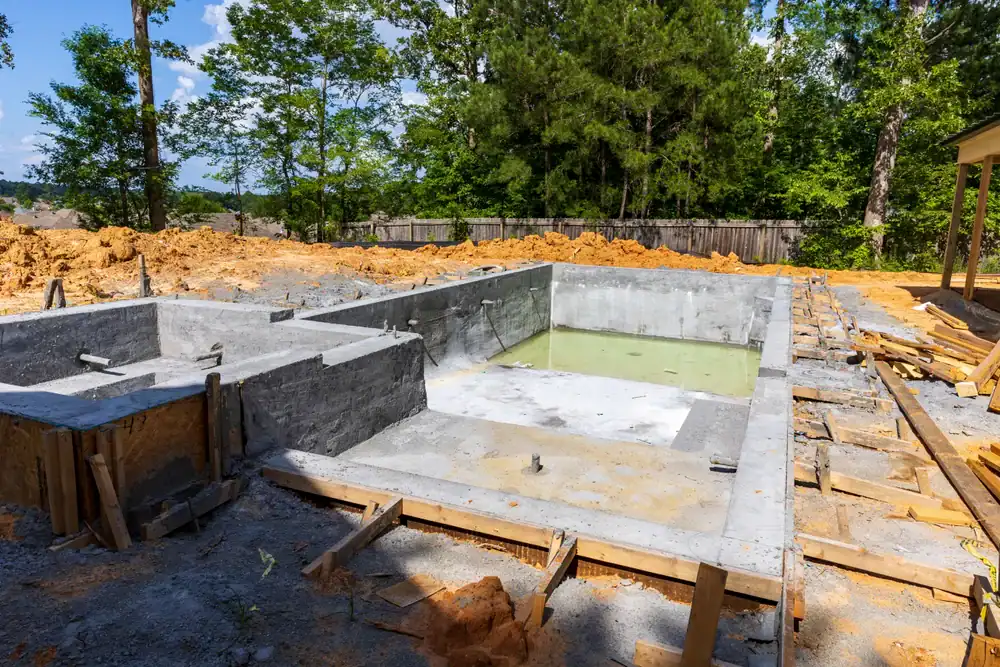
Once design is locked in, we handle all permitting through the Lowndes County Building Permits and Inspections Department. That means we pull every permit in our name, schedule every required inspection including the mandatory rebar cage inspection before gunite is applied and manage the entire process with the county. You don’t track paperwork or make calls to the permitting office. That’s on us.
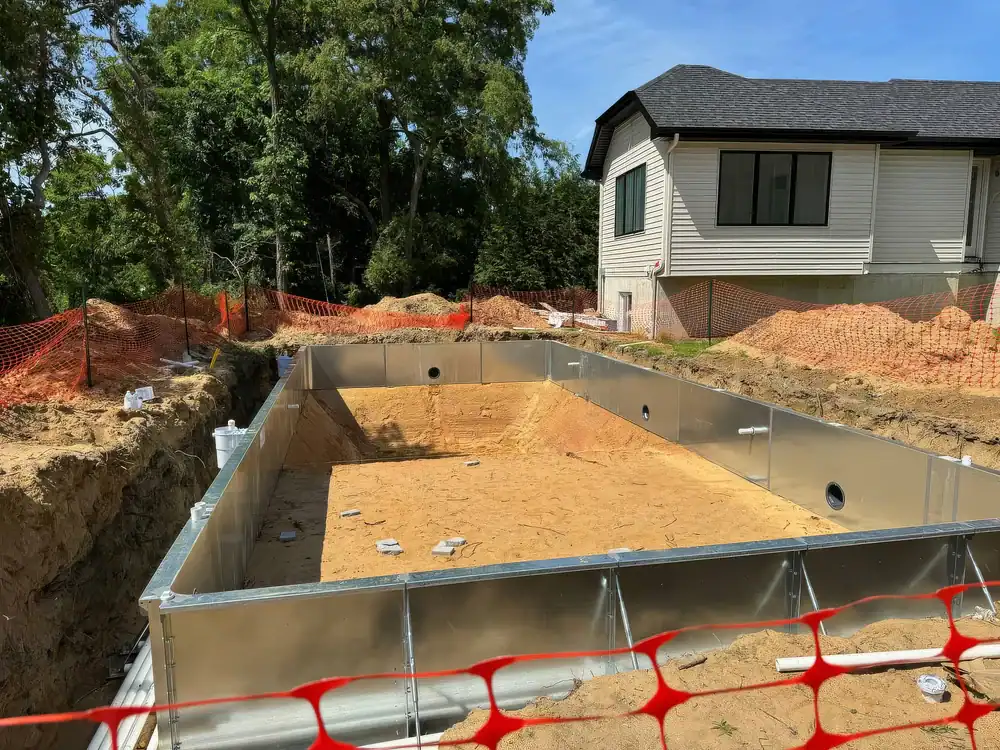
From there, excavation begins. We dig, set the rebar cage, pass inspection, apply the gunite, and move through plumbing, electrical bonding and grounding, and deck installation all with the same crew. In South Georgia, where the wet season runs June through September, we plan around weather windows to keep your project moving. If you’re aiming to swim by Memorial Day, the conversation should start no later than late fall or early winter.
Ready to get started?
Every pool we build is a complete, custom gunite construction not a fiberglass shell dropped into a hole, not a catalog shape that may or may not fit your property. If you’re in Cypress Lakes or on a larger rural tract off Old Clyattville Road, the design works around your actual yard, not the other way around. That’s the core difference between gunite and what the fiberglass-only builders in the Valdosta area are offering.
The full scope of every build includes site evaluation, 3D design renderings, excavation, rebar cage installation, gunite application, all pool plumbing, NEC Article 680-compliant electrical bonding and grounding, pool deck installation, and complete equipment setup. A custom safety cover is also included with every build not as an upgrade, not as an add-on. It’s standard. For homeowners with grandchildren visiting or neighbors nearby, that’s not a small thing.
We coordinate directly with Lowndes County’s building and inspections department so nothing falls through the cracks between stages. The result is a finished pool with a clear paper trail, every inspection passed, and no loose ends left for you to chase down after we leave.
Yes pool construction in Clyattville falls under Lowndes County jurisdiction, since Clyattville is an unincorporated community with no city government of its own. That means all permits go through the Lowndes County Building Permits and Inspections Department, not a municipal office. You’ll need a building permit, an electrical permit, and you’ll go through multiple inspections including a mandatory rebar cage inspection before the gunite can be applied. That inspection is a hard stop; no legitimate builder skips it.
The important thing to know is who pulls the permit. When a contractor pulls the permit in their name, they’re taking legal accountability for the work passing inspection. When a homeowner pulls it instead, they’re on the hook if something fails and the contractor has moved on. We pull every permit in our name on every project. It’s not a convenience it’s accountability, and it matters when you’re investing this much in a permanent structure on your property.
From signed contract to your first swim, most custom gunite pool projects run somewhere in the three-to-six month range. The variables are permitting timelines, weather, and how quickly decisions get made during the design phase. In Lowndes County, the permitting process through the county’s building department adds time upfront that some homeowners don’t anticipate it’s not something you can rush, and it’s not something to skip.
South Georgia’s wet season roughly June through September can affect excavation scheduling and gunite application windows. Heavy rain makes soil walls unstable during excavation and can interfere with the gunite cure. We plan around those windows rather than pushing through them and creating problems. If your goal is to be swimming by Memorial Day or the Fourth of July, the time to start the conversation is the previous fall or early winter. That’s just how the calendar works when you factor in design, permitting, and construction in this climate.
For most properties in Lowndes County, gunite has real structural advantages. The coastal plain soils here sandy loam over clay-bearing subsoils can shift with moisture changes, and the water table on lower-lying lots can be higher than homeowners expect, especially during South Georgia’s wet season. A fiberglass shell is a fixed structure that was manufactured somewhere else and dropped into your yard. If the soil moves or hydrostatic pressure builds up, a fiberglass pool has limited ability to flex without consequences.
Gunite is built in place, over a rebar cage, engineered to the specific site it’s going into. The shell thickness, the rebar layout, and the structural design can all be adjusted based on what’s actually in the ground on your property not based on what a standard mold allows. That matters in a county where soil conditions vary meaningfully from lot to lot. Beyond that, a properly built gunite pool gets stronger as the concrete cures over time, and with correct water chemistry it’s a structure that realistically lasts 30-plus years without the surface degradation or liner replacement cycles you see with other pool types.
Custom gunite pool construction in the Clyattville and Valdosta area typically ranges from the mid-$50,000s into the $80,000-plus range depending on size, shape, depth, deck footprint, and equipment package. That’s a wide range because no two properties or projects are the same a pool on a flat Cypress Lakes lot with standard dimensions is a different project than a larger custom design on a rural tract with grade changes or drainage considerations.
What matters as much as the number is what’s included in it. Some builders quote low and add costs as the project moves forward. We build a fixed scope into the contract design, permits, excavation, gunite, plumbing, electrical, deck, and safety cover so the number you agree to at signing is the number you work from. That doesn’t mean every project comes in at the same cost, but it does mean you won’t be getting change order surprises mid-build. For a structure that’s going to be on your property for 30-plus years, the upfront investment is worth evaluating against the long-term value, not just the bottom line on page one of the quote.
We serve Southeast Georgia broadly, and Clyattville is well within our service area. Sitting about 20 miles from the Georgia-Florida state line, the communities along the Route 31 corridor including Clyattville are a regular part of our work in Lowndes County. Distance from our Douglas home base doesn’t change how a project is managed or staffed. The same crew that handles every other build handles yours.
What does change as you move further south in Georgia is the cultural context around pools. Homeowners in this corridor are close enough to North Florida that private pool ownership is a familiar expectation, not a novelty. That’s actually useful it means most people asking about a pool here already have a clear picture of what they want and why. They’re not asking whether a pool makes sense in this climate. They’re asking who builds it right. That’s the question we’re set up to answer.
In most cases, yes and the Lowndes County market is a reasonable place to expect that return. A custom inground pool typically adds around 7% to residential property value in Georgia markets, and in an area where home prices have been climbing steadily, that percentage represents a real dollar figure. For established homeowners in Clyattville who have built equity in their properties, a pool is one of the few improvements that combines daily lifestyle value with a meaningful impact on resale.
The caveat is quality. A pool that was built cheaply, permitted incorrectly, or shows structural issues at the time of sale can actually complicate a transaction rather than help it. Buyers and their inspectors will look at the permit history, the condition of the shell, and the equipment. A pool with a clean permit record every inspection passed, every phase documented is a selling point. One without that paper trail is a liability. That’s one reason the permitting process matters beyond just legal compliance. It’s also the record a future buyer’s agent is going to ask about when your property goes on the market.