
Hear from Our Customers
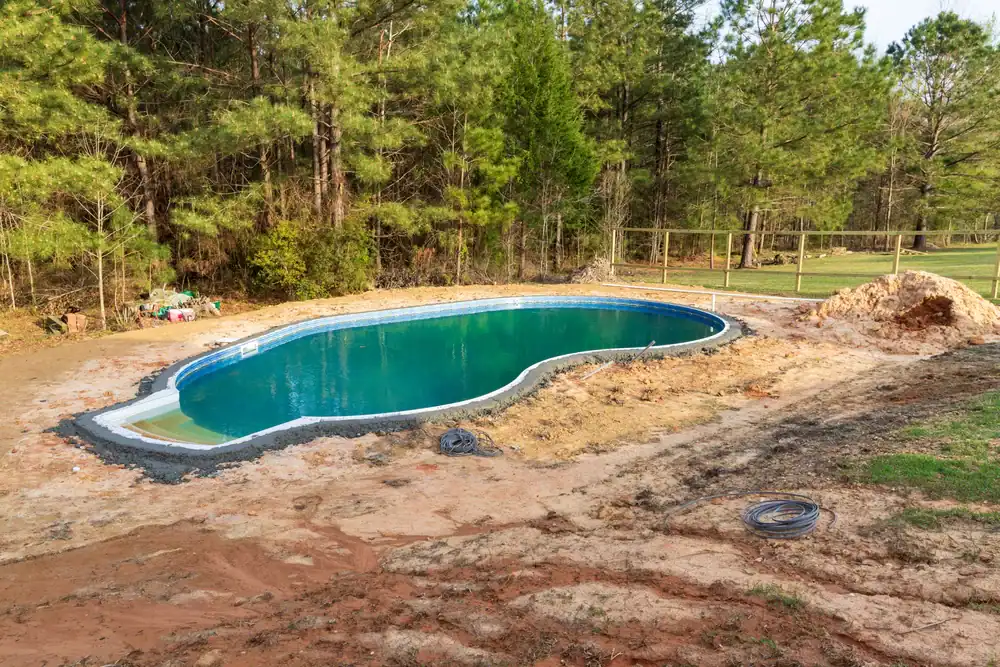
Deenwood sits right on the edge of the Okefenokee Swamp basin, and that matters more than most pool companies will tell you. The soils here sandy coastal plain, peat deposits, variable water table depending on where your lot sits are nothing like the red clay you find in central Georgia. A builder who treats every job the same regardless of location is taking a risk with your property. One who understands what’s actually under the ground in Ware County is not.
When a pool is built correctly for Deenwood’s conditions, you get a structure that doesn’t shift, doesn’t crack, and doesn’t develop hydrostatic pressure problems after a heavy rain. You also get a backyard that becomes the most-used space on your property from April through October which in Southeast Georgia is a long stretch of genuinely hot weather. That’s real value.
For families in Deenwood, especially those in newer subdivisions like Alton Circle or in the established neighborhoods near Wacona Elementary, a well-built pool adds lasting value to the property. Gunite pools don’t need liner replacements every decade. They don’t degrade the way fiberglass surfaces do over time. Built right, they’re a 30-plus year investment one your family will actually use.
Deep Waters Pools was founded in 2014, but the experience behind it goes back more than three decades. Our founder didn’t pivot into pool construction from another industry he spent 30-plus years doing the hands-on work: concrete, plumbing, excavation, and custom pool builds across Southeast Georgia before formalizing the company. That matters when you’re making a $60,000 to $90,000 decision.
Based in Douglas, we serve communities throughout Southeast Georgia, including Ware County and Deenwood. We’re familiar with the specific soil conditions, permit requirements, and construction realities that come with building in this part of the state. We know the difference between sandy soils and peat-influenced soils, and we know how the water table behaves in Deenwood neighborhoods after heavy rain.
No subcontractors. The same crew that breaks ground is the crew that finishes the deck. Every permit including the building and electrical permits required through Ware County for unincorporated communities like Deenwood is pulled and managed in-house from start to finish.
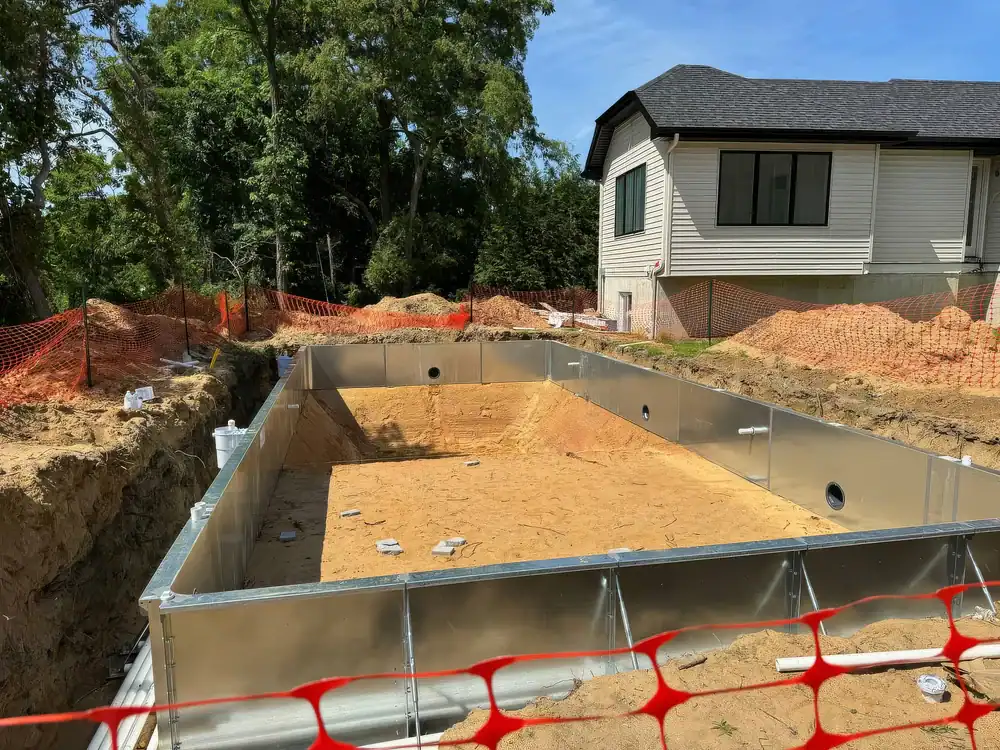
It starts with a site visit. Before anything is drawn up or quoted, we look at your property the lot size, the soil, the grade, and where the pool will actually sit. In Deenwood, that evaluation includes checking for conditions specific to the Ware County area: sandy or peat-influenced soils that require adjusted engineering, and water table depth that affects both excavation timing and pool shell design. This isn’t a step that gets skipped.
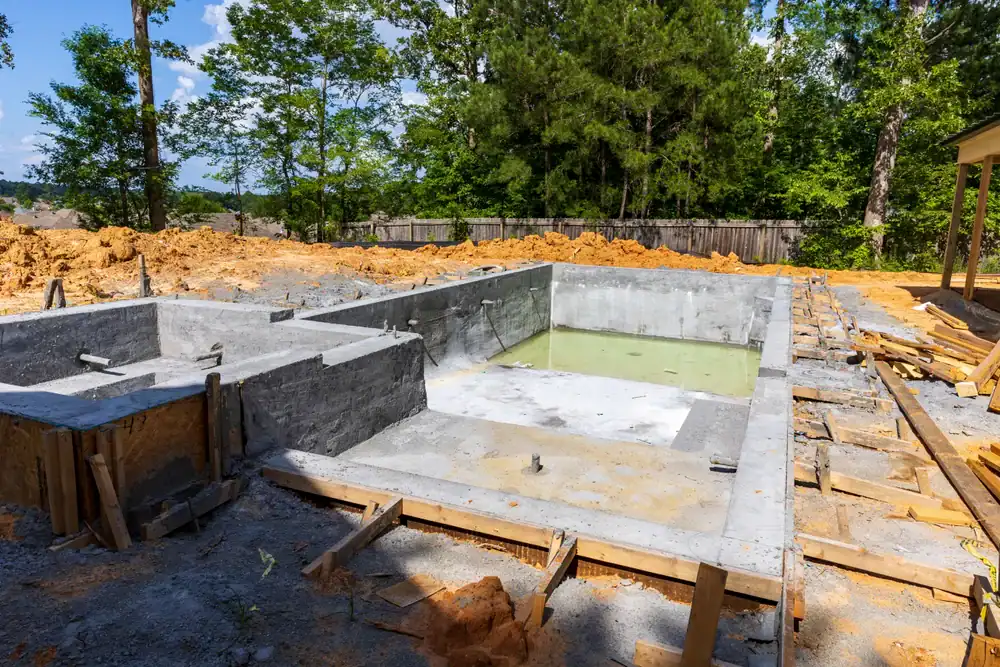
Once the design is finalized and the quote is agreed to, we pull all required permits through Ware County. Because Deenwood is an unincorporated community, permits go through the county building office not a city department and that process typically takes two to eight weeks. We handle every form, every submission, and every required inspection, including the mandatory rebar cage inspection that Georgia building code requires before gunite is ever applied.
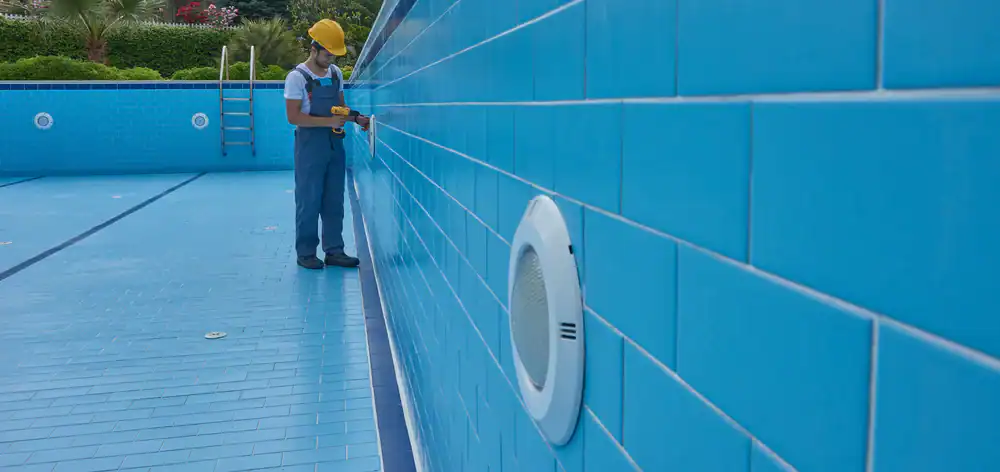
After permits clear, excavation begins. From that point, the sequence moves through rebar installation, gunite application, plumbing, equipment installation, and deck work all done by our crew, in order, without handoffs to outside contractors. Total construction time from excavation to finished pool runs roughly six to eight weeks. Plan for three to five months from your first conversation to your first swim, and if you want to be in the water by Memorial Day, the conversation needs to start in the fall or early winter.
Ready to get started?
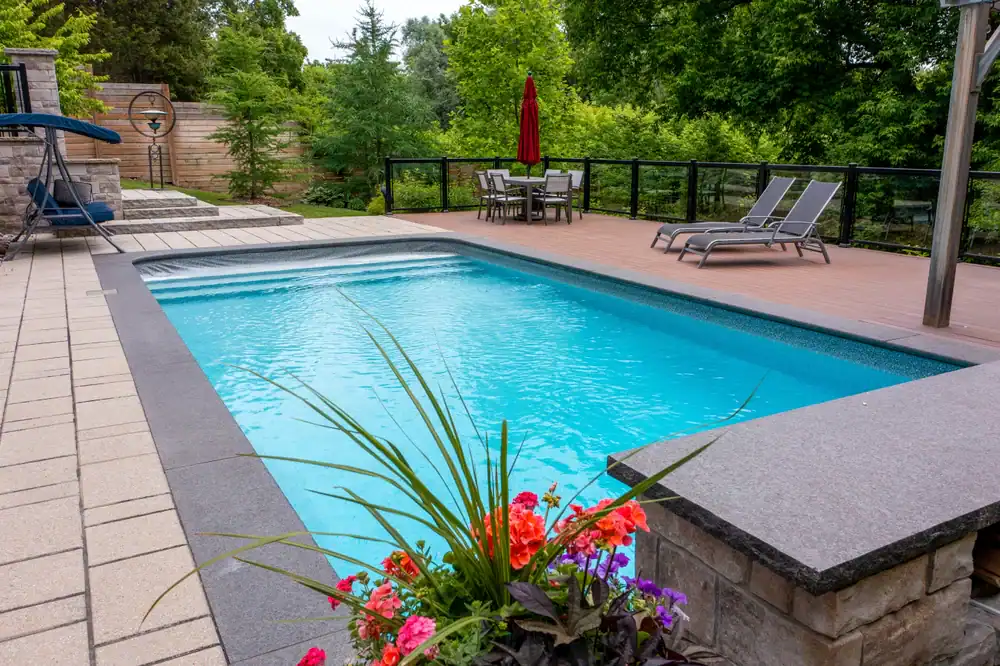
Every pool we build is a gunite pool poured and shaped on your property, not manufactured in a factory and dropped into a hole. That means the shape, depth, and footprint are designed around your specific lot, whether that’s a compact yard in an older Deenwood neighborhood or a larger parcel in a newer development. The build includes full excavation, custom rebar cage fabrication, gunite shell application, all swimming pool plumbing, NEC Article 680-compliant electrical bonding and grounding, equipment installation, and pool deck installation. A custom safety cover fitted to your pool’s exact shape is included with every project.
The electrical work on every build meets the National Electrical Code’s Article 680 requirements, which govern bonding and grounding specifically for swimming pools. This isn’t optional it’s code and it’s built into every project without being treated as an add-on. For homeowners in Deenwood who are on private septic systems, the site evaluation also accounts for drain field location before excavation is planned, which is a relevant consideration in parts of Ware County where older homes haven’t connected to municipal sewer.
The deck is not an afterthought. It’s part of the build, completed by our crew, and designed to complement the pool and work with your existing yard. When the project is done, it’s done not “mostly done, waiting on a subcontractor.”
Yes, and because Deenwood is an unincorporated community, those permits come from Ware County not a city building department. That’s a distinction a lot of homeowners don’t realize until they’re already trying to figure out who to call. The permit process covers the building permit, the electrical permit, and all required inspections throughout the construction sequence.
One inspection that often surprises homeowners is the rebar cage inspection, which Georgia building code requires before any gunite can be applied. That step isn’t optional, and a contractor who skips it or works around it is creating a code violation that can surface at resale. We pull every permit in our name and schedule every inspection you don’t have to navigate any of it. The permitting process in Ware County typically takes two to eight weeks, which is one of the main reasons starting the process earlier than you think you need to is always the right call.
It’s one of the most important questions to ask, and most builders won’t bring it up on their own. Ware County’s soils are part of Georgia’s coastal plain a mix of fine sand, silt, peat deposits near the swamp basin, and variable clay. These are fundamentally different from the red clay soils in central Georgia, and they behave differently under load, after rain, and over time. Sandy or peat-influenced soils can have lower bearing capacity and are more susceptible to shifting, especially in areas where the water table runs higher after significant rainfall.
For pool construction, that means the engineering has to account for local conditions not just follow a standard template. Hydrostatic pressure, which is the force groundwater exerts against the pool shell from below, is a real concern in areas with elevated water tables. A pool built without accounting for that can develop structural problems over time. We evaluate every site in Deenwood before finalizing any design, specifically to understand what’s under the ground before excavation begins.
Realistically, plan for three to five months from your first conversation to the day you swim. That timeline breaks down into a few distinct phases: design and quoting typically takes one to four weeks, Ware County permitting runs two to eight weeks depending on current processing times, and active construction from excavation through finished deck and equipment takes roughly six to eight weeks.
The most common mistake homeowners make is starting the process in April expecting a July pool. By then, the permit window alone may push you into late summer. In Southeast Georgia, pool season runs from roughly April through October, which is seven months of genuine swimming weather. If you want to use all of it, the conversation needs to start in the fall or winter before the season you’re targeting. We book out, and the homeowners who are swimming by Memorial Day are almost always the ones who called the previous November or December.
The core difference is that gunite is built on your property from scratch, and fiberglass comes as a pre-manufactured shell that gets set into an excavated hole. That distinction matters a lot depending on your lot. Fiberglass pools are limited to the shapes and sizes the manufacturer produces if your yard doesn’t accommodate one of those shells cleanly, your options get narrow fast. Gunite can be built in any shape, any depth, and any footprint, which makes it the only real option for lots with irregular dimensions, slopes, or specific aesthetic goals.
For Deenwood specifically, gunite also holds up better over the long term in this region’s soil and climate conditions. Fiberglass surfaces can degrade, blister, and require resurfacing over time, particularly in high-humidity environments. Vinyl liner pools need liner replacement every ten to fifteen years, which adds recurring cost. A properly built gunite pool in this area is a 30-plus year structure one that gets stronger as the concrete continues to cure, not weaker.
Generally, yes though the return depends on the quality of the build and the price range of your neighborhood. Across the market, a well-built inground pool typically adds around seven percent to a home’s appraised value. In Deenwood’s newer subdivisions, where homes are selling in the $355,000 to $430,000 range, that’s a meaningful number. In the more established parts of the community where median home values sit closer to $135,000, the more relevant consideration is the quality-of-life return seven months of use per year, in your own backyard, for a family that would otherwise be driving to a public pool or not swimming at all.
One thing worth knowing: a pool built without permits, or one that doesn’t pass final inspection, can create complications when you sell. Buyers’ lenders and inspectors will ask, and an unpermitted pool can delay or kill a sale. A properly permitted and inspected pool is an asset at resale. One that was built around the process is a liability.
In many cases, yes but it requires careful planning before excavation begins. Some older homes in Deenwood and the surrounding Ware County area are on private septic systems rather than municipal sewer, and the location of the drain field has to be identified and accounted for before the pool footprint is finalized. Building over or too close to a drain field can damage it, and in some cases, it can create a permit issue with the county.
During the site evaluation phase, we review the property layout to understand where the septic system is located relative to where the pool will be built. If the lot allows for a pool without impacting the drain field, the project moves forward normally. If the layout creates a conflict, that gets identified before any design is finalized not after excavation has already started. This is one of the reasons the site visit happens before anything else, and why working with a builder who asks the right questions upfront saves a significant amount of time and money later.