
Hear from Our Customers
Most people who’ve been burned by a pool contractor can tell you exactly when things went sideways usually somewhere between the signed contract and the moment a stranger showed up to do a phase they’d never heard about. The pool got built, eventually. But not the way it was supposed to, not on the timeline they were told, and not without a few uncomfortable conversations about costs that weren’t in the original number.
When the build is done right, none of that happens. You get a pool that was engineered for your specific lot not a catalog shape forced onto your land. Out here around Ochlocknee and Thomas County, that matters more than most places. The soil profile is a mixed composition: red clay underneath, sandy Coastal Plain material above it. Clay expands and contracts with every rain cycle. Sandy soil shifts during excavation if nobody’s read the site before the first cut. A pool that wasn’t designed with those conditions in mind will show you the consequences eventually usually in cracks, in shifting, or in equipment problems that trace back to how the shell was seated.
The other thing that changes is your timeline reliability. Southwest Georgia’s swimming season runs from April through October seven solid months. If you start the conversation in November or December, you can be swimming by Memorial Day. That only works if your builder knows how to manage permitting through Thomas County Inspections and Planning, schedule inspections without delays, and keep the build moving through Georgia’s summer rain season without losing weeks to poor scheduling.
Deep Waters Pools was founded in 2014, but the experience behind it goes back more than three decades. Before we started the company, our founder spent 30-plus years working in concrete, plumbing, and custom pool construction across South Georgia. That means the person overseeing your project in Ochlocknee has already seen what happens when the rebar spacing is wrong, when gunite gets applied in wet conditions, or when a pool shell wasn’t engineered for the soil it’s sitting in. We’ve fixed those problems on other people’s pools. We don’t create them on yours.
We serve the Ochlocknee, Thomasville, and Thomas County area with one operational commitment: no subcontractors. The same crew that evaluates your site digs the excavation, runs the plumbing, applies the gunite, and finishes the deck. Every person on your property is part of the Deep Waters team which means there’s one point of accountability from the first site visit to the day you swim.
It starts with a site evaluation before anything else. We look at your specific lot the soil profile, the grade, the drainage patterns, any mature trees or existing structures near the proposed pool area. On properties outside Ochlocknee’s city limits, that often means reading land that’s been used for agriculture, pecan operations, or large rural tracts where the soil has been worked and compacted in ways that affect excavation. That evaluation shapes the design. The pool gets engineered around what’s actually in the ground, not around a standard blueprint.
Once the design is finalized, we handle every permit in-house. If your property is within Ochlocknee’s city limits, that means working through Ochlocknee City Hall. If you’re on a rural tract in unincorporated Thomas County, it’s the Thomas County Inspections and Planning office on West Jefferson Street in Thomasville. Either way, you don’t make calls, track paperwork, or follow up on inspection scheduling. We handle it and we’re legally taking responsibility for the work meeting code.
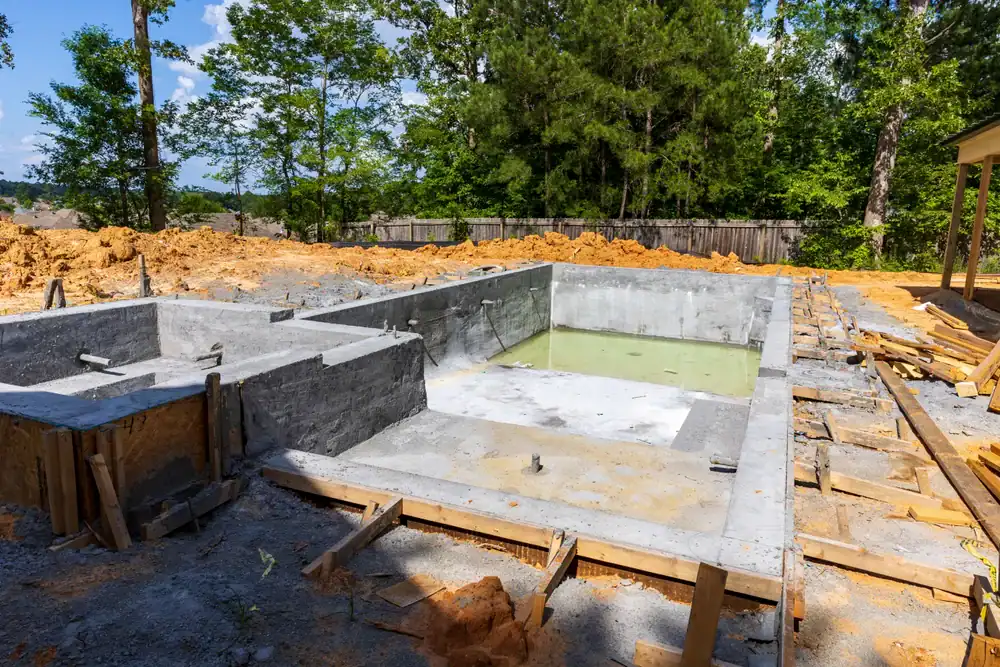
From there, excavation begins, followed by rebar installation, the mandatory Georgia building code inspection of the steel before gunite is applied, gunite application, plumbing, electrical bonding and grounding to NEC Article 680 standards, equipment installation, and finally the deck. Your custom safety cover is included not quoted separately at the end. The process is sequential, managed by one crew, and communicated to you throughout.
Ready to get started?
A Deep Waters pool build covers the full scope in a single contract. Site evaluation, excavation, rebar and gunite shell, all swimming pool plumbing, all electrical work, equipment installation, pool deck installation, and a custom safety cover. Nothing gets handed off to a subcontractor who quotes separately. Nothing appears as a line item after you’ve already committed.
The gunite pool building process means your pool is constructed on-site from the ground up any shape, any depth, any footprint that works with your land. That’s not possible with a fiberglass shell, which arrives on a flatbed in a fixed catalog size and requires your property to adapt to it. On the larger lots and rural tracts common around Ochlocknee, where the land has its own character, that flexibility matters. You might want the pool to sit a specific way relative to an existing outbuilding, a pecan grove, or a covered patio. Gunite makes that work.
We manage new pool projects entirely in-house. We coordinate the inspection sequence, manage the timeline around Thomas County’s permitting review periods, and account for southwest Georgia’s summer rain patterns which can delay excavation and gunite application if a builder hasn’t planned for them. The pool deck installation is part of that same managed process, not a separate conversation after the shell is done. When the project closes, your pool is complete, inspected, and ready.
Yes and the permitting layer depends on where your property sits. If you’re within Ochlocknee’s city limits, the permit goes through Ochlocknee City Hall. If your property is in unincorporated Thomas County, you’re working with the Thomas County Inspections and Planning office at 227 West Jefferson Street in Thomasville. Either way, a residential pool construction project requires a building permit, and the electrical work requires a separate electrical permit under Georgia’s contractor licensing requirements.
Georgia building code also mandates a rebar inspection before gunite is applied meaning the steel cage has to be reviewed and signed off by an inspector before the concrete shell goes on. This isn’t optional, and a contractor who skips it is creating a code violation that becomes your problem at resale. We pull every permit in our own company’s name and manage every required inspection from start to finish. You don’t navigate any of this. That’s part of what you’re hiring us to handle.
It’s one of the more important variables in this area, and it’s one that doesn’t get discussed enough. The soil profile around Ochlocknee and the broader Thomas County area is a mix of red clay underlayment and sandy Coastal Plain material. Those two soil types behave very differently during and after construction. Red clay expands when it absorbs moisture and contracts when it dries out that cycle, repeated over years, puts stress on a pool shell that wasn’t engineered to handle it. Sandy soil, meanwhile, can shift during excavation if the site isn’t properly evaluated before the first cut.
This is exactly why we start every build with a site evaluation. We’re reading what’s actually in the ground on your specific lot before the design is finalized. A pool engineered around your soil conditions is structurally different and more durable than one built from a standard blueprint applied to every job regardless of what’s underneath. If you’re on a larger rural tract outside Ochlocknee’s city limits, where the land may have been farmed or worked over the years, that pre-construction evaluation is especially important.
The most practical difference is this: a gunite pool is built on your property, around your land. A fiberglass pool arrives on a truck in a shape that was decided in a factory. If your lot has a specific footprint, a grade change, a tree you want to work around, or a shape in mind that doesn’t exist in a manufacturer’s catalog fiberglass can’t accommodate that. Gunite can.
Beyond customization, the durability comparison is significant for a long-term investment. Gunite is concrete it gets stronger with age, not weaker. A properly built gunite pool in Thomas County should be performing correctly 25 to 30 years from the day it was plastered. Fiberglass gel coat surfaces degrade over time and typically need resurfacing. Vinyl liner pools require liner replacement every 10 to 15 years, which adds recurring cost to what initially looked like a lower price. For an Ochlocknee homeowner making a significant investment in their property one they intend to be there for decades the long-term math on gunite is straightforward.
If Memorial Day is the target, November or December is the right time to start the conversation not February. Here’s why: permitting review through Thomas County Inspections and Planning typically takes two to eight weeks depending on the complexity of the project and the current workload at the office. Add the full construction sequence excavation, rebar, inspection, gunite, plumbing, electrical, equipment, and deck and you’re looking at a build timeline that needs to start well before spring arrives.
Southwest Georgia’s summer rain season, which runs June through September, also affects scheduling. Heavy rain events can delay excavation and gunite application, and a builder who doesn’t account for that in the project calendar will routinely miss timelines. We plan for those variables from the start. Spring is also peak demand season builders with strong local reputations fill their calendars quickly. If you’re thinking about a pool for next summer, the time to reach out is now, not when the weather warms up and everyone else has the same idea.
Generally, yes and the conditions around Ochlocknee make the case stronger than average. Properties in Thomas County tend to sit on larger lots, which means a pool doesn’t dominate the usable yard or create the cramped feel that can actually hurt value on smaller suburban lots. On a rural tract or a property with acreage, a custom inground pool adds a lifestyle feature that very few competing properties can offer which matters when it’s time to sell.
The estimated property value increase from a well-built inground pool runs around 7%, though that varies based on the home’s existing value, the neighborhood, and the quality of the build. A gunite pool that was properly engineered, permitted, and inspected adds more value than one with a questionable construction history because buyers and their agents ask about permits and inspections. We build to code and pull every permit in-house, which means your pool has a clean paper trail from excavation to final sign-off. That documentation matters at resale.
Georgia law requires that any pool contractor performing residential work above $2,500 hold a valid license through the Georgia State Licensing Board for Residential and General Contractors. Electrical work on pool equipment falls under a separate Georgia electrical contractor licensing requirement. These aren’t suggestions they’re legal requirements, and working with an unlicensed contractor means the work may not pass inspection, may not be insurable, and creates liability that lands on you as the homeowner.
The verification process is straightforward: ask the contractor for their Georgia license number and look it up directly on the State Licensing Board’s website. If they hesitate, that’s your answer. Also ask who pulls the permit a contractor who asks you to pull your own permit is a contractor who doesn’t want their name attached to the legal responsibility for the work meeting code. We pull every permit in our own company’s name, which is exactly how it should be done.