
Hear from Our Customers
Putney summers are not subtle. When July humidity sits at 76% and afternoon temperatures push past 90°F, your backyard either becomes the place your family wants to be or the place everyone avoids. A properly built inground pool changes that equation completely. It becomes the center of your property for most of the calendar year, not just a few weeks in August.
But there’s more to it than just beating the heat. Putney sits on flat, fertile farmland with the Flint River running along the community’s western edge and that terrain has real implications for how a pool should be built. Drainage has to be engineered, not assumed. Soil preparation matters. A pool that wasn’t designed with this specific geography in mind can develop structural issues over time that cost far more to fix than they would have to prevent.
The other thing most homeowners don’t think about until after the fact is long-term ownership. With roughly 51 inches of rain each year and a swimming season that stretches from early spring through late fall, your pool and its equipment take on a lot of work. We provide full-service pool care regular maintenance, water testing, and equipment support that keeps that investment running the way it should, season after season.
We were founded in Douglas, Georgia in 2014 but the experience behind us goes back more than 30 years of hands-on work in concrete, plumbing, and pool construction across south Georgia. We didn’t start because we spotted a market opportunity. We started because we watched too many families in communities like Putney get burned by contractors who took deposits, missed deadlines, and delivered something far short of what was promised.
That founding reality shapes how we handle every project. Dougherty County’s permitting process, the drainage characteristics of southeastern Dougherty County’s flat farmland, the septic system review requirements that apply to unincorporated properties along the US-19 corridor these aren’t abstract concerns. They’re the specifics that determine whether your project moves forward smoothly or stalls out for months. We know this area, and that knowledge shows up before the first shovel breaks ground.
It starts with a design consultation where the focus is on your specific property your lot’s orientation, your yard’s drainage characteristics, and how you actually plan to use the pool. In Putney, where many properties sit on flat land with particular drainage patterns, that site evaluation isn’t a formality. It’s one of the most important steps in the entire process.
From there, we handle the permitting through Dougherty County’s building department. Because Putney is unincorporated, there’s no city hall involved it’s a county-level process, and if your property runs on a private septic system, there’s an Environmental Health review that has to happen before a permit can be issued. Contractors who don’t know this step create delays that can push your project back by weeks. We’ve navigated this process many times and know how to keep things moving.
Once permits are in hand, construction begins with excavation, structural engineering, and concrete placement all built to handle south Georgia’s soil and climate conditions. After the pool is complete, you get a full walkthrough of your new system so you know exactly how to operate it. If you want ongoing maintenance, equipment service, or just a free water test after a heavy spring storm, that support doesn’t disappear once construction wraps up.
Ready to get started?
We build custom inground concrete pools from the ground up no catalog selections, no cookie-cutter shapes. Every pool is designed around your specific property and your family’s needs. Concrete is the deliberate choice here. Unlike fiberglass, which can shift and pop in the kind of soil conditions found near the Flint River basin, concrete cures and strengthens over time. It’s the only material built for a 30-plus year lifespan in this environment.
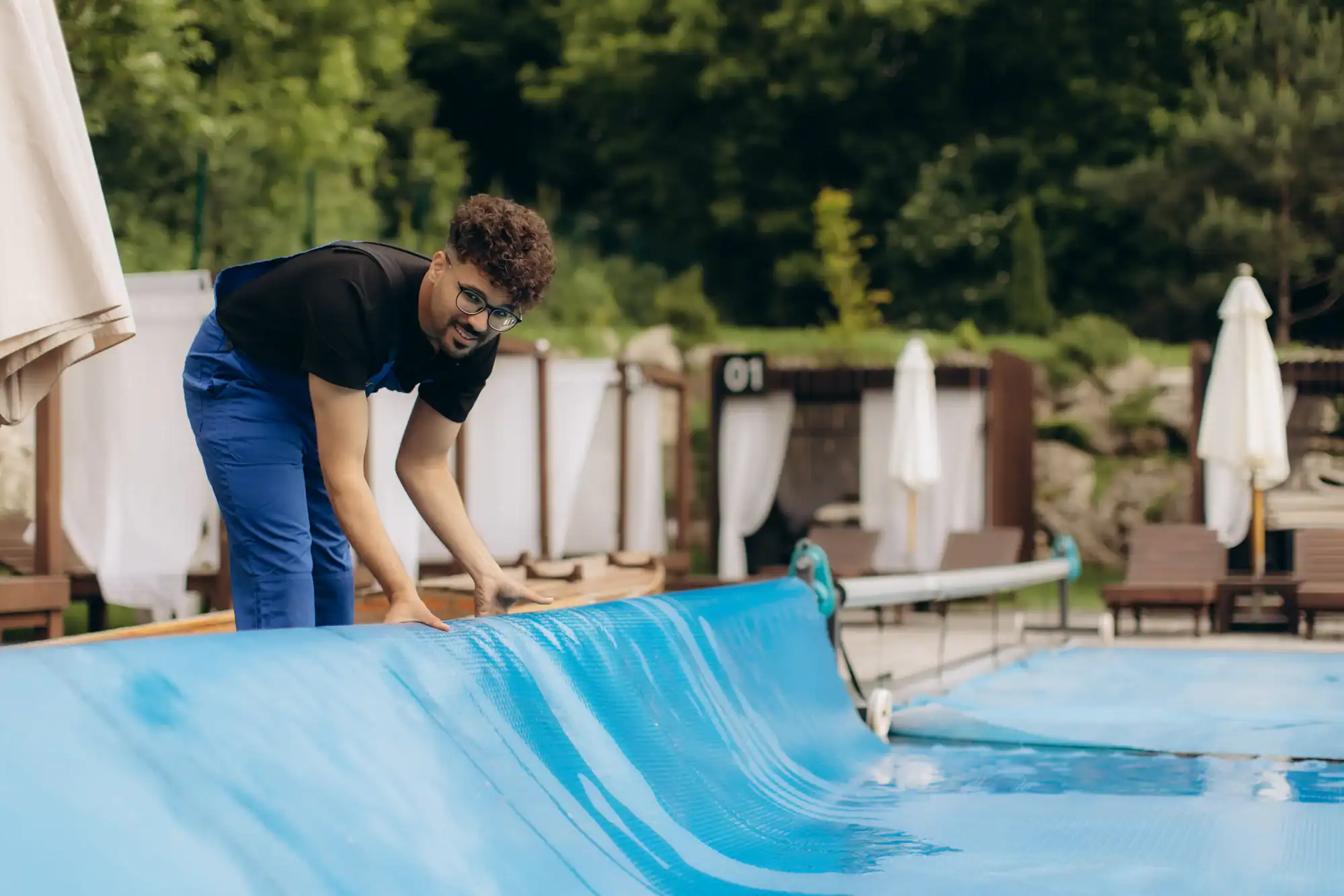
Beyond new construction, we provide pool renovation and resurfacing for existing pools, which matters in a community where housing stock was largely built between 1970 and 1999. A lot of pools in Dougherty County are aging and a renovation done right extends the life of that investment significantly rather than replacing it entirely. Pool covers, custom design features, and equipment upgrades are all part of what we offer.
On the service side, we offer ongoing pool maintenance, emergency pool repair, and free professional water testing. With Putney’s heavy annual rainfall regularly disrupting water chemistry, that water testing isn’t a minor convenience it’s the difference between a balanced pool and a green one the week before a family gathering. We’re trained on all major equipment brands, including Hayward, Pentair, Jandy, Sta-Rite, and Zodiac, so whatever your pool is running, it can be serviced without sending you to find someone else.
Yes any inground pool in Putney requires a building permit, and because Putney is an unincorporated community, that permit comes through Dougherty County’s building department rather than a city office. The county follows Georgia’s International Swimming Pool and Spa Code, which covers setback requirements from property lines, safety barrier and fencing standards, electrical bonding specifications, and inspection checkpoints during and after construction.
There’s one additional step that catches a lot of homeowners off guard: if your property is on a private septic system which applies to a significant number of Putney properties the location of your pool has to be reviewed and approved by Environmental Health relative to your septic tank and drain field before the building permit can move forward. This isn’t a complicated process if you know it’s coming, but contractors who aren’t familiar with Dougherty County’s unincorporated permitting environment can miss it entirely and create delays that push your project back by weeks. Working with a builder who already knows this process makes a real difference in how smoothly your timeline runs.
For a custom inground concrete pool in the Albany and Dougherty County area, most projects fall somewhere in the $55,000 to $90,000 range depending on size, design complexity, features, and site-specific factors. Simpler builds on straightforward lots come in on the lower end. Larger pools with custom features, water elements, or properties that require more drainage engineering tend to run higher.
It’s worth framing this as a long-term investment rather than just a construction cost. A concrete pool built correctly for south Georgia’s soil and climate conditions is engineered to last 30 years or more. Compare that to a vinyl liner pool that needs a full liner replacement every 5 to 10 years, or a fiberglass pool that can develop structural issues in the kind of shifting soil conditions found near the Flint River basin, and the total cost of ownership over time looks very different. The upfront number matters but so does what you’re actually getting for it.
Dougherty County averages around 51 inches of rain per year, and heavy rain events especially during Georgia’s spring storm season can significantly dilute your pool’s chemical balance. When a large volume of fresh water enters the pool quickly, it drops chlorine levels, shifts pH, and can create conditions that allow algae to take hold faster than most people expect. A pool that looked perfectly clear on Monday can be noticeably green or cloudy by Thursday after a serious storm.
The practical answer is regular water testing, not guesswork. We offer free professional water testing that gives you exact readings rather than estimates so you know precisely what your pool needs and how much product to add, rather than over-treating and wasting money or under-treating and dealing with the consequences. For homeowners in Putney who are using their pool seven to nine months out of the year, staying ahead of water chemistry after rain events is one of the most important parts of keeping the pool in good condition throughout the season.
All three pool types are available in the market, but they’re not equal especially in south Georgia’s specific conditions. Fiberglass pools are pre-formed shells installed as a single unit. They can be faster to install, but they’re vulnerable to ground movement. In areas near the Flint River basin, where soil conditions can shift and drainage patterns are a real engineering consideration, fiberglass pools carry a higher risk of structural issues over time, including the pool shell lifting or cracking.
Vinyl liner pools have a lower upfront cost but require full liner replacement roughly every 5 to 10 years, which adds up significantly over the life of the pool. Concrete pools cost more to build initially, but they cure and harden over time, offer complete design flexibility in shape and size, and are the only option genuinely engineered for a 30-plus year structural lifespan. For a Putney homeowner making a long-term investment in their property especially with the area’s growing home values and the community’s ongoing development concrete is the build that holds its value and its structure over the decades.
If you want your pool ready before Memorial Day weekend, the planning conversation needs to happen in late fall or early winter ideally between October and January. Custom concrete pool construction in Dougherty County typically takes several months from design and permitting through completion, and the permitting process through the county building department adds time that can’t always be compressed. Starting that process early is the only reliable way to guarantee a summer ready pool.
Spring is when demand spikes across south Georgia. Contractors who are already booked from early-season planning won’t have open slots for homeowners who start calling in April hoping for a June completion. The families who get their pools done in time for the first hot weekend are almost always the ones who started the conversation the previous fall. Putney’s swimming season runs from roughly March through November that’s a long stretch of usable weather, and it’s worth protecting by not losing the front end of it to a delayed start.
In warm southern states like Georgia, inground pools consistently add measurable resale value and the longer the usable swimming season, the stronger that value argument becomes. Putney’s climate supports pool use for seven to nine months of the year, which means a pool here isn’t a seasonal amenity that buyers might overlook. It’s a functional outdoor living feature that’s usable for the majority of the calendar year, and buyers in this market recognize that.
The Albany-Dougherty County area has been identified as a regional growth market, and Putney itself has seen roughly 21% population growth since the 2020 Census. That kind of residential momentum tends to support home improvement investments more buyers entering the market means more competition for well-appointed properties. A concrete pool that’s been properly maintained and built to last adds to that picture in a way that a dated or poorly constructed pool doesn’t. The key is the quality of the build. A pool that was engineered correctly for the local soil and climate, kept in good condition, and permitted through Dougherty County properly is an asset. One that wasn’t is a liability. That distinction starts with who builds it.