
Hear from Our Customers
From May through October, Putney doesn’t ease into summer it arrives fast and stays heavy. Heat indices pushing past 104°F and humidity that doesn’t let up make a backyard pool less of a luxury and more of a genuine quality-of-life decision. Seven months of usable water in your own yard is a different kind of freedom than anything a neighborhood park or drive up US-19 to Albany can offer.
Beyond the comfort, there’s a real financial case here. Putney home values jumped 41% year over year as of late 2024. A custom inground pool, engineered correctly and built to last 30-plus years, adds measurable value to a property that’s already gaining ground. You’re not just buying a place to cool off you’re making a calculated improvement to an asset that’s actively appreciating.
And because Putney sits close to the Flint River, with the clay-heavy soils that come with it, the engineering behind your pool matters more than most people realize. A pool built without accounting for those soil conditions how they shift, how they drain, how they behave after a heavy rain event is a pool that can crack, settle, or leak within a decade. Getting it right from the start isn’t a premium. It’s the only version worth buying.
We were founded in 2014, but the experience behind us goes back more than 30 years in concrete, plumbing, and custom pool construction across South Georgia. That’s not a marketing line it means the person making decisions on your Putney project has seen every variation of coastal plain soil, Dougherty County drainage condition, and county permitting complication that southwest Georgia can produce.
Putney is unincorporated, which means permits for your pool run through Dougherty County not the City of Albany. That’s a distinction that trips up a lot of contractors who aren’t familiar with how the county’s planning and code enforcement offices operate separately from the city system. We handle all of it in-house, pulling every permit in our own name and managing every required inspection from start to finish.
The crew that breaks ground on your property near the Liberty Expressway is the same crew that finishes it. No handoffs, no strangers showing up mid-project, no wondering who’s accountable when a question comes up. That consistency isn’t common in this industry and it’s exactly why it matters.
It starts with a site evaluation. Before any design is finalized, we look at your actual lot the grade, the drainage, the soil composition, and how close you are to any moisture-sensitive areas near the Flint River corridor. That evaluation shapes everything that comes after, because a pool built for your specific ground is built to stay put.
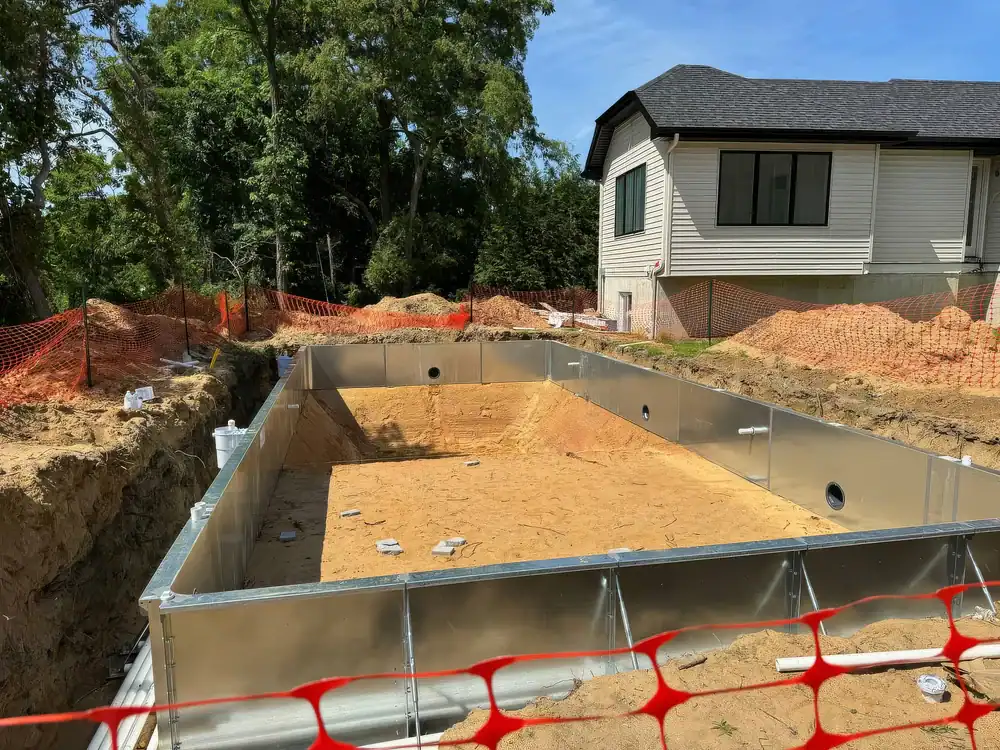
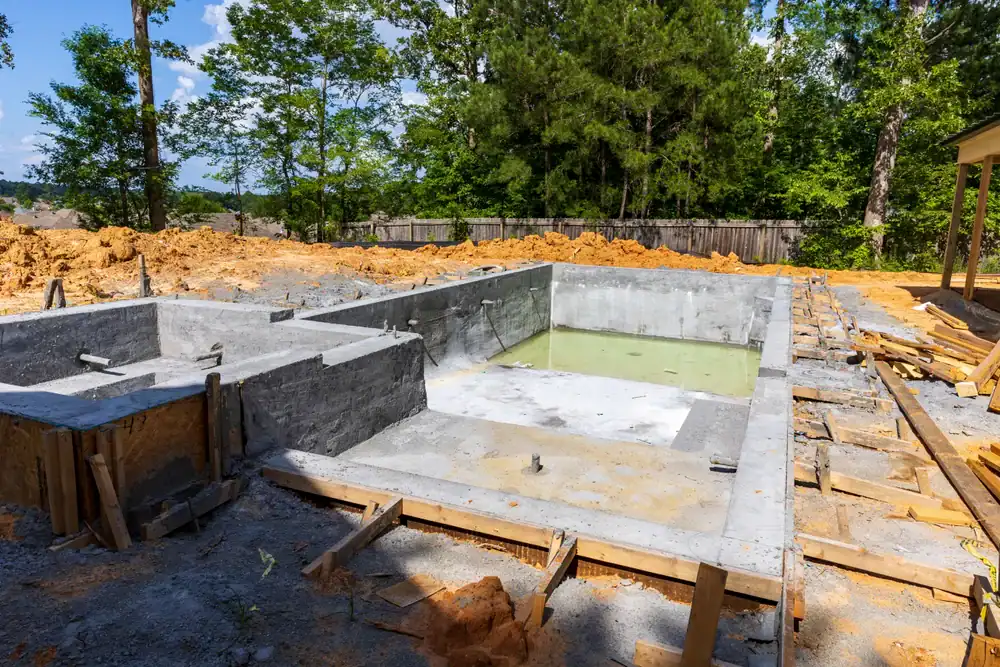
Once the design is locked in, we pull all required permits through Dougherty County’s Planning Department. That step alone can take two to eight weeks depending on the county’s current review schedule, which is why starting the process in fall or winter gives you the best shot at swimming by spring. After permits are approved, excavation begins and from that point, active construction typically runs six to eight weeks. The rebar cage goes in, gets inspected by the county before a single yard of gunite is applied, and then the shell is built to cure over roughly 28 days to reach full structural strength.
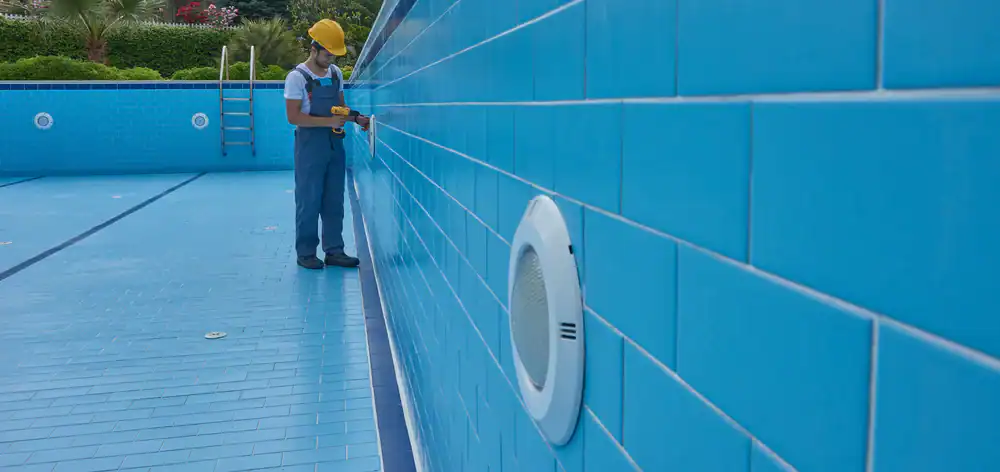
Plumbing, electrical bonding and grounding, equipment installation, and the pool deck all follow in sequence handled by our crew, not passed off to whoever’s available. A custom safety cover is included at the end, measured and fitted to your pool’s exact dimensions. When the job is done, it’s done completely. No open items, no follow-up invoices for things that should have been in the contract.
Ready to get started?
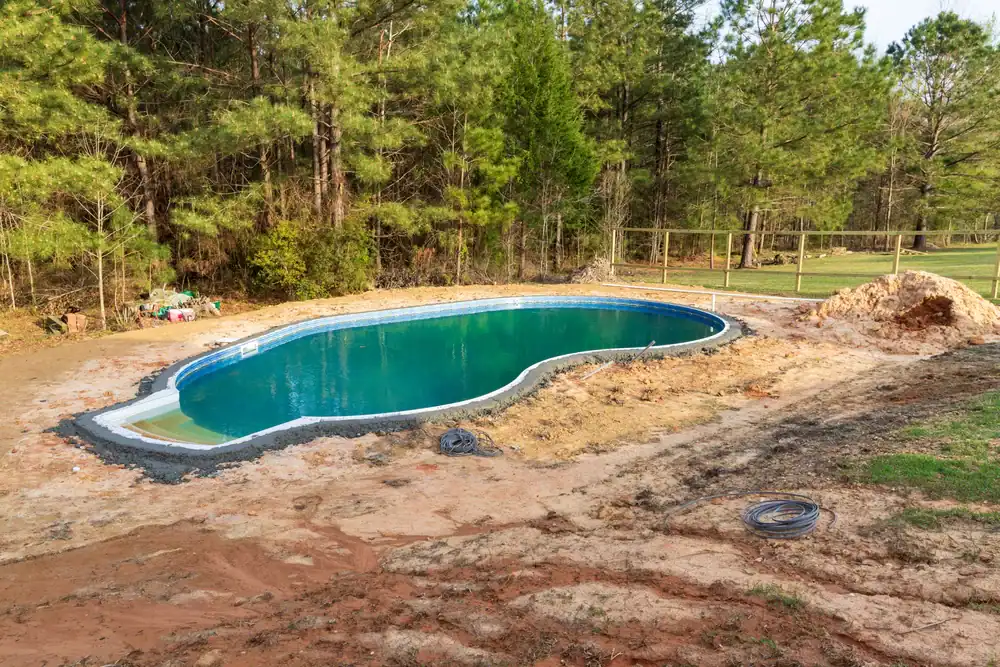
Every pool we build is a custom gunite build meaning it’s designed from scratch for your yard, not selected from a catalog of fixed shapes. That matters especially in Putney, where residential lots tend to run larger than a typical suburban plot. You have real flexibility in how the pool is sized, shaped, and oriented on your property, and gunite is the only material that gives you that freedom without compromise.
The full scope of every project covers site evaluation, excavation, the rebar cage and structural shell, all plumbing, NEC Article 680-compliant electrical bonding and grounding, equipment installation, pool deck construction, and a custom-fitted safety cover all under one contract, at one price. There are no phases handed to outside subcontractors who then bill separately, and no add-ons introduced after you’ve already signed. What’s in the contract is what gets built.
We do not build fiberglass or vinyl liner pools. That’s not a gap in our menu it’s a deliberate focus. Gunite pools, when engineered correctly for local conditions like Dougherty County’s clay soils, are built to last 30 or more years without the recurring resurfacing costs that come with other materials. If you’re weighing the long-term cost of ownership against the upfront number, that lifespan difference is a significant part of the math.
Yes and because Putney is unincorporated, those permits run through Dougherty County, not the City of Albany. That’s an important distinction. The Dougherty County Planning Department and Code Enforcement Office operate on a separate administrative track from Albany’s city permitting system, and the process is built around contractors, not homeowners trying to navigate it on their own.
We pull every building permit and electrical permit in our own name. We schedule all required inspections including the mandatory rebar cage inspection that must happen before gunite is applied and manage the full permitting timeline from application through final sign-off. You won’t be making calls to the county office at 240 Pine Avenue or chasing an inspector to confirm your project is moving. That’s handled entirely by our team building your pool.
It affects it more than most people expect. The southwestern Georgia coastal plain which includes Dougherty County and the ground under your Putney property is characterized by clay-heavy soils that expand when wet and contract when dry. The proximity of the Flint River along Putney’s western boundary adds another layer of complexity, because moisture levels in riverside and near-river soils can be inconsistent and harder to predict, especially after heavy rain events.
This is why a thorough site evaluation before excavation isn’t optional it’s the foundation of the entire build. A gunite pool is engineered and built on-site, which means the structure can be designed specifically for the drainage characteristics and soil behavior of your lot. A pre-formed fiberglass shell dropped into a hole doesn’t account for any of that. If the ground shifts, the shell shifts with it. A properly engineered gunite shell, built with the right rebar configuration and cured to full structural strength, is designed to stay stable through the kind of ground movement that southwest Georgia’s clay soils can produce over decades.
The honest answer is three to six months from the time you start the process to the day you’re swimming and most of that time is front-loaded in design and permitting, not construction itself. Active construction, from excavation through finished deck and equipment installation, typically runs six to eight weeks. But getting to that point requires design finalization, Dougherty County permit approval, and scheduling all of which take time.
Georgia’s mild winters are actually an advantage here. Unlike builders in northern states who lose months to frozen ground and weather delays, we can build year-round in southwest Georgia. If you want a pool ready for Putney’s April-through-October swimming season, starting the process in fall or early winter gives you the most realistic path to being in the water by spring. Waiting until March to start the conversation usually means waiting until late summer at the earliest and that’s a season you won’t get back.
The core difference is customization and longevity. A fiberglass pool is manufactured off-site in a fixed shape and size, then transported and installed into a pre-dug hole. It’s faster to install, but you’re limited to whatever shapes and dimensions the manufacturer offers. A gunite pool is built on your property from the ground up any shape, any depth, any configuration which is a significant advantage on the larger residential lots common in Putney’s unincorporated areas.
On durability, a properly built gunite pool is designed to last 30 or more years. Fiberglass pools can last a long time too, but their gel coat surfaces fade and degrade over time, and the fixed shape limits your renovation options down the road. Vinyl liner pools require liner replacement every 10 to 15 years, which adds recurring cost that rarely shows up in the initial quote. When you’re comparing options, the upfront price of a gunite pool looks different once you account for what you’re not spending on replacements and repairs over the next three decades.
In a market where home values rose 41% year over year as of late 2024, the equity case for a custom inground pool is stronger in Putney than it’s been in years. Georgia real estate data generally supports a 5 to 7% increase in property value for homes with a well-built inground pool, and that figure carries more weight in a rising market where buyers are actively competing for properties with upgraded features.
The key word is well-built. A pool that was poorly engineered for local soil conditions, permitted incorrectly, or left unfinished by a contractor who walked off the job is not an asset it’s a liability that shows up in every home inspection and every buyer negotiation. A properly permitted, fully completed gunite pool with documentation of county inspections and code compliance is a different story entirely. It adds value because it was done right, not just because it exists.
This is one of the most common and legitimate concerns in pool construction, and it comes from a real pattern in the industry contractors who quote one number to win the job and then introduce additional costs phase by phase until the final bill looks nothing like what was discussed at the kitchen table.
We write a complete contract before any work begins. That contract covers every phase of the project: site evaluation, excavation, rebar, gunite shell, all plumbing, NEC Article 680-compliant electrical bonding and grounding, equipment installation, pool deck, and a custom safety cover. Nothing in that list is a separate conversation after signing. There are no subcontractors billing independently, no “while we’re at it” additions, and no phases that weren’t accounted for in the original scope. The number in the contract is the number. If something genuinely changes a site condition that couldn’t have been known before excavation, for example that conversation happens openly, before the work continues, not after it’s already done.