
Hear from Our Customers
Most pool problems don’t start with the wrong chemical. They start with not knowing what the water actually needs. When you’re guessing based on test strips or a quick color match, you’re always a step behind and in a South Georgia summer, that gap closes fast. Algae can take hold in under 48 hours when temperatures push into the mid-90s. By the time you see it, you’re already dealing with a treatment job instead of a maintenance call.
Out here in rural Coffee County, a lot of properties run on well water. That matters more than most people realize. The mineral content in your source water iron, calcium, manganese shapes your pool chemistry before a single chemical is added. A generic pool store test doesn’t account for that. It just reads what’s in the pool right now, without any context for where that water came from or what it brought with it.
When you know exactly what’s off and why, fixing it is straightforward. You stop buying chemicals that don’t move the needle, stop second-guessing your readings, and stop watching your pool flip back to cloudy a week after you treated it. That’s what a professional water test actually gives you a clear picture, a specific plan, and a pool you can actually use.
We’re based in Douglas the Coffee County seat, and the same town Bushnell residents already rely on for most everything else. This isn’t a regional chain routing calls through a dispatch center two counties over. We’re a local operation that has been working in this area for decades, building and servicing pools across Coffee County’s rural landscape, including properties throughout Bushnell and the surrounding communities.
Our team brings more than 30 years of hands-on experience in pool construction, plumbing, and water chemistry long before we were formally established in 2014. That history matters when it comes to water testing, because we built pools like yours. We know what a gunite surface needs chemically, what happens when calcium hardness drifts in either direction, and how South Georgia’s climate puts pressure on pool chemistry in ways that generic advice doesn’t account for.
When you call Deep Waters Pools, you’re talking to people who know Coffee County’s roads, its water, and its seasons not someone reading from a script.
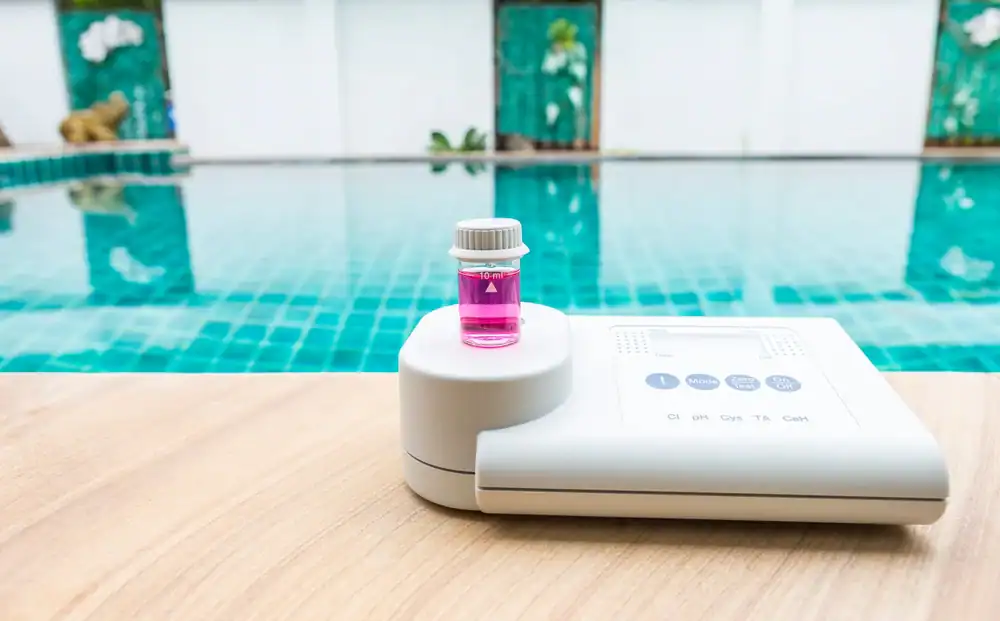
It starts with a full digital water analysis not test strips, not a color-matching kit. Every key parameter gets measured precisely: free chlorine, total chlorine, pH, total alkalinity, calcium hardness, cyanuric acid, total dissolved solids, and metals. These aren’t rough estimates. They’re exact readings that show what’s happening in your water at a level that basic home tests simply can’t reach.
From there, we review the results in context. That means accounting for your source water especially relevant if your property runs on a private well, which is common across the rural stretches of Coffee County. It also means factoring in recent conditions: whether there’s been a heavy rain in the past few days, where we are in the season, and what the pollen load has looked like. South Georgia’s spring pollen season is intense, and a significant pollen event can shift your chemistry meaningfully within 24 to 48 hours. That context changes the correction plan.
Once the full picture is clear, you get a plain-English explanation of what’s off, what’s causing it, and exactly what needs to happen to fix it. No mystery chemicals, no vague recommendations. Just a specific plan you can act on and a clear understanding of why it will work.
Ready to get started?
Our full water analysis covers everything that affects how your pool looks, feels, and holds up over time. pH and total alkalinity are tested first, because they set the foundation for everything else. When pH climbs above 7.8 which happens quickly in the heat and sun exposure that Coffee County pools deal with all summer chlorine loses roughly half its sanitizing power even when the reading looks normal. That’s the reason pools go green after a week of “balanced” chemistry. Getting pH right first is what makes everything else work.
Calcium hardness and total dissolved solids are measured to protect your pool’s surface. For gunite and shotcrete pools the type we build and service throughout the area these readings matter more than most owners realize. Water that’s too soft becomes corrosive and eats into the plaster finish. Water that’s too hard scales and stains. Cyanuric acid levels are also tested precisely, because high CYA from stabilized chlorine products is one of the most common and most misdiagnosed problems in South Georgia pools, and test strips can’t catch it accurately at elevated concentrations.
Metals are included in the analysis as well particularly important for Bushnell-area properties on well water, where iron or manganese in the source can cause surface staining if it’s not being managed. Every reading comes with a clear explanation and a correction plan built around your specific pool, not a generic checklist.
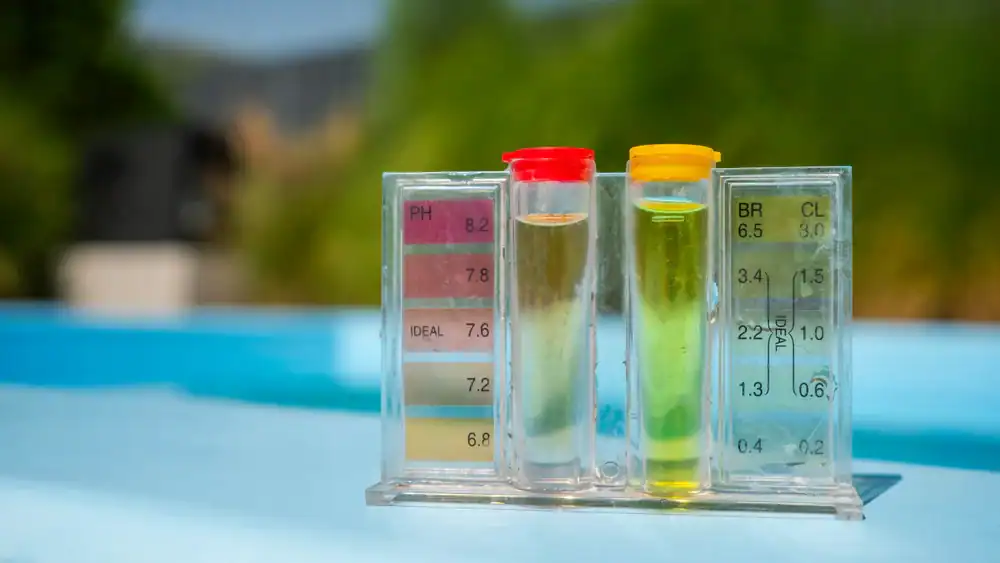
For most pools in Coffee County, a professional water test at least once a month during the active season is a reasonable baseline but the honest answer is that South Georgia’s conditions push that number higher than what people expect. When temperatures are consistently in the 90s from June through August, your chemistry can shift meaningfully in just a few days. Chlorine burns off faster in the heat, evaporation concentrates minerals, and algae can establish in under 48 hours if conditions are right.
Beyond the regular schedule, there are specific events that should trigger a test regardless of when you last checked: a significant thunderstorm, a heavy pollen drop, a period of unusually high bather load, or any time you notice the water starting to look off. Waiting for the next scheduled test after one of those events usually means you’re already behind. A professional test at the right moment is almost always cheaper than the treatment it prevents.
This is one of the most common frustrations pool owners bring to us, and it almost always comes down to one of two things: pH that’s too high, or cyanuric acid that’s built up to a level where chlorine can’t do its job effectively. When pH drifts above 7.8, chlorine’s sanitizing ability drops dramatically so even if your chlorine reading looks fine, it’s not actually working the way it should. You can add more chlorine all day and the problem won’t resolve until the pH is corrected first.
The cyanuric acid issue is trickier because it’s harder to catch without a precise test. CYA is added to stabilize chlorine against UV breakdown, which is genuinely necessary in South Georgia’s sun exposure. But if it accumulates over time which happens when you consistently use stabilized chlorine products it starts to suppress chlorine’s effectiveness even at normal concentrations. Test strips can’t accurately measure CYA at elevated levels, so you may have no idea it’s the problem. Our digital water analysis catches it immediately.
Yes, and it’s one of the most overlooked variables for rural properties in this area. A lot of homes in and around Bushnell draw from private wells, and the mineral content in that source water varies significantly from what you’d get on a municipal supply. Iron and manganese are common in South Georgia’s Lower Coastal Plain groundwater, and both can cause surface staining if they’re not being managed with the right sequestering agents. Calcium levels in well water also tend to be different from municipal water, which affects where your pool starts on the hardness scale before any chemicals are added.
The problem with most pool store water tests is that they only read what’s in the pool at that moment they don’t account for what your source water contributed. If you’re filling or topping off from a well with elevated iron, for example, and that’s not factored into the chemistry plan, you’ll keep chasing a staining problem without ever addressing the actual cause. Our professional analysis that considers your source water gives you a complete picture instead of just a snapshot.
Calcium hardness measures how much dissolved calcium is in your pool water, and it directly affects the long-term condition of your pool’s surface. The ideal range for most pools is between 200 and 400 parts per million, but the consequences of being outside that range are different depending on which direction you’ve drifted. Water that’s too low in calcium becomes aggressive it will actually pull calcium out of your plaster or grout to satisfy its own chemistry, which leads to pitting, roughness, and surface damage that’s expensive to repair. Water that’s too high deposits calcium as scale, leaving white mineral buildup on surfaces and inside equipment.
For gunite and shotcrete pools, which are the most common pool type built by quality contractors in South Georgia, calcium hardness management is especially important. These pools have a plaster finish that is directly affected by water chemistry in a way that fiberglass or vinyl pools are not. If you’re not monitoring calcium hardness regularly particularly during the summer when evaporation concentrates minerals you may not notice the damage until it’s already significant. Our professional test catches the drift before it becomes a repair.
More than most people expect. Coffee County’s landscape a mix of pine forest and agricultural land produces a heavy pollen load in the spring, and pine pollen in particular introduces organic nitrogen compounds into pool water that spike chlorine demand and can destabilize pH within a short window. A pool that tested perfectly balanced on a Monday can need meaningful chemistry correction by Wednesday after a significant pollen event, especially if the pool isn’t covered.
The practical issue is that most homeowners are testing on a fixed schedule rather than responding to conditions. If a heavy pollen drop happens two days after your last test, you’re going into the weekend with chemistry that’s already been compromised. Algae doesn’t wait. The best approach during peak pollen season typically March through May in South Georgia is to test more frequently and to check the water after any visible pollen accumulation on the surface, not just on your regular schedule.
Pool store testing is a retail tool, not a diagnostic one. Most stores offer free water testing because it generates chemical sales the test is designed to identify something to sell you, not necessarily to give you the most accurate picture of what your water actually needs. That’s not a knock on the people running the test; it’s just the business model. The result is that you often walk out with a bag of chemicals, add them, and find yourself back in the same store two weeks later with the same problem.
Our professional digital water analysis measures every parameter to a level of precision that color-matching tests can’t match, and the results come with a correction plan that’s built around your specific pool its surface type, its source water, its recent history, and the current conditions in your area. For Bushnell homeowners who have already spent a season buying chemicals that didn’t solve the problem, a professional test usually pays for itself on the first visit. Catching a chemistry issue early before it becomes a visible algae bloom or surface damage is consistently cheaper than treating it after the fact.