
Hear from Our Customers
When a pool is built correctly, you stop thinking about it. No cracks showing up in year three, no structural questions, no wondering whether the crew that poured the concrete actually knew what was under your yard. You just use it and in Unionville, where summer temperatures push past 90°F for months straight, that matters more than most people realize until they have one.
Unionville’s soil profile is something a lot of contractors don’t think about until it becomes your problem. The clay-influenced subsoils in this part of South Georgia expand when wet and contract when dry, and that cycle puts real pressure on a pool’s walls and floor over time. A pool engineered for what’s actually in the ground here not built off a generic spec sheet handles that movement without issue for decades.
The other thing a properly built pool gives you is a property that’s worth more. Pools in Georgia have been shown to add around 7% to residential home value. In a corridor where Tift County is actively investing in infrastructure the county just completed a $6.7 million water and sewer upgrade specifically for the Phillipsburg and Unionville area improving your property now is a forward-looking move, not just a lifestyle one.
We’re based out of Douglas, Georgia about 40 miles from Unionville and have been building custom gunite pools across Southeast Georgia for over a decade. Our founder brought 30 years of hands-on experience in concrete, plumbing, and pool construction into the business before the first pool was ever dug. That background isn’t a tagline it shows up in how the work actually gets done.
Every pool we build is handled by the same in-house crew from the first day of excavation through the final deck finish. No subcontractors, no handoffs, no strangers showing up on your Unionville property who’ve never seen the project. When something comes up mid-build and it always does you’re talking to the same people who started the job.
For Unionville homeowners specifically, that means a builder who knows Tift County’s permitting process, understands the soil conditions along the US 41 corridor, and has worked through the county building department on Tift Avenue before. That’s not something a franchise or a traveling crew brings to the table.
It starts before anything is dug. We do a site evaluation on your Unionville property first assessing your soil conditions, your yard’s layout, setback requirements, and anything else that affects how the pool gets built. This step exists because what’s in the ground on your specific lot determines how the pool needs to be engineered. Skipping it is how pools end up with problems five years in.
Once the site is assessed and the design is confirmed, we pull permits through the Tift County Building and Permits Department not the City of Tifton’s office, which only handles properties inside city limits. Unionville is unincorporated Tift County, and that distinction matters when it comes to which office handles your application. We manage all of it: building permit, electrical permit, and every required inspection. You don’t call a single county office.
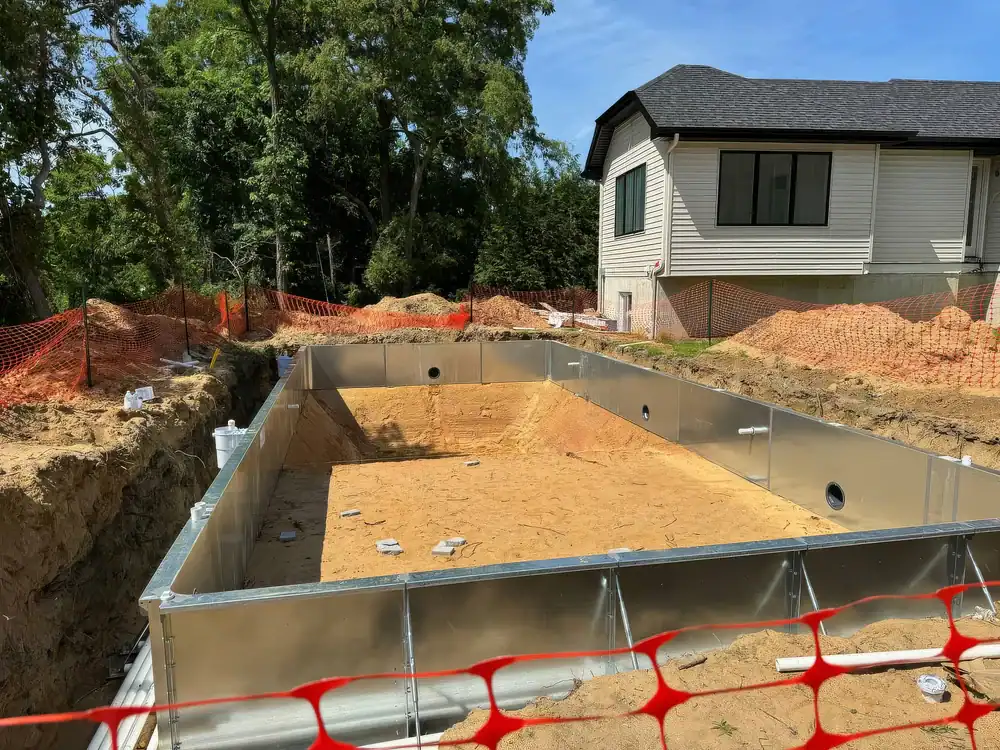
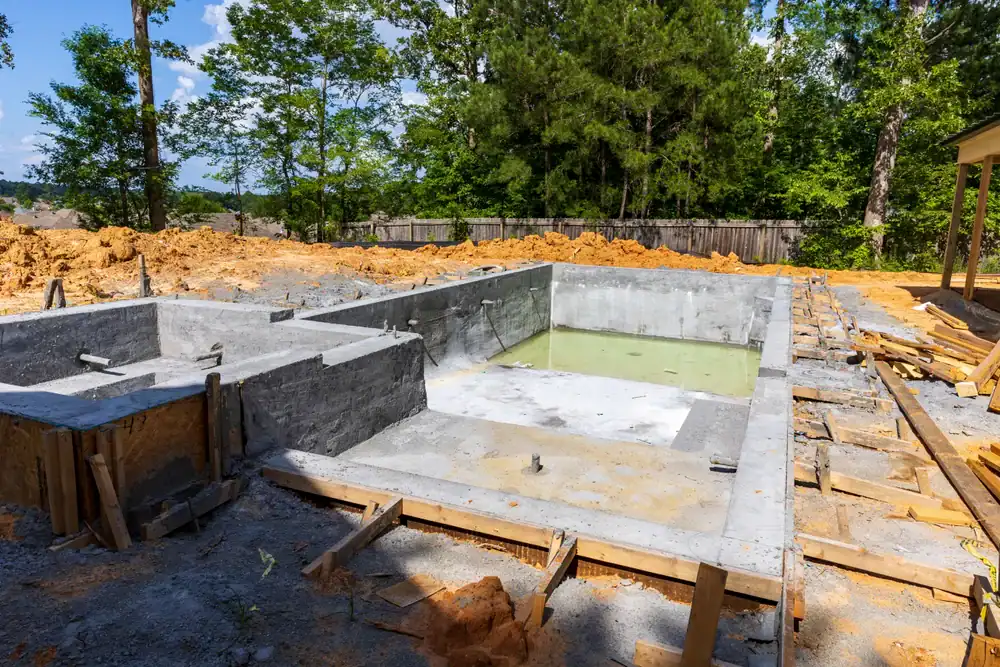
From there, we excavate, install the rebar cage, and schedule the mandatory Georgia rebar inspection before a single drop of gunite is applied. That inspection is a code requirement it exists because the rebar is the structural skeleton of your pool, and once it’s buried in concrete, no one can check it again. After the inspection is signed off, gunite goes in, the cure period runs its course, and then plumbing, electrical, and deck installation follow in sequence. South Georgia’s summer thunderstorm season heaviest from June through September can affect excavation and gunite scheduling, and we build that reality into the timeline honestly rather than promising a number that doesn’t hold up.
Ready to get started?
Every pool we build is gunite fully custom, built on-site from scratch to your dimensions. That means any shape, any depth, any footprint your yard allows. Unlike fiberglass shells that arrive in fixed factory sizes and force your yard to work around them, or vinyl liner pools that need the liner replaced every 10 to 15 years, a gunite pool is engineered specifically for your property and built to hold up for 30 years or more when done right.
What’s included in every build: the pre-excavation site evaluation, all Tift County permits and inspections, the full construction sequence handled by our in-house crew, pool plumbing, electrical work compliant with NEC Article 680 bonding and grounding requirements, pool deck installation, and a custom safety cover. Nothing in that list gets handed to a subcontractor. The same team that digs your yard finishes your deck.
For homeowners in Unionville and the Phillipsburg corridor, the county’s recent water and sewer infrastructure upgrades mean more reliable service for pool filling and long-term maintenance a practical detail worth knowing if you’ve had older utility infrastructure concerns in the area. And because we pull every permit in our own company name, the legal accountability for code compliance sits with us, not with you.
Because Unionville is an unincorporated community, your property falls under Tift County jurisdiction not the City of Tifton. That means your pool permit goes through the Tift County Building and Permits Department at 225 Tift Ave North in Tifton, not through the city’s building division. It’s a distinction that trips up a lot of first-time pool buyers in Unionville who call the wrong office and lose weeks waiting for a response that was never going to come.
Beyond the building permit, you’ll also need an electrical permit, and Georgia code requires a mandatory rebar inspection before gunite can be applied. There’s also a pool safety barrier requirement at minimum a 4-foot fence with self-closing, self-latching gates. We manage every step of this process in our company name, which means we take the legal responsibility for the work meeting code. You don’t track paperwork, schedule inspectors, or figure out which county office handles what.
A realistic timeline for a custom gunite pool in the Unionville and Tifton area runs roughly 10 to 16 weeks from permit approval to a finished, swim-ready pool. That includes the permitting window at the Tift County Building Department typically 2 to 8 weeks depending on current workload and 6 to 8 weeks of active construction once permits are in hand.
South Georgia’s summer storm season is a real variable in that timeline. Heavy rainfall from June through September can delay excavation when trench walls become unstable, and gunite can’t be applied in active rain without compromising the concrete’s structural integrity. If you want a pool ready for the April or May opening of swim season, starting the process in October through January gives you the most reliable runway.
The clay-influenced subsoils in Tift County’s Lower Coastal Plain expand when they absorb moisture and contract when they dry out. That cycle creates lateral pressure on a pool’s walls and floor, and it’s a cycle that happens every year. Fiberglass shells are manufactured off-site in fixed shapes and sizes they’re not engineered for the specific soil conditions on your property, and they can shift or pop under hydrostatic pressure if the ground conditions aren’t ideal.
Gunite is built on-site, from scratch, with a rebar cage and bond beam engineered specifically for what’s in your yard. The concrete is applied directly against the excavated earth, and when it cures fully about 28 days to full structural strength it becomes part of the ground rather than sitting on top of it. For a property in Unionville where the soil profile is what it is, that’s not a small distinction. It’s the difference between a pool that performs for 30 years and one that starts showing structural stress in year four or five.
A custom gunite inground pool in the Unionville and Tifton area typically runs between $55,000 and $80,000 depending on size, shape, depth, and what’s included in the finish package. That range covers the full build excavation, rebar, gunite, plumbing, electrical, deck, and a custom safety cover. It does not include optional add-ons like water features, lighting upgrades, or specialty tile work, which are priced separately based on what you choose.
It’s a real investment, and it’s worth understanding what you’re getting for it. A gunite pool built correctly has a 30-plus year lifespan without major structural work. Vinyl liner pools require liner replacement every 10 to 15 years at a cost of $4,000 to $10,000 per replacement. Fiberglass pools have lower upfront costs in some cases but come with size and shape limitations that may not work for your yard. When you factor in the long-term cost of ownership and the roughly 7% increase in home value that pools add in Georgia, the math on a properly built gunite pool tends to hold up well.
Unionville’s swimming season runs from roughly April through October about seven months of genuinely usable pool weather. Summer temperatures in Tifton regularly exceed 90°F from June through August, and the humidity makes it feel considerably hotter than the thermometer reads. That’s not a brief summer window like you’d get in a northern state it’s more than half the year where a pool gets real, daily-use value for your family.
For a household with children, that seven-month season changes how your backyard functions entirely. It becomes the place people actually spend time, not just a yard you maintain. Compared to markets where a pool is usable for three or four months, the return on a pool investment in Unionville both in terms of lifestyle and property value is genuinely higher. The more important question is whether the pool gets built right.
In Georgia, any pool construction contract over $2,500 requires the contractor to hold a valid Georgia residential contractor license. The most direct way to verify this is to ask the contractor for their license number and look it up through the Georgia Secretary of State’s license verification portal. A legitimate contractor will give you that number without hesitation. One who deflects or gets vague about it is a contractor worth walking away from.
Beyond the license itself, the most telling sign of a contractor’s accountability is whose name the permit gets pulled in. When a builder pulls the permit in their own company name, they are legally responsible for the work meeting Georgia building code. If a contractor asks you to pull your own permit or if permits aren’t mentioned at all that’s a significant red flag. It means the legal accountability for code compliance shifts to you as the homeowner, and if something fails inspection or causes a problem down the line, you’re the one holding it. We pull every permit in our name, which is exactly how it should work.