
Hear from Our Customers
Out here in Coffee County, most properties have the space. What they don’t always have is a builder who understands what that space actually requires. The sandy loam and clay-heavy soils common around Lehigh and the surrounding unincorporated communities have specific drainage behavior that affects how a pool site gets prepared, how the shell gets engineered, and how the deck gets sloped. A builder without local experience might not catch that during a site visit. You end up with a pool that looks fine at first and causes headaches by year three.
South Georgia’s swim season runs from roughly April through October sometimes longer. That’s just the reality of living in the Wiregrass. A well-built gunite pool here isn’t a warm-weather luxury. It’s something your family will use more often than almost any other improvement you make to your property. The question isn’t really whether a pool makes sense. It’s whether the one you build will still be performing the way it should twenty-five years from now.
Gunite construction lasts. Done right, you’re looking at thirty-plus years without the liner replacements that vinyl pools demand every eight to twelve years, and without the structural limitations that come with fiberglass. It’s a permanent addition to your land and in a warm-climate market like South Georgia, it adds real, measurable value to your property when it comes time to sell.
We’re based in Douglas the county seat of Coffee County, right down the road from Lehigh. That matters more than it might sound. When something comes up after your pool is finished, you’re not tracking down a company that drove in from Valdosta or Tifton. You’re calling a neighbor. One whose reputation in this county depends on every project we complete here.
Our founder has over thirty years of hands-on pool construction experience in South Georgia. We started Deep Waters Pools in 2014 specifically because we’d spent too many years watching families in this region get burned contractors who took deposits, disappeared, or delivered work that didn’t hold up. That’s not a backstory invented for marketing. It’s the reason we exist.
Every project we take on is managed by the same team from site evaluation through final inspection. No rotating subcontractors. No one passing the blame when something needs to be addressed. One crew, one contract, and one number to call.
It starts with a site visit before any money changes hands. On a rural Coffee County property, that step carries more weight than it does on a standard suburban lot. Drainage patterns, soil conditions, utility locations, equipment access across uneven terrain these are things that need to be assessed before a design gets drawn, not after the excavator arrives. You’ll know exactly what you’re working with before you sign anything.
Once the design is finalized and the build agreement is signed, we pull every permit required by Coffee County’s building department. Because Lehigh is an unincorporated community, all permitting runs through the county not a city office. That process includes the building permit, electrical permit, and coordination of inspections at each required phase. You don’t navigate any of that. It’s handled in-house, in the right order, so nothing stalls mid-build waiting on paperwork.
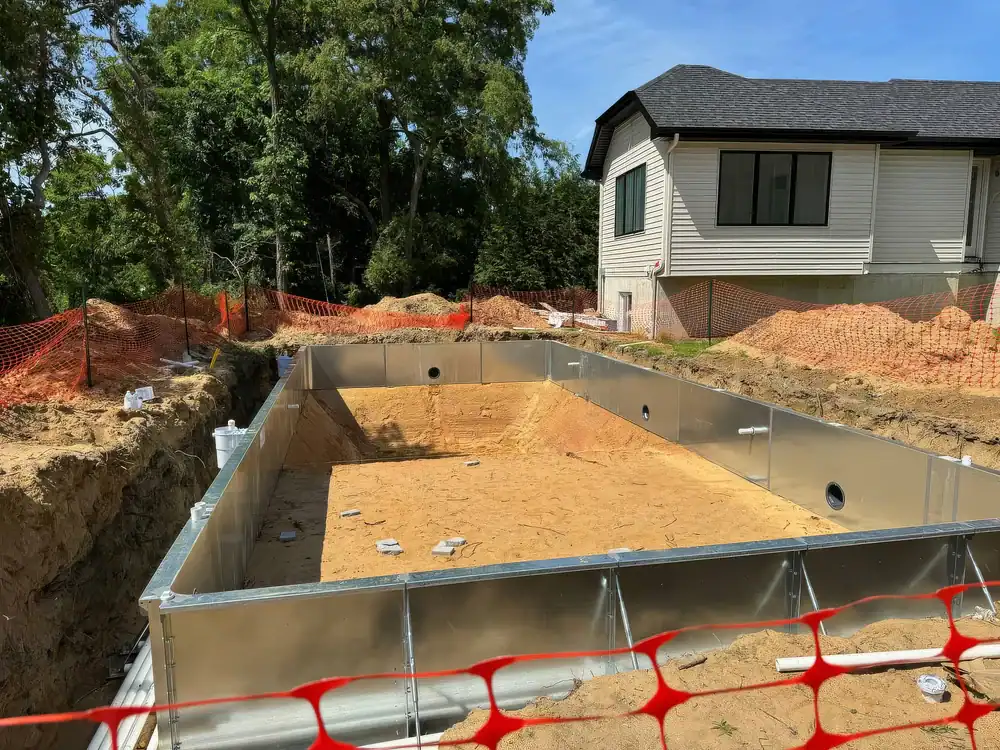
Construction itself follows a clear sequence: excavation typically takes one to three days, gunite application runs one to two days, plumbing and electrical work concurrently over one to two weeks, and decking takes three to five days. Because the same team manages every phase, the handoffs are clean and the schedule holds. A standard residential build runs six to eight weeks from excavation to water and that timeline is achievable because there’s no subcontractor coordination to wait on.
Ready to get started?
We handle the full scope of residential pool construction gunite shell, swimming pool plumbing, electrical, and pool deck installation under one roof, with one crew. There’s no point in the process where your project gets handed off to someone who wasn’t part of the conversation from the start.
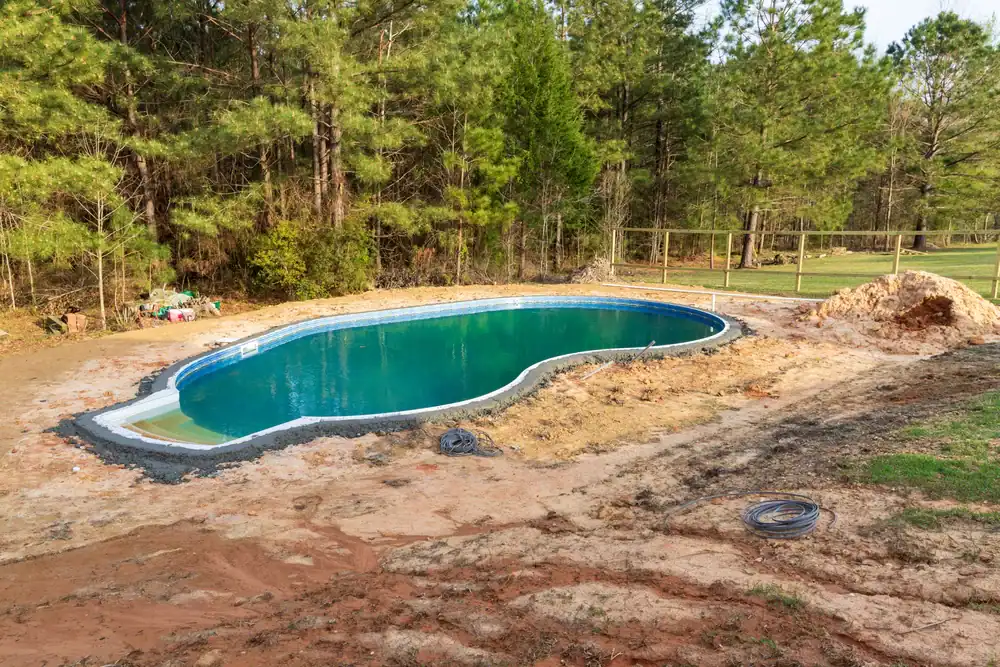
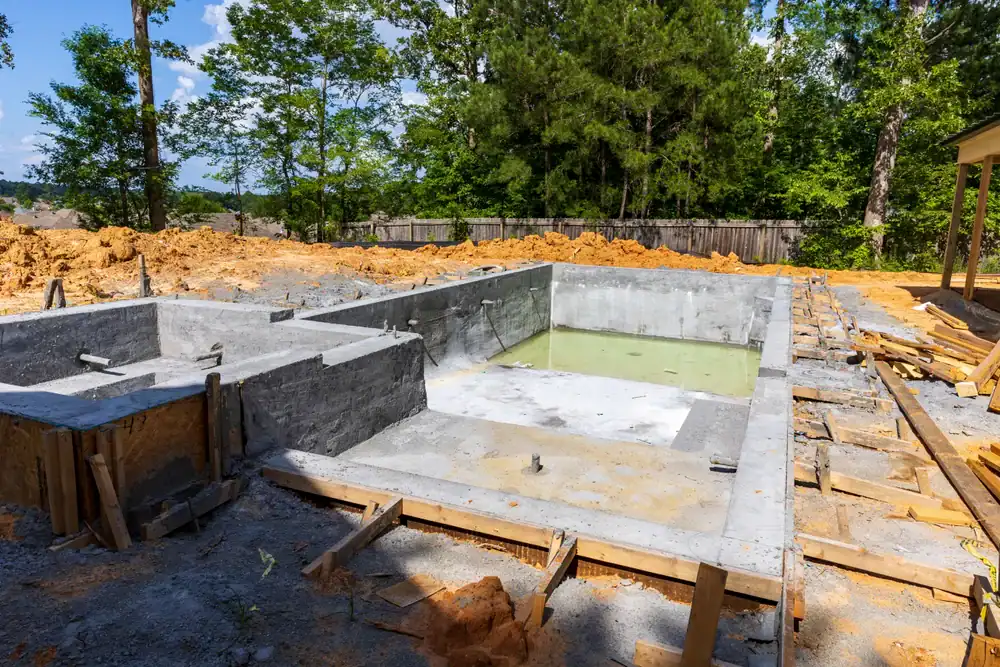
The gunite build process is what separates a pool that lasts from one that doesn’t. Once excavation is complete, a steel rebar framework is assembled and gunite a high-strength concrete mixture is pneumatically applied to form the shell. This isn’t a prefabricated product dropped into a hole. It’s constructed on your specific Coffee County property, shaped to your yard, your slope, and your drainage conditions. Swimming pool plumbing is then run through the shell before the interior finish is applied, and all electrical work is installed and bonded to meet NEC Article 680 requirements which Georgia enforces on every permitted residential pool.
Pool deck installation is the final major phase before water goes in. On rural properties around Lehigh, deck design often needs to account for grade changes, equipment access, and drainage away from the structure details that matter more on acreage than they do in a subdivision. Whether you’re looking at brushed concrete, pavers, or a combination, the deck gets designed for how you’ll actually use the space, not just how it photographs. Final inspection through Coffee County is completed before the pool is filled, so you’re not just getting a finished pool you’re getting one that’s fully documented and code-compliant.
Yes and because Lehigh is an unincorporated community in Coffee County, all permitting runs through Coffee County’s building department rather than any city office. That includes a building permit before excavation begins, a separate electrical permit for all pool wiring, and a series of inspections at specific phases of construction. Georgia state law also requires barrier fencing around all residential pools, which applies in unincorporated Coffee County the same as anywhere else in the state.
The Virginia Graeme Baker Pool and Spa Safety Act adds a federal layer anti-entrapment drain covers are required on all new residential pool construction nationwide. We manage every permit, every inspection, and every compliance requirement in-house as a standard part of every build. You don’t have to figure out which county office to call or what order the inspections need to happen in. That’s handled before our crew ever shows up.
Gunite pool construction in the South Georgia market including Coffee County and the Lehigh area typically runs between $55,000 and $100,000 for a standard residential build. Custom designs, larger footprints, elevated decking, water features, or significant site preparation needs can push projects above $150,000.
What drives cost in this area specifically is often site preparation. Rural properties around Lehigh tend to have more variables than a standard suburban lot drainage conditions, distance from utilities, equipment access across uneven terrain, and soil composition all factor into what excavation and prep actually cost. That’s why a site visit before any design work happens isn’t optional. It’s how you get a quote that reflects your actual property, not a number pulled from a brochure. We provide detailed, itemized quotes so you know exactly what you’re paying for before you commit to anything.
For a standard residential gunite pool, we build on a six-to-eight week timeline from excavation to water. That timeline covers excavation (one to three days), gunite application (one to two days), plumbing and electrical (one to two weeks, running concurrently), interior finish, and deck installation (three to five days), followed by final inspection through Coffee County before the pool is filled.
The reason that timeline is achievable is straightforward: one team manages every phase. There’s no waiting on a separate excavation subcontractor to free up, no scheduling a different plumbing crew, no gap between the shell work and the deck work while someone coordinates handoffs. In South Georgia, where the build season is long and weather delays are usually limited to brief summer thunderstorms, a well-managed build moves consistently from one phase to the next. Permit timing is the one variable that can add days to the front end, which is why we submit permit applications as early in the process as possible.
The short answer: gunite is built on your property, fiberglass is manufactured somewhere else and installed in one piece. That distinction matters more on a rural Coffee County property than it does in a standard subdivision.
Fiberglass pools come in fixed shapes and sizes. If your yard has a specific slope, an irregular shape, or site conditions that don’t line up with a prefabricated shell, your design options are limited by what’s available. Gunite is constructed in place the shell is formed around a steel rebar framework and pneumatically applied on your specific site, which means it can be shaped to fit your property rather than the other way around. It also lasts longer. Gunite pools have a thirty-plus year lifespan with proper maintenance. Fiberglass pools typically run fifteen to twenty-five years before major repairs become necessary, and vinyl liner pools need liner replacement every eight to twelve years at a cost of three to five thousand dollars per replacement. For a property you’re building on for the long term, the math on gunite is straightforward.
Yes and this is one of the areas where local experience makes a real difference. The sandy loam and clay-heavy soils common in Coffee County behave differently than what you’d find in a suburban market, and some areas of South Georgia have water table conditions that affect how excavation and site preparation need to be approached. A builder without experience in this specific region may not identify those conditions during a site visit, which can lead to drainage problems, settling, or structural issues after construction is complete.
We evaluate every site before any design work begins. That means looking at drainage patterns across your property, assessing soil conditions, identifying where utilities run, and figuring out equipment access all before a shovel goes in the ground. If there are site-specific challenges, you’ll know about them upfront, along with what it takes to address them properly. There are no surprises mid-build because the evaluation was done right the first time.
The basics first: any pool contractor working in Georgia should be able to show you proof of a valid state contractor’s license and current general liability and workers’ compensation insurance. Ask for both before any conversation about design or pricing gets serious. If a contractor hesitates on either, that tells you something important.
Beyond credentials, pay attention to how the process is structured. Does the company manage permits in-house, or are they expecting you to figure that out? Do they use a consistent crew, or are they assembling subcontractors for each phase? Can they give you a specific build timeline with a clear explanation of how they achieve it? In a rural area like Coffee County, where your options are more limited than they’d be in a larger city, these questions matter more not less. If a project stalls mid-build or something goes wrong and there’s no single accountable party, you’re in a difficult position. The structure of how a builder operates tells you more about what your experience will be like than any sales pitch will.