
Hear from Our Customers
Most pool problems don’t start with something you can see. The water looks fine. Maybe it’s a little cloudy, maybe it’s not but underneath the surface, pH is drifting, chlorine is burning off faster than you can add it, and calcium is either scaling your finish or quietly eating through it. By the time you notice, the problem is already expensive.
Out here near the Irwin County line where Ambrose sits, your pool is dealing with conditions that suburban pools in bigger cities don’t face the same way. The open fields, timber operations, and agricultural land surrounding Ambrose mean heavier pollen loads and more airborne organic debris landing in your water and every bit of it spikes your chlorine demand. Add in the afternoon thunderstorms that roll through Coffee County almost daily in July and August, and your chemistry can swing hard within 24 hours of a test that looked perfectly balanced.
Then there’s the water itself. The Floridan Aquifer that supplies this area is limestone-rich, which means the water you’re filling your pool with already carries calcium and magnesium before you add a single chemical. Without regular calcium hardness testing, that mineral content either scales your pool’s finish or if the balance tips the other way starts pulling calcium directly out of the plaster. Professional water testing catches all of this. Not eventually. Before it costs you.
We’re based in Douglas, about 12 miles east of Ambrose on the SR 32 corridor the same road most Ambrose residents already travel for work, errands, and everything else. That proximity isn’t a coincidence. This is the community we operate in, and Ambrose’s water, weather, and pool conditions aren’t abstract to us. We work in them every week.
Our team brings more than 30 years of hands-on experience in concrete, plumbing, and pool construction. That background matters for water testing specifically because we understand what happens at the surface level when chemistry goes wrong not just in theory, but in the actual gunite and shotcrete pools we’ve built and maintained across this region. We’re not a pool store running a free test to sell you a cart full of chemicals. We test accurately, explain what we find in plain language, and tell you exactly what your water needs nothing more.
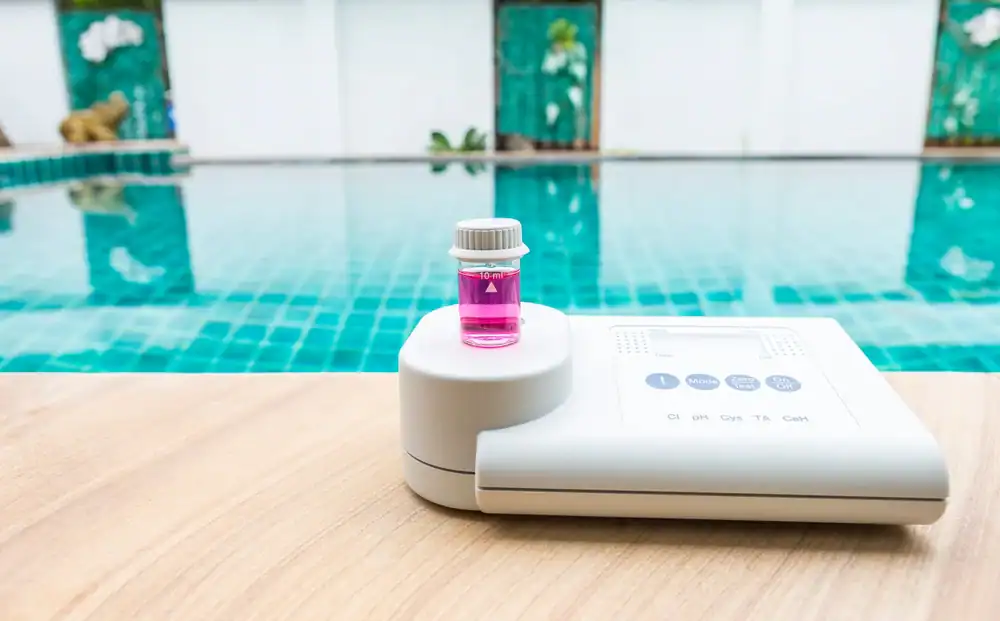
It starts with a water sample either brought in to us in Douglas or collected on-site, depending on your situation. From there, we run it through advanced digital analysis equipment that measures every major parameter with precision: free chlorine, total chlorine, pH, total alkalinity, calcium hardness, cyanuric acid (CYA), total dissolved solids, and metals including iron and copper. This isn’t a color-matching test strip. It’s the same level of analysis used by certified operators managing commercial pool facilities, and it gives us numbers accurate to multiple decimal points.
Once we have your results, we walk you through them parameter by parameter, in plain language. If your CYA is saturated from years of stabilized chlorine, we’ll tell you what that means and what to do about it. If your calcium hardness is low enough that your water is becoming aggressive toward the plaster surface, we’ll flag it before it causes visible damage. If everything looks good, we’ll tell you that too.
Given South Georgia’s extended pool season which runs from roughly April through October in this climate we’d recommend testing at the start of the season, after any significant storm event, and at least once mid-summer when heat and UV exposure are doing the most damage to your water balance. For Ambrose pool owners who don’t have a service company checking in regularly, that schedule keeps small problems from turning into expensive ones.
Ready to get started?
When we test your water, we’re looking at the full picture not just chlorine and pH. Free chlorine tells you what’s actively sanitizing your water. Total chlorine includes the combined chlorine (chloramines) that cause eye irritation and that familiar “pool smell” a sign that your sanitizer is exhausted, not that your pool is clean. pH level balancing matters because even a small drift above 7.8 cuts your chlorine’s effectiveness roughly in half, even when the reading looks normal. Total alkalinity is what keeps pH stable between tests, so if your pH keeps bouncing around, alkalinity is usually the root cause.
Calcium hardness testing is especially relevant for pools in the Coffee County area. Because the local water supply draws from the Floridan Aquifer a limestone-rich source fill water already carries mineral content before any pool chemicals are added. We check calcium hardness every time because the consequences of getting it wrong go in both directions: too high and you get white scaling on the finish and clogged equipment; too low and the water turns aggressive, leaching calcium directly out of the plaster surface. Cyanuric acid (CYA) testing rounds out the picture by confirming whether your chlorine is protected from UV breakdown critical in a climate where South Georgia’s summer sun can burn through unprotected chlorine in under two hours.
If you have a saltwater pool, we also check salt levels and TDS. If you’re on well water or have an older pool that’s never had a full chemistry workup, we’ll look at metals too. The goal is a complete, accurate baseline not a partial answer that leaves the real problem undiagnosed.
This is one of the most common calls we get from pool owners in Coffee County, and the answer almost always comes down to the same chain of events. When a significant rainstorm hits Ambrose, it dilutes your pool’s chemicals chlorine drops, pH drops with it, and alkalinity shifts. That combination creates the exact environment algae needs to take hold. In South Georgia’s summer heat, algae can go from invisible to visibly green in less than 48 hours once conditions are right.
The deeper issue is that most homeowners don’t test after every storm they test on a schedule, or when the water looks off. By then, the algae is already established and you’re looking at shock treatments, brushing, and potentially multiple service visits to clear it. Professional water testing after significant rain events catches the chemistry shift before it becomes a bloom. If your pool is turning green on a regular basis after summer storms, there’s also a good chance your cyanuric acid levels are off, which affects how well your chlorine holds up between tests in the first place.
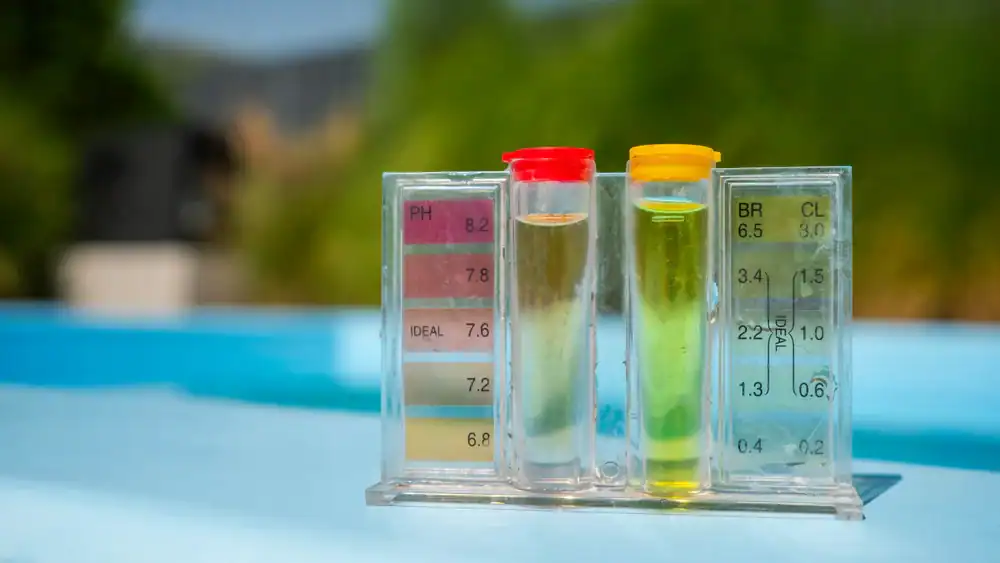
Test strips give you a rough estimate they’re designed for a quick check, not a precise diagnosis. The core problem is that they can’t accurately measure cyanuric acid levels above about 50 ppm, which is a condition that’s extremely common in pools that have been using stabilized chlorine for several seasons. They also can’t detect combined chlorine (chloramines) separately from free chlorine, so they’ll show a “good” chlorine reading even when your sanitizer is essentially used up. And they’re notoriously unreliable in direct sunlight which is exactly when most people are testing.
Professional digital water analysis measures every parameter to precise decimal-point accuracy. That level of detail matters because pool chemistry isn’t a single number it’s a system where each parameter affects the others. A pH that looks fine on a strip might be sitting at 7.9, which cuts your chlorine’s effectiveness nearly in half. A calcium hardness reading that looks “okay” might be low enough that your water is slowly etching the plaster surface. Strips can’t tell you that. A professional test can and does.
The water supply in the Douglas and Coffee County area including Ambrose draws from the Floridan Aquifer, which is a limestone-rich underground source. That means the fill water you’re adding to your pool already carries calcium and magnesium roughly 6 grains per gallon of hardness and around 178 parts per million of total dissolved solids before any pool chemicals enter the picture. For most pools, that’s a manageable starting point, but it accumulates over time.
The practical effect is that calcium hardness tends to climb in local pools, especially as water evaporates during South Georgia’s long, hot summers and gets replaced with more mineral-carrying fill water. If that buildup isn’t monitored and managed, you’ll eventually see white scaling on the pool finish, cloudy water, and clogged filtration equipment. On the other side, if you’ve done a significant water change or dilution and calcium drops too low, the water becomes chemically aggressive and starts pulling calcium out of the plaster itself. Regular calcium hardness testing is the only way to stay ahead of both problems and it’s something we check every time we test.
Georgia’s Department of Public Health requires commercial pool operators to test chlorine and pH at least twice daily which gives you a sense of how quickly chemistry can shift in this climate. For a private residential pool in Ambrose, you don’t need to test twice a day, but you do need to test more often than most homeowners think.
At a minimum, a full professional water analysis at the start of the season (March or early April), once during peak summer (late June or July), and before closing in the fall gives you three solid checkpoints across the year. Beyond that schedule, you should test after any significant storm event which in Coffee County during summer means fairly often and any time your water looks off: cloudy, slightly green, or if swimmers are complaining about eye or skin irritation. That last one is usually a sign of combined chlorine buildup, which a test strip won’t catch but a professional analysis will. The goal isn’t to test constantly it’s to test at the right moments so small chemistry shifts don’t compound into real problems.
Clear water and safe water aren’t the same thing, and this is one of the clearest examples of why. Eye and skin irritation in a pool that looks clean is almost always caused by combined chlorine also called chloramines. These form when free chlorine reacts with organic material in the water: sweat, sunscreen, body oils, and the heavy pollen and organic debris that land in outdoor pools, especially in a rural setting like Ambrose where there’s more airborne material than you’d find in a suburban neighborhood.
Chloramines don’t sanitize. They’re the byproduct of chlorine that’s already been used up, and they’re what cause the “pool smell” and the burning eyes. The fix isn’t adding more chlorine it’s breakpoint chlorination, which requires knowing your exact combined chlorine level first. A basic test strip shows you total chlorine but can’t separate free chlorine from combined chlorine accurately enough to diagnose this. A professional water test gives you both numbers precisely, so you know exactly what you’re dealing with and exactly what correction is needed rather than guessing and potentially making the irritation worse.
“Seems fine” is where most pool surface damage and equipment problems start. The chemistry conditions that cause the most expensive damage low calcium hardness etching plaster, high CYA reducing chlorine effectiveness to near zero, rising TDS making water increasingly difficult to balance are all invisible until they’ve been working on your pool for a while. By the time the finish looks rough, the equipment is struggling, or the water won’t hold a balance no matter what you add, you’re already past the point where a water test is cheap insurance.
For Ambrose homeowners specifically, there’s also the reality that this community doesn’t have a local pool supply store or a competitor offering walk-in testing. We’re 12 miles east on SR 32 genuinely close but without making that trip or scheduling a service call, many residents go extended periods between professional checks. In South Georgia’s climate, with the pollen loads, the storm frequency, and the mineral content already in the local water supply, that gap adds up. A professional test once or twice a season catches the slow-moving problems that “fine-looking” water is hiding and the cost of catching them early is a fraction of what correcting them late looks like.