
Hear from Our Customers
When your water is properly balanced, your pool stays clear, your equipment lasts longer, and you stop throwing money at chemicals that aren’t fixing the real problem. That’s the straightforward version. The longer version matters more if you’re out here in Coffee County running a pool off a private well.
Well water in this part of South Georgia can carry iron, calcium, and other minerals that shift your pool chemistry from the moment you fill it. When those levels aren’t accounted for, you end up with rust-colored staining on your plaster, cloudy water that won’t clear up, and chlorine that burns through faster than it should. None of that shows up on a basic test strip but it shows up on your pool surface and in your wallet.
Then there’s the summer. Between the UV intensity, the heat, and the thunderstorms rolling through June to September, your chemistry can swing from balanced to problematic within 48 hours. Pine pollen off the trees surrounding most properties out here doesn’t help either it drops pH and spikes chlorine demand fast. Professional water testing catches those shifts early, before they turn into a green pool or a staining problem that costs real money to fix.
We’re based in Douglas, GA right down US 441 from Sapps Still. We’re not a franchise routing your call through a regional office. When you reach out, you’re talking to the same team that will show up at your pool.
Our background isn’t just pool service it’s pool construction. Over 30 years of building gunite and shotcrete pools in South Georgia, including throughout the Sapps Still and Coffee County area, gives us a different lens on water chemistry than a company that only handles maintenance. We understand what corrosive water does to a plaster finish, what scaling does to a filter, and why the chemistry requirements for a well-fed pool in rural Coffee County aren’t the same as what the generic guides describe.
We’ve been testing, balancing, and servicing pools for homeowners across this part of the state for years. If your pool is giving you trouble and you haven’t been able to figure out why, there’s a good chance the answer is in the water and we can find it.
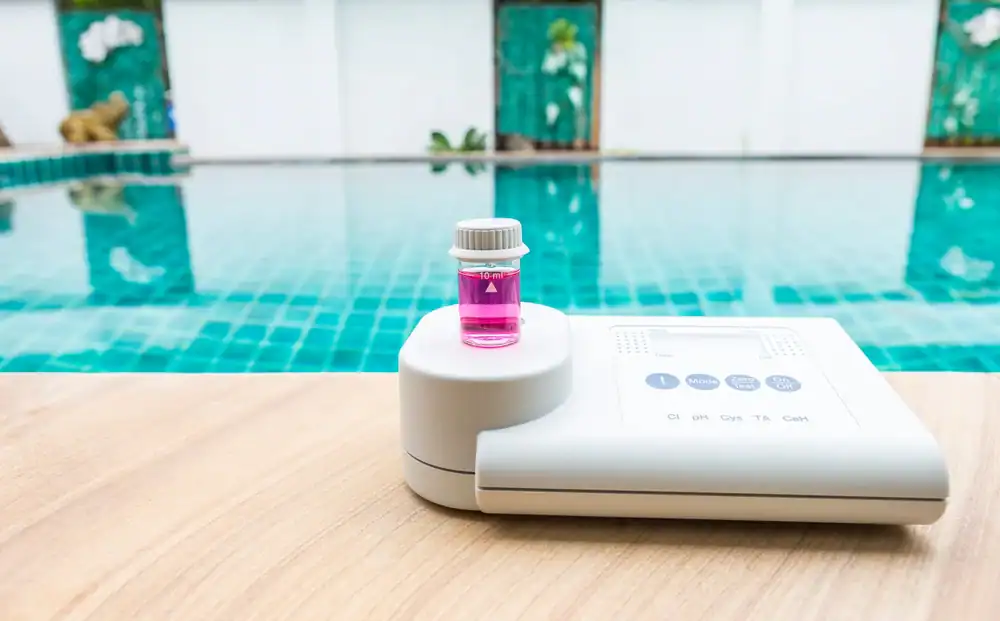
It starts with a full digital water analysis not a strip test, not a color match. We test for all the parameters that actually matter: pH, total alkalinity, calcium hardness, chlorine levels (both free and combined), cyanuric acid, and metals including iron. For a pool owner in Sapps Still running off a private well, that metals test alone can tell you more about what’s been happening in your pool than months of strip testing ever would.
Once we have your full reading, we walk you through what’s off and why. Not a list of products an actual explanation. If your iron levels are elevated from well water, we tell you what that means for your surface and what needs to happen to address it. If your CYA is maxed out from months of stabilized chlorine tablets, we explain why your chlorine stopped working and what the fix looks like. You get a clear picture, not a guess.
From there, we make the corrections on-site or give you a specific plan based on what your pool needs. Given how fast South Georgia’s summer heat and storm activity can shift chemistry, we’ll also talk through a realistic testing schedule so you’re not caught off guard mid-season. The goal is for you to leave that appointment actually understanding your pool not just hoping it clears up.
Ready to get started?
A professional water test from us covers the full picture. pH level balancing is where most problems start well water in Coffee County doesn’t come with a predictable baseline, and even a small pH swing in either direction can make chlorine ineffective or start eating away at your pool’s finish. We test it precisely and correct it the same visit.
Total alkalinity is what keeps your pH stable between visits. Without it in the right range, your pH bounces around every time it rains, every time the wind drops pine needles in the water, every time you add chemicals. Calcium hardness testing tells us whether your water is aggressive meaning it’s pulling minerals out of your plaster or scaling, meaning it’s depositing calcium on your surfaces and inside your equipment. Both are destructive over time, and both are invisible until the damage is already done.
Chlorine levels get tested as both free chlorine and combined chlorine. Combined chlorine chloramines is what causes eye irritation and that sharp chemical smell. It also means your sanitizer isn’t working the way you think it is. Cyanuric acid stabilizer levels round out the analysis, which is especially critical in South Georgia’s direct summer sun where unprotected chlorine can burn off in a matter of hours. No named tiers, no upsell packages just a complete, honest read on your water and a clear path to fixing what’s actually wrong.
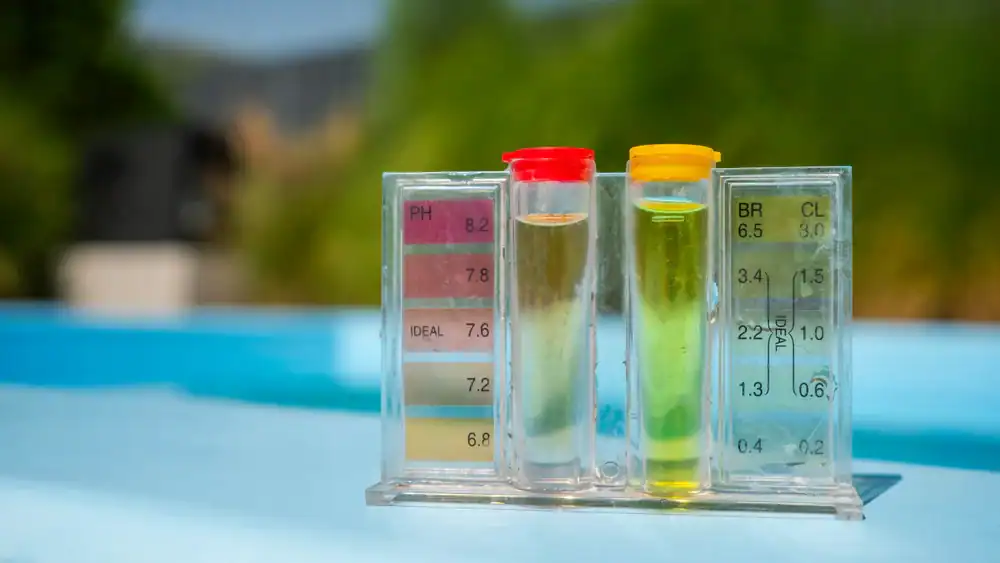
Yes and it’s one of the most common reasons pool owners out here struggle with chemistry that never seems to stay right. Municipal water goes through treatment before it reaches your tap, which means it has a relatively predictable mineral content. Well water doesn’t. Depending on how deep your well is and what layer of the aquifer it draws from, you could have elevated iron, high calcium, low calcium, or pH that’s completely different from your neighbor’s well a quarter mile down the road.
Iron is the big one in this part of Coffee County. It doesn’t show up in your water looking rusty it’s usually clear when it comes out of the ground. But once it hits a chlorinated pool and oxidizes, it turns brown and sticks to your plaster and tile. By the time you see the staining, it’s been depositing for weeks. A professional test that includes metal analysis catches this before it becomes a surface problem. It also tells us what sequestrant level you need to keep metals in solution and out of your finish.
At minimum, twice a season once at opening and once mid-summer. But honestly, if you’re in South Georgia and your pool is getting heavy use between June and August, a monthly professional test is worth it. The combination of UV intensity, heat, and frequent afternoon thunderstorms creates conditions where chemistry can shift faster than most homeowners expect.
A significant rainstorm dilutes your chemicals, drops your pH, and introduces whatever organic material was sitting on your surrounding landscape into the water. Out here near Sapps Still, that often means pine pollen, agricultural runoff, and debris from the tree line. Each of those adds to your chlorine demand and puts pressure on your pH. A strip test after a storm might read fine because it’s measuring the wrong things or reading them imprecisely. A professional digital test tells you what actually changed and what needs to be corrected before the problem compounds.
The most common reason is cyanuric acid the stabilizer that protects chlorine from UV breakdown. It sounds counterintuitive, but too much CYA actually makes chlorine ineffective. Once your stabilizer level gets too high, the chlorine gets locked up and can’t sanitize the water properly, even if your test strip shows a normal chlorine reading. This happens gradually over time as you add stabilized chlorine tablets.
In South Georgia’s summer sun, this problem gets worse fast. UV intensity out here is high enough that pool owners often compensate by adding more and more chlorine which adds more stabilizer which makes the chlorine less effective which leads to more adding. It’s a cycle that ends in a green pool that “shouldn’t” be green based on what the strip says. A professional test gives you an accurate CYA reading and tells you whether a partial drain and refill is needed to reset the balance. It’s a straightforward fix once you know that’s the problem.
Pool store testing is free because it’s designed to lead to a sale. The recommendations you get are filtered through what’s on their shelves that day. That’s not a criticism it’s just how the model works. The problem is that you might walk out with $150 worth of chemicals that address a symptom without fixing the underlying cause, and you’re back in two weeks with the same issue.
Our professional test is independent. We’re not selling you chemicals off a shelf we’re diagnosing your water and telling you what it actually needs. We use digital analysis equipment that measures all critical parameters with precision, including metals and combined chlorine, which most pool store tests don’t include. For a pool owner in Sapps Still who drove to get a “free” test and came home with products that didn’t solve the problem, the difference becomes pretty clear pretty fast. You’re paying for a diagnosis, not a sales visit.
It can, and it does more often than most people realize until the damage is already visible. Low pH combined with low calcium hardness makes your water chemically aggressive. It starts pulling minerals out of whatever surface it’s in contact with your plaster, your grout, your pump seals, your heat exchanger if you have one. Gunite and shotcrete pools, which are the most common inground pool type in South Georgia, are particularly vulnerable to this because the plaster finish is the first thing aggressive water attacks.
On the other side, high pH and high calcium hardness causes scaling calcium carbonate deposits that coat your filter media, build up on your tile line, and clog your equipment over time. Neither condition is dramatic in the early stages. Both are caught easily with professional testing. By the time you can see etching on your plaster or a heavy calcium line on your waterline tile, you’re already looking at a resurfacing or acid wash costs that run into the thousands. A water test is a fraction of that, and it’s the only thing that catches these problems before they become expensive.
Honestly, most of the time you don’t not until something goes visibly wrong. Total alkalinity problems usually show up as pH that won’t hold. You adjust it, it looks fine, and within a day or two it’s drifted again. That’s alkalinity doing its job poorly. Low alkalinity means your pH is unstable and vulnerable to anything that hits the water rain, pollen, bather load, chemicals. In the Sapps Still area where summer storms are frequent and pine trees are everywhere, that instability shows up fast.
Calcium hardness issues are even harder to spot early. Water that’s too soft looks perfectly clear. It’s quietly etching your plaster and corroding metal components while you’re enjoying the pool. Water that’s too hard looks fine too until you notice the white haze on your tile or the rough texture developing on your pool walls. By then, the scaling has been building for a while. A digital water test gives you the actual numbers on both parameters so you’re not guessing based on how the water looks. Clear water isn’t always safe water, and in South Georgia’s climate, the gap between “looks fine” and “needs attention” closes faster than most people expect.
Other Services we provide in Sapps Still