Trying to decide between a gunite and vinyl pool in Coffee County? Here's what actually matters before you commit to either.
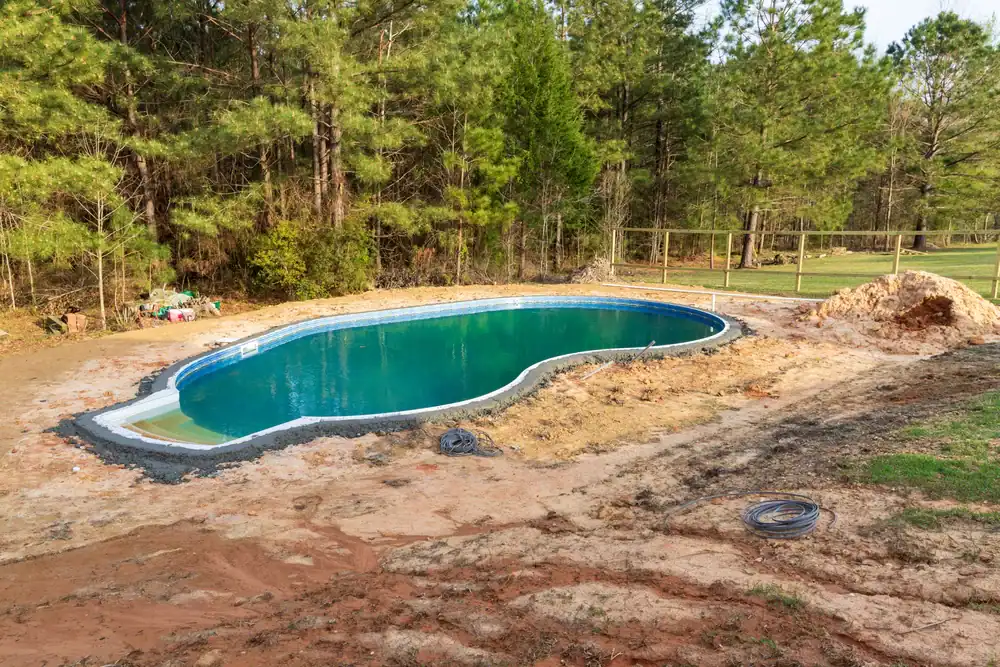
You’ve decided you want a pool. Now comes the part nobody warns you about — figuring out which type is actually worth building. Gunite and vinyl liner pools are the two most common choices for inground pools in Georgia, and the difference between them goes a lot deeper than price. One is built to last generations. The other gets you in the water faster. Both have trade-offs worth understanding before you sign anything. If you’re in Coffee County or anywhere in South Georgia, there are some local factors that change this conversation — and we’ll get into all of it.
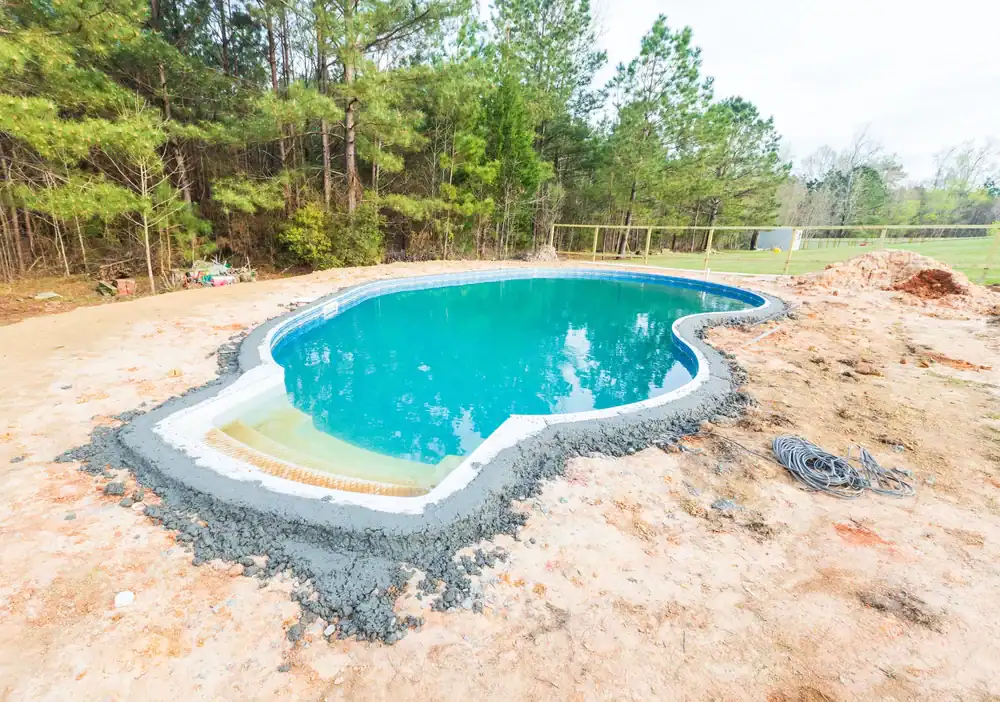
Gunite pools are built on-site from the ground up. A steel rebar framework is shaped to your exact specifications, then sprayed with a high-pressure mixture of concrete and sand — that’s the gunite. Once it cures, the interior is finished with plaster, quartz, pebble, or tile. The result is a seamless, custom shell that’s part of the ground itself.
Vinyl liner pools work differently. A steel or polymer frame is installed in the excavated hole, and a pre-made vinyl liner is stretched and fitted inside it. The liner is what holds the water. It’s faster to install and costs less upfront, but the liner itself is a consumable — it will eventually need to be replaced.
That core difference — a permanent structure versus a replaceable interior — is what drives almost every other trade-off between these two pool types.
Upfront, vinyl liner pools are cheaper. Most vinyl inground pools in Georgia run between $25,000 and $65,000 installed. Gunite pools typically start around $50,000 and can reach $150,000 or more for a fully custom build. That gap is real, and it’s the first thing most buyers see.
But here’s what the sticker price doesn’t show you: vinyl liners need to be replaced every seven to twelve years. A single liner replacement costs between $3,000 and $7,500 depending on the size and complexity of the pool. Over thirty years of ownership, that’s potentially $6,000 to $22,500 in liner costs alone — and that’s before you factor in any repairs from punctures, shifting, or installation issues.
Gunite pools do require maintenance too. You’ll want an acid wash every three to five years (roughly $300 to $1,000) and a full resurfacing every ten to fifteen years (around $8,000 to $10,000). But the structure itself doesn’t wear out. A well-built gunite pool can last fifty to one hundred years or more with proper care. The pool your kids swim in today could still be there when their kids are grown.
There’s also a southern-specific pricing factor that surprises a lot of buyers. Gunite pools are often more competitively priced in the South than buyers expect. Southern soil conditions generally require less steel reinforcement in concrete construction than northern markets, which keeps costs lower. Here in Coffee County, the sandy loam soil with clay subsoil layers actually works in your favor — it means the price gap between gunite and vinyl is narrower than it would be in northern states. That changes the math on which type actually makes more financial sense over time.
This one comes with a nuanced answer. Vinyl liner pools have a non-porous surface, which means they absorb less sanitizer and typically use about twenty-five percent less chlorine than gunite pools. On paper, that’s a maintenance advantage. In practice, though, the liner itself introduces a different kind of maintenance burden — one that has nothing to do with chemistry.
Vinyl liners can be punctured. A dog’s nail, a sharp pool toy, a piece of debris during a storm — any of these can cause a tear that requires patching or, in worse cases, full liner replacement. In Coffee County, where summer thunderstorms roll through regularly and outdoor living is a year-round reality, that fragility matters more than it might in a climate with shorter pool seasons.
Gunite pools require more chemical attention because the plaster surface is porous and can harbor algae if not properly maintained. Regular brushing and consistent chemical balancing are part of owning a gunite pool. Georgia’s humidity accelerates algae growth regardless of pool type, so staying on top of chemistry is important either way. The difference is that with gunite, you’re managing chemistry — not worrying about the structural integrity of a liner.
The swim season in Coffee County runs roughly from April through October, sometimes longer. That’s six to seven months of active use every year. A pool that gets that much use needs to be built for it. Gunite handles heavy, sustained use better than vinyl over the long run, which is one reason it remains the dominant choice for custom pools in warm-climate states like Georgia.
Want live answers?
Connect with a Deep Waters Pools expert for fast, friendly support.
The honest answer is that it depends on your timeline and priorities. If you want a pool this summer and budget is the primary concern, vinyl gets you there faster and for less money upfront. If you’re planning to stay in your home for ten, twenty, or thirty years — and you want a pool that looks like a permanent part of your property — gunite is almost always the better investment.
In Coffee County, a few local factors push that recommendation toward gunite pretty clearly. The soil here behaves differently than the red clay you’d find in North Georgia. We’ve been building pools in this specific geography long enough to know how to engineer for it. That local knowledge matters more than most buyers realize until something goes wrong with a builder who doesn’t have it.
One of the most common concerns we hear about gunite pools is cracking. It’s a legitimate concern — but it’s largely a northern climate problem. Concrete cracks when water gets into it and freezes, expanding and contracting with the seasons. That freeze-thaw cycle is brutal on concrete in states with hard winters.
Coffee County doesn’t have hard winters. We rarely see sustained freezing temperatures, and when we do, it’s brief. That means gunite pools here face almost none of the thermal stress that causes cracking in northern markets. The structural risk that makes buyers hesitate about concrete simply isn’t a significant factor in South Georgia’s climate.
What our climate does bring is heat, humidity, and summer rain. Afternoon thunderstorms are a regular part of life from June through August, and the humidity stays high well into fall. None of that is a problem for a properly built gunite pool — concrete handles wet, warm conditions well. It does mean that chemical management is an ongoing part of pool ownership here, and that’s true whether you build gunite or vinyl.
There’s also the design side of this. Coffee County has a lot of rural properties with generous lots — the kind of backyard where a standard rectangular pool feels like a missed opportunity. Gunite gives you complete design freedom: freeform shapes, varying depths, integrated spas, tanning ledges, waterfalls. Vinyl liner pools can be customized to a degree, but they work within limits that gunite simply doesn’t have. If your property has the space for something genuinely custom, gunite is the only pool type that can fully deliver on that.
A few questions come up in almost every conversation we have with homeowners in Douglas and the surrounding area. Here are the honest answers.
“How long will it take to build?” Gunite pools take longer — typically three to six months from contract to first swim, including permitting and curing time. Vinyl pools can be installed in four to eight weeks. If you want a pool by Memorial Day, the conversation needs to start in the fall or early winter. That’s not a limitation so much as a planning reality, and it’s one we walk every customer through upfront.
“Do I need permits in Coffee County?” Yes. Georgia requires permits for any inground pool construction, and Coffee County has its own review process — including septic approvals, safety barrier documentation, and inspection scheduling. We handle all of that. You won’t be left figuring out county paperwork on your own or finding out mid-project that something wasn’t filed correctly.
“Will a pool add value to my home?” In warm climates like ours, an inground pool can increase home value by five to seven percent. A gunite pool carries more perceived value at resale than a vinyl liner pool, partly because buyers know the liner will eventually need replacing. In a market like Coffee County — where the median property value sits around $125,700 — a well-built pool is a meaningful upgrade that improves both livability and long-term equity.
“Can I use a saltwater system with a gunite pool?” Yes, but it needs to be built with that in mind. Salt does accelerate wear on certain plaster finishes and metal components over time. A builder who knows what they’re doing will spec the right materials from the start so your saltwater system and your gunite pool work together for the long haul.
The pool type you choose matters. But who builds it matters just as much. A gunite pool built by someone who doesn’t understand South Georgia’s soil, permitting process, or drainage requirements is a liability, not an investment.
We’ve been building custom gunite pools in this area since 2014, backed by more than thirty years of hands-on experience in concrete, plumbing, and pool construction. We know Coffee County. We know what the ground does here, how the county permit process works, and what it takes to build something that’s still going to look great two decades from now.
If you’re trying to figure out which pool type makes sense for your property — or you’re ready to start talking specifics — reach out to us. We’ll give you a straight answer, not a sales pitch.
Summary:
Share: