Concrete pools are making a massive comeback in Coffee County, GA. Here's why homeowners are choosing gunite over fiberglass—and what it means for your backyard project.
You’ve probably heard the pitch: fiberglass is faster, easier, lower maintenance. For a while, that story dominated pool construction across Georgia. But something’s shifted in Coffee County, GA. Concrete pools—specifically gunite and shotcrete—are back, and they’re not just competing with fiberglass anymore. They’re winning.
The reason? Homeowners are realizing that speed isn’t everything when you’re investing $35,000 to $65,000 in a backyard feature that could outlast your mortgage. You want something built to last. Something that fits your yard, your vision, and most importantly, your soil. Concrete delivers on all three. Fiberglass compromises on at least two.
The comeback isn’t just about durability, though that’s a big part of it. It’s about design freedom, structural integrity in challenging soil conditions, and long-term pool value that actually holds up when you sell. Working with professionals experienced in pool construction ensures the structure is engineered correctly for local soil conditions and built to last.
If you’re considering pool construction in Coffee County, GA understanding why concrete is regaining market share will help you make a smarter decision for your property.
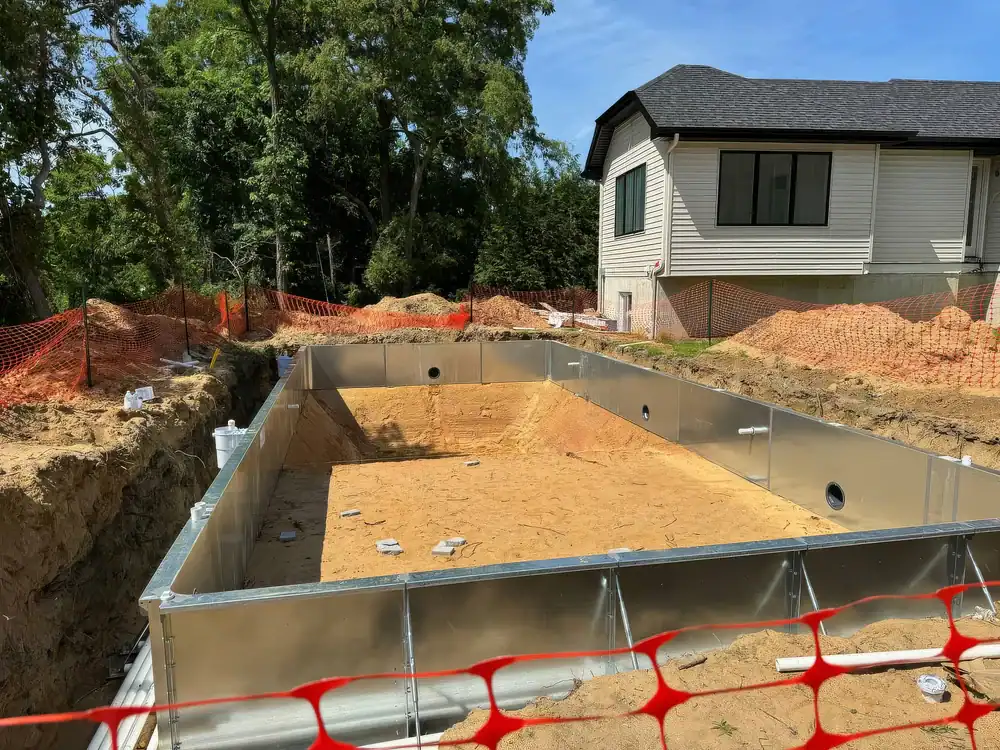
Concrete pools aren’t poured from a mold or dropped into a hole. They’re built on-site, layer by layer, using either gunite or shotcrete—two methods that both involve spraying a cement-and-sand mixture over a steel rebar framework.
Gunite uses a dry mix that gets combined with water at the nozzle. Shotcrete arrives pre-mixed and wet. Both create a solid, permanent structure that’s shaped to your exact specifications. No size limits. No shape restrictions. Just your yard, your design, your pool.
That’s the first reason concrete is experiencing this comeback. You’re not picking from a catalog. You’re building something that actually fits your property, not forcing your property to accommodate a pre-made shell.
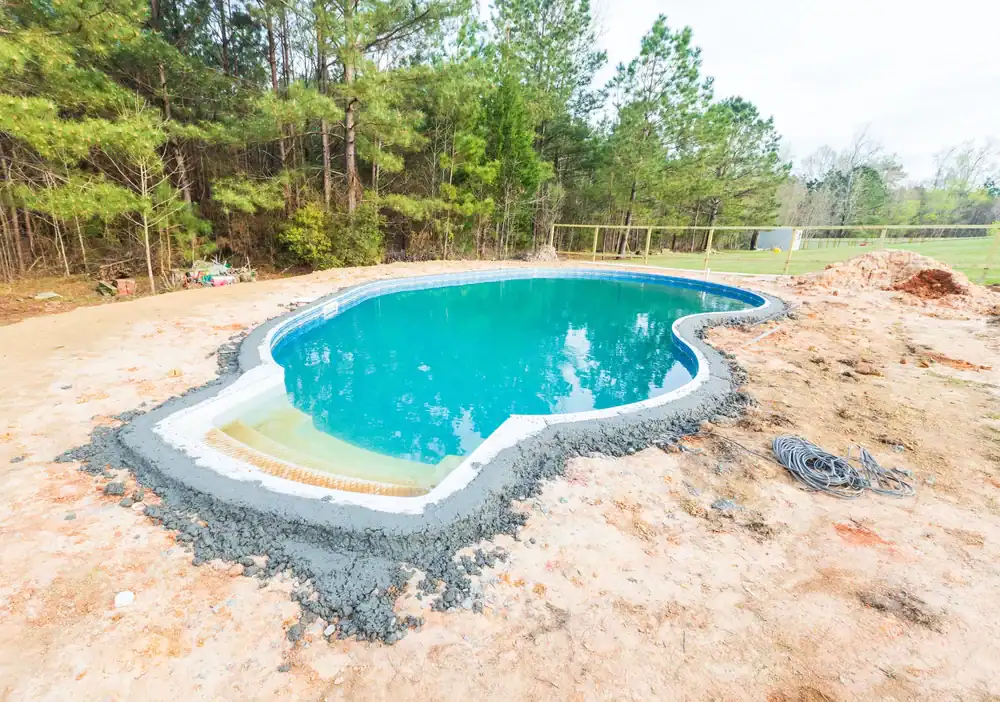
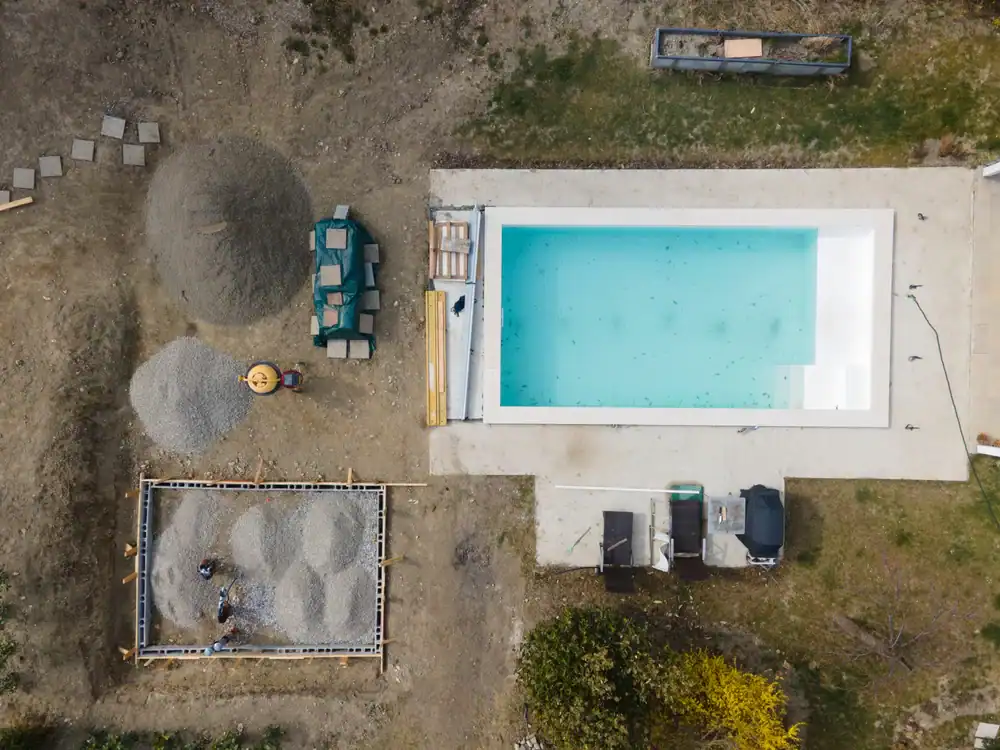
Understanding the process helps you see why concrete pools perform differently than fiberglass. Pool construction starts with excavation—digging out the exact shape you want, including every curve, depth change, and custom feature. Then comes the rebar framework, which acts as the skeleton. This steel structure is what gives your pool its strength and ability to withstand soil pressure for decades.
The concrete application happens next. With gunite, a dry mix travels through a hose and mixes with water right at the spray nozzle. The crew can stop and start as needed, adjusting water ratios for different areas. This flexibility allows for detailed work on steps, benches, and curves. Gunite tends to cost less than shotcrete and results in fewer errors because the nozzleman has complete control over consistency.
Shotcrete comes pre-mixed from the plant with precise ratios already established. It needs to be applied in one continuous session, which makes it faster but requires careful planning. You can’t pause once you start. The benefit is a very consistent surface with less rebound material. Both methods produce strong, watertight shells when done correctly by experienced crews.
After the concrete cures—usually 28 days in Georgia’s climate—the pool gets its finish. That might be plaster, pebble aggregate, or tile. Then comes the deck, equipment installation, and final touches. The whole process takes 8 to 12 weeks in Coffee County, GA, depending on weather, permits, and customization level.
Yes, it’s longer than fiberglass installation. But you’re not just installing a pool. You’re building a permanent structure engineered for your specific property conditions. That level of customization and structural integrity takes time. Rush it, and you’ll pay for it later in repairs and performance issues.
Most pool companies won’t lead with this, but it matters: Coffee County, GA sits in Georgia’s Piedmont region, which means red clay soil. That clay expands when wet and contracts when dry. It shifts. It moves. And it puts constant pressure on anything buried in your yard.
Fiberglass pools are rigid shells manufactured off-site. They can’t flex with soil movement. If the ground shifts, the shell can crack or, in extreme cases with high water tables, even pop out of the ground. It’s not common, but it happens—especially in areas with poorly compacted backfill or significant clay content.
Concrete pools are built in place, integrated with the surrounding soil through proper engineering and compaction. The rebar reinforcement allows the structure to handle both compression and tension forces from soil movement. When installed correctly with proper site preparation, concrete pools can adapt to minor ground shifts without structural damage.
This is exactly why concrete pools are recommended for Georgia’s varied soil conditions, from the clay found throughout Coffee County, GA to the sandy soils in other parts of the state. You’re not fighting the ground. You’re working with it through engineering that accounts for local conditions.
If your property has challenging soil—and most in Coffee County, GA do—a concrete pool isn’t just a preference. It’s the smarter structural choice. Fiberglass might work in sandy or stable soils elsewhere, but in clay-heavy areas, concrete gives you a foundation engineered to last. The extra cost upfront prevents expensive repairs down the road when soil movement inevitably occurs.
Pool builders with local experience understand this. We know how Coffee County, GA soil behaves, what drainage issues to watch for, and how to engineer the pool structure accordingly. That local knowledge matters when you’re building something permanent.
Want live answers?
Connect with a Deep Waters Pools expert for fast, friendly support.
Fiberglass pools come in pre-made shapes. You pick from what’s available in the manufacturer’s catalog. If your yard is an odd size, or you want a specific feature, you’re out of luck. Concrete pool construction doesn’t have that problem.
With gunite or shotcrete, you can build any shape. L-shaped pools that wrap around patios. Freeform lagoon styles with beach entries. Geometric rectangles with integrated spas. Kidney shapes, figure-eights, or completely custom designs that fit your landscape perfectly.
You’re not limited by mold sizes or transportation restrictions. If you can draw it, an experienced concrete crew can build it. That’s why custom pool builders almost always use concrete. It’s the only material that gives you true design freedom without compromise.
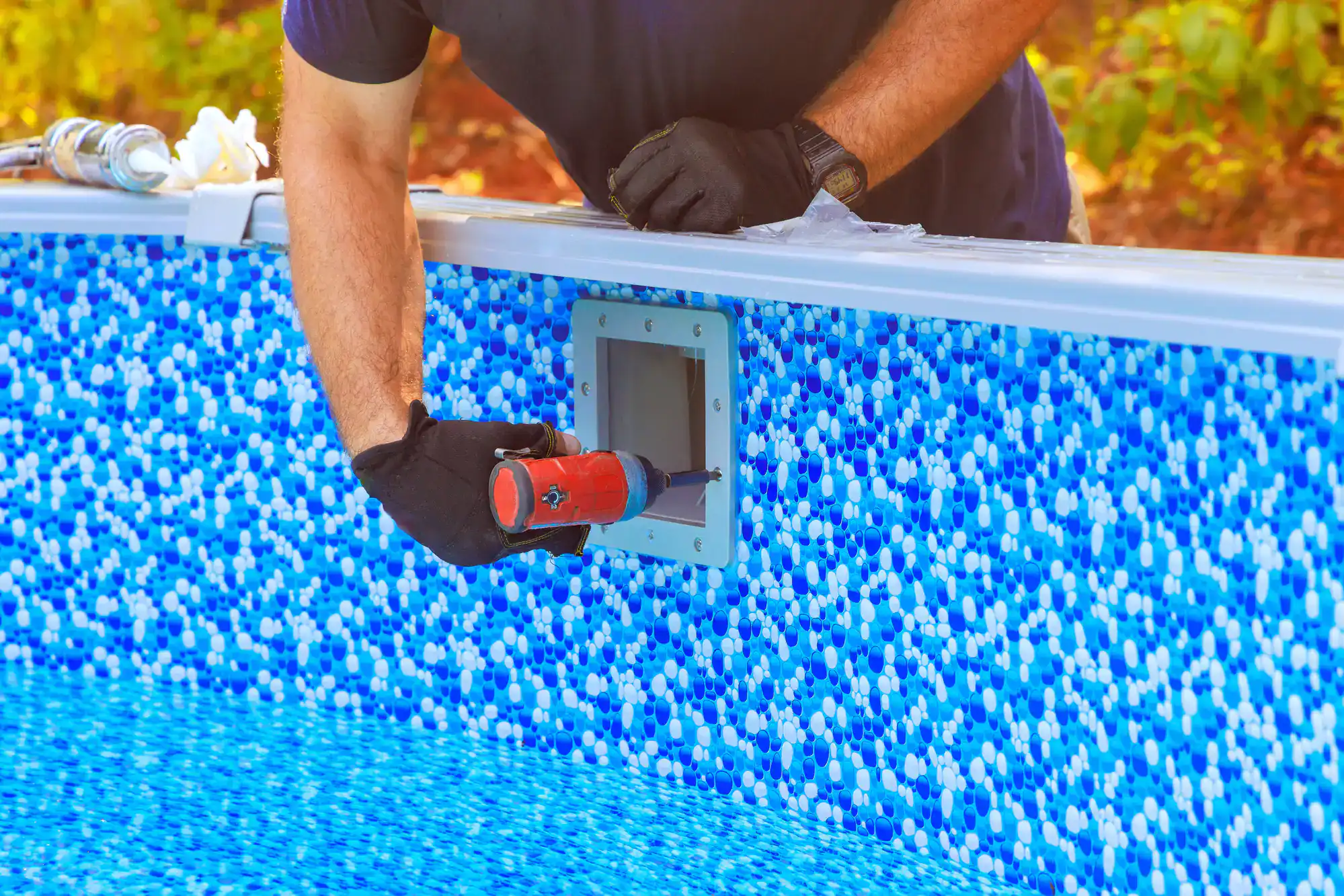
Design freedom isn’t just about the pool’s outline. It’s about what you can build into the structure itself. Concrete allows for custom features that simply aren’t possible with a pre-formed fiberglass shell.
Want a tanning ledge? Concrete lets you build it at the exact depth, width, and location you need. Swim-up bars, built-in seating, multiple depth zones, raised spas that spill into the pool—all of this is standard with concrete pool construction. You’re not adding features as afterthoughts. You’re designing them into the structure from the beginning, which means they’re integrated, permanent, and built to last.
Fiberglass pools can have some of these features, but only if the manufacturer included them in that particular mold. You can’t customize depth, placement, or size. You get what comes with that model. If you want to add something later, you’re looking at expensive retrofitting or simply living without it.
Concrete pools are also better for integrating water features. Waterfalls, grottos, deck jets, and spillways can all be engineered into the design. The structure is built to support these features from day one, not adapted to accommodate them after the fact.
This matters especially if you’re thinking long-term. Your needs will change. Kids grow up and want deeper water. You might decide to add a spa five years from now. With concrete, modifications are possible because you’re working with a solid structure. With fiberglass, you’re stuck with what you bought unless you want to replace the entire shell.
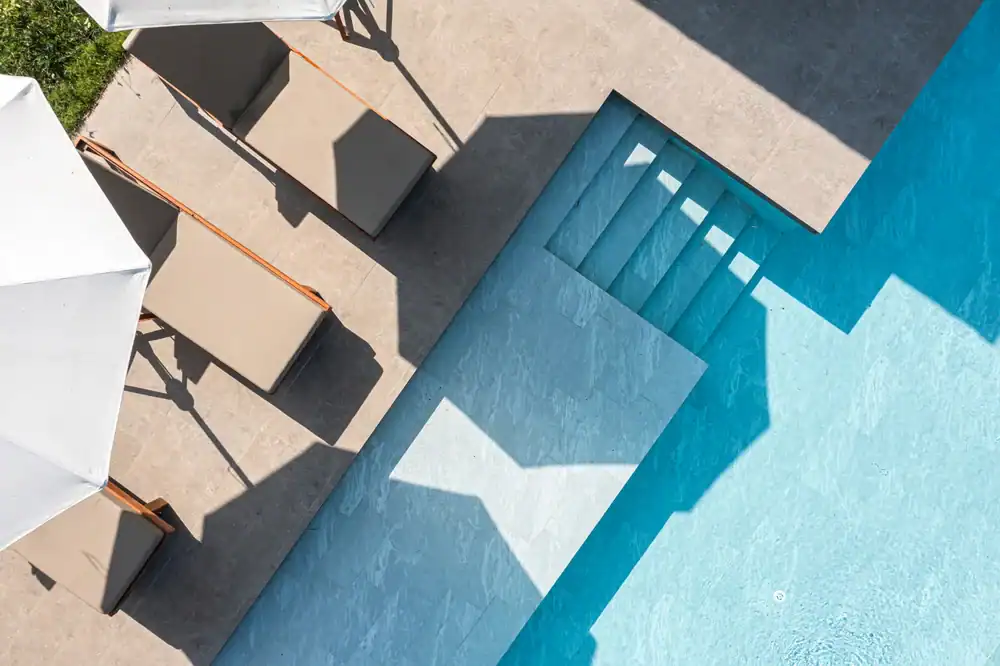
Consider stairs and entry points too. Concrete pools can have stairs built exactly where you want them, at the width and depth that makes sense for your family. Fiberglass stairs are molded into the shell at the factory, so you’re limited to whatever the manufacturer decided. If those stairs end up in an awkward spot for your yard layout, there’s nothing you can do about it.
When you’re spending $35,000 to $65,000 on pool construction, you should get exactly what you want. Concrete makes that possible. Fiberglass makes you compromise from the start.
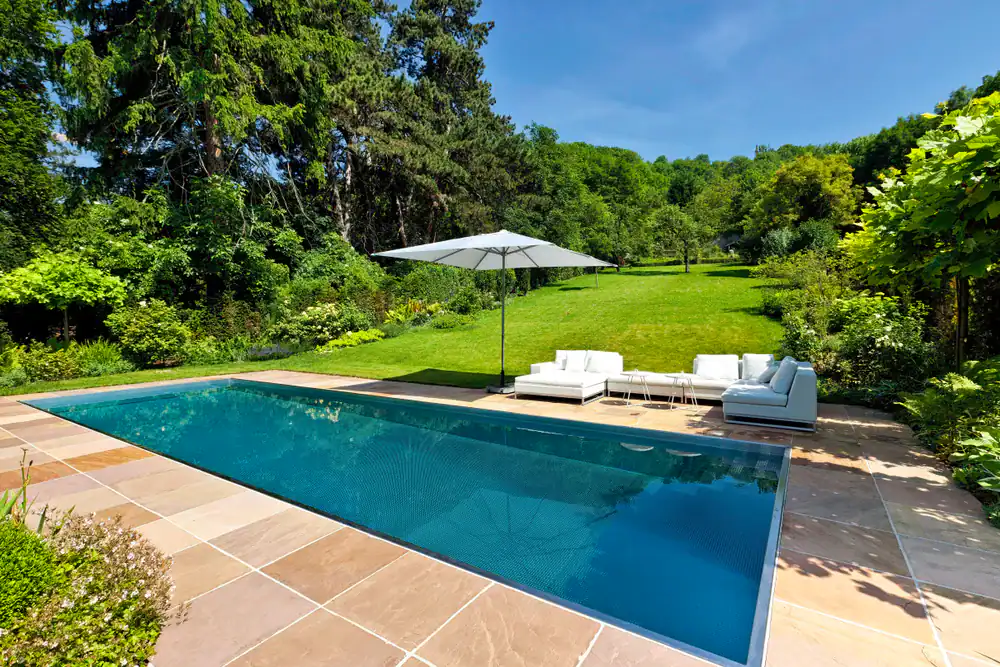
The pool itself is only part of the project. The deck surrounding it matters just as much for both function and appearance. If you’re going with concrete for the pool, stamped concrete decks are the perfect complement that ties everything together.
Stamped concrete gives you the look of natural stone, slate, brick, or even wood planks—but at a fraction of the cost of those materials. It’s poured in one continuous surface, which means no gaps for weeds to grow through, no individual pavers to shift or settle over time, and no grout lines to crack. Just a seamless, durable surface that integrates perfectly with your concrete pool.
You can choose from dozens of patterns and colors. Flagstone texture creates a natural, organic look. Slate patterns offer something more refined and modern. Wood plank stamps give you that boardwalk feel without the maintenance, rot, or splinter issues of real wood. The color options let you match your home’s exterior or create contrast that makes the pool area stand out as a destination space.
Stamped concrete decks also handle Georgia’s weather better than most alternatives. When properly sealed, they resist UV fading from intense summer sun, pool chemicals that splash out during use, and constant water exposure from swimmers tracking wetness across the surface. You can add a non-skid grit to the sealer for better traction around wet areas, which is crucial for safety. Unlike wood or composite decking, stamped concrete won’t warp, splinter, or need replacing every decade.
The real advantage is integration. Because both the pool and deck are concrete, they’re designed together as one cohesive project. The coping, the deck finish, the pool surface—it all flows visually. You’re not mixing materials and hoping they work together. You’re creating a unified outdoor space where everything complements everything else.
If you want to get creative, stamped concrete decks allow for borders, inlays, or multiple colors to define different zones. You might use one pattern around the pool and another for the patio area. Or add a border in a contrasting color to separate spaces visually. Stamped concrete is flexible enough to handle complex designs without the cost of actual stone or tile. For most Coffee County, GA homeowners, it’s the best combination of durability, aesthetics, and value for a pool deck.
This is where concrete really separates itself from fiberglass. A well-maintained gunite pool can last 75 to 100 years. That’s not marketing exaggeration. We’re talking about a structure that could outlive you and still be in use by the next generation.
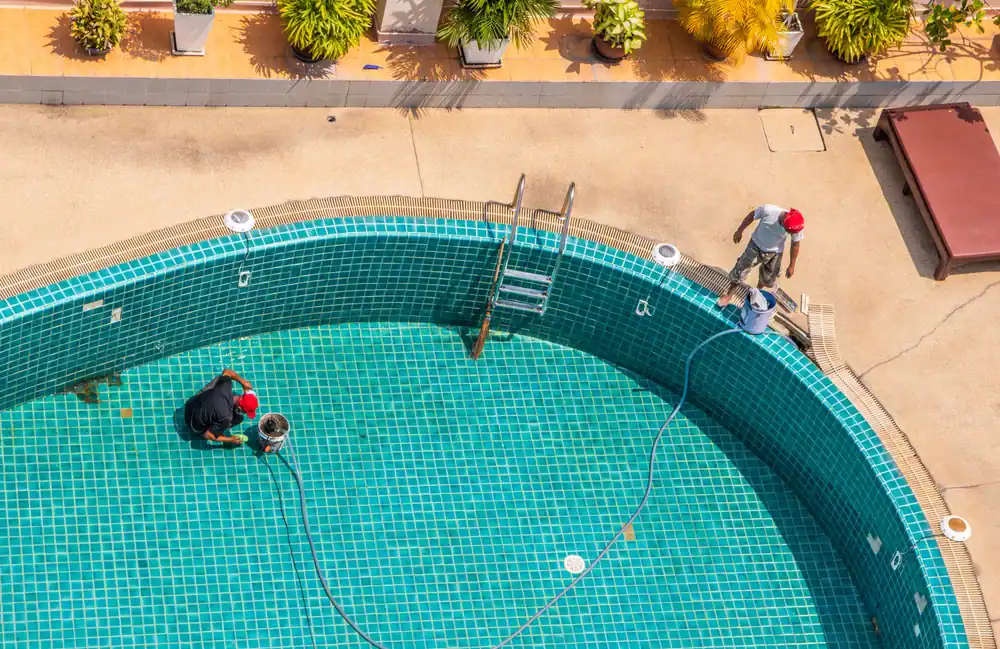
Fiberglass pools are durable for what they are. But the gelcoat surface degrades over time from UV exposure and chemical use. The shell itself might last 25 to 30 years before it needs serious work or replacement. Concrete pools need resurfacing every 10 to 15 years, but the structure underneath—the rebar and concrete shell—stays solid for decades longer than any fiberglass alternative.
That longevity matters when you’re thinking about long-term pool value. Yes, concrete costs more upfront. But when you spread that cost over 75 years instead of 25, the math changes dramatically. You’re not just buying a pool. You’re building a permanent feature that adds value to your property for generations.
Summary:
Share: