Explore top infinity edge pool design ideas that transform Douglas County backyards into resort-style retreats with expert engineering and timeless luxury appeal.

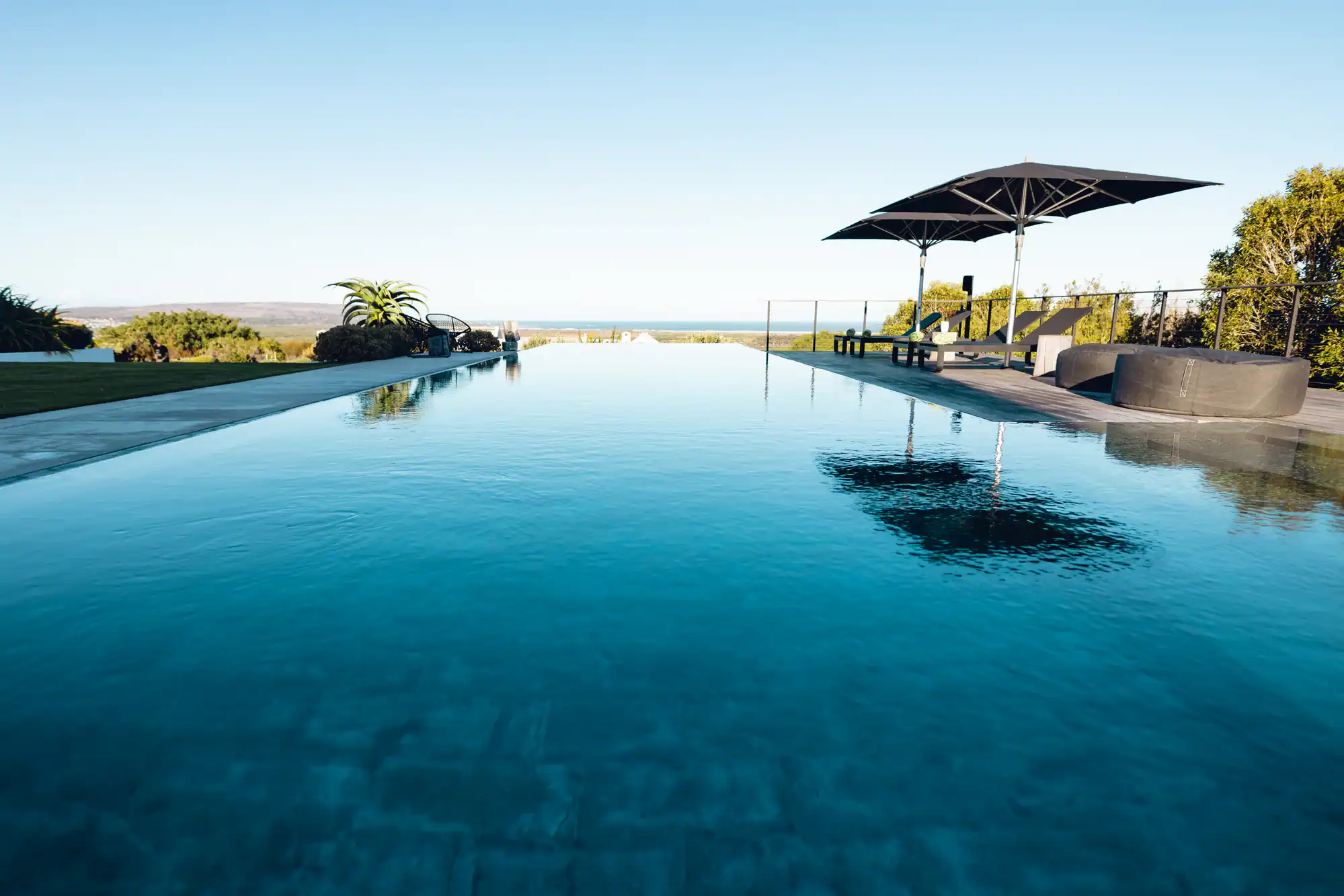
An infinity edge pool creates the illusion that water extends endlessly into the distance. The effect happens because water flows over one or more edges into a hidden catch basin, then gets pumped back into the main pool.
The edge—called a weir wall—sits slightly below the water’s surface. When water spills over, it disappears from view. That’s what creates the vanishing effect. You don’t see a traditional pool wall or coping on that side. Just water meeting the horizon.
This isn’t a cosmetic add-on. The entire pool is engineered differently. You need a secondary catch basin to collect overflow water, a recirculation system to pump it back, and precise leveling to maintain that thin sheet of water flowing over the edge. Even a quarter-inch deviation can disrupt the effect.
Traditional pools use skimmers to pull surface debris into the filtration system. Infinity edge pools don’t need them. Water constantly flows over the edge, carrying leaves, bugs, and surface debris with it into the catch basin.
The catch basin sits just below and behind the vanishing edge. It’s essentially a second, smaller pool that collects overflow. From there, pumps move the water through your filtration system and back into the main pool. This continuous circulation keeps the surface cleaner than most standard pools.
You will need a larger pump system to handle the extra water movement. The catch basin also has to be sized correctly—not just for normal overflow, but for displacement when people get in the pool. If five people jump in at once, that water has to go somewhere. A properly designed catch basin accounts for surge capacity so you don’t lose water over the sides or run the pump dry.
Wind is another factor. On elevated properties or open lots, strong gusts can push water out of the pool faster than normal. The catch basin needs to be wide enough to collect wind-driven overflow without letting it spill onto your deck or yard. This is why site evaluation matters before you commit to a design.
Temperature control works the same as any pool, but automation makes it easier. Modern systems let you adjust water temperature, lighting, and filtration schedules from your phone. You can warm the pool before you get home or set the edge flow to a gentle trickle for a quieter evening. The technology isn’t just convenient—it helps you manage operating costs by running equipment during off-peak hours.
The recirculation system runs continuously when the pool is in use. That means slightly higher energy costs compared to a traditional pool. Variable-speed pumps help offset this by adjusting flow rates based on demand. When no one’s swimming, the system can run at lower speeds to maintain circulation without burning through electricity.
An infinity edge pool has one or two sides that overflow. A perimeter overflow pool lets water spill over all four sides. Both create stunning visual effects, but they serve different purposes and come with different price tags.
Infinity edge designs work best when you have a view you want to emphasize. The vanishing edge faces the vista—whether that’s a wooded lot, a golf course, or just open sky. The other three sides use traditional coping. This keeps costs lower than a full perimeter overflow while still delivering that signature disappearing effect.
Perimeter overflow pools create a mirror-like surface because water flows evenly on all sides. There’s no coping to interrupt the waterline. The pool sits flush with the deck, and the entire perimeter acts as a continuous skimmer. This design costs more because you’re essentially building gutters and catch basins around the entire pool, not just one edge.
The visual difference is subtle but meaningful. Infinity edge pools have a directional focus. Your eye follows the vanishing edge toward the view. Perimeter overflow pools feel more self-contained. The water becomes a reflective surface, almost like a liquid mirror set into your deck.
Construction complexity also differs. A single vanishing edge requires precise engineering on one side. Perimeter overflow demands that precision on all four sides, with tolerances within 1/32 of an inch. If one section is even slightly off-level, water won’t flow evenly, and the effect breaks down.
For flat properties in Douglas County, GA, perimeter overflow can actually be easier to execute than a traditional infinity edge. You don’t need a natural slope or fabricated elevation. The pool can sit at grade level with the deck, and the overflow system handles everything. But you do need more space around the pool for the gutter system, and excavation costs go up because you’re digging for catch basins on all sides.
Maintenance requirements shift slightly too. Perimeter overflow pools have more gutter footage to keep clean, but debris removal is constant and automatic. Infinity edge pools concentrate overflow on one side, which can make that catch basin fill faster with leaves and dirt if you have trees nearby. Both designs need regular attention to keep the overflow system functioning properly, but the workload distributes differently.
Want live answers?
Connect with a Deep Waters Pools expert for fast, friendly support.
Douglas County properties range from flat suburban lots to gently sloped acreage. That variety opens up different design possibilities depending on your land and what you want the pool to do.
Some concepts prioritize views. Others focus on creating elevation where none exists. A few integrate spas, fire features, or zero-entry sections to build a complete outdoor living space. The right concept depends on your property’s topography, your budget, and how you plan to use the space.
These ten concepts represent approaches that work well in Georgia’s climate and soil conditions. They’re not one-size-fits-all templates. Think of them as starting points that can be customized to fit your specific site and vision.

This design places the infinity edge on the side facing your best view—whether that’s a tree line, open sky, or landscaped yard. The opposite end features a raised spa that spills over into the main pool, creating a second water feature.
The spa sits 12 to 18 inches above the pool deck. Water flows from the spa over a spillway into the pool, adding movement and sound. When the spa’s heated, that warmth gradually mixes into the pool, extending your swimming season without running the main pool heater constantly.
You can finish the spa walls in tile, stone, or the same material as your pool interior. Glass tile catches light and creates a shimmering effect as water cascades down. Natural stone gives a more organic, grotto-like feel. The finish you choose sets the tone for the entire backyard.
This concept works well on properties with a gentle slope. The infinity edge faces downhill to maximize the vanishing effect. The spa sits at the high end, using the natural grade to create elevation without extensive excavation. If your lot is relatively flat, you can build up the spa area with fill and retaining walls, but costs increase.
Lighting transforms this design at night. LED strips under the spa spillway make the falling water glow. Perimeter lights around the infinity edge create a floating effect after dark. Programmable systems let you change colors for different moods or events—soft white for quiet evenings, vibrant blues and greens for parties.
Automation is almost essential with this setup. You’ll want independent control over spa temperature, pool temperature, spillover flow rate, and lighting. Modern systems handle all of this through a single app. You can fire up the spa from inside the house, adjust the spillover to a gentle trickle or a dramatic cascade, and set lighting scenes without touching a single switch.
The catch basin for the infinity edge needs to account for both normal overflow and the additional water coming from the spa spillover. If both features are running at full capacity and someone gets in the pool, displacement can be significant. Proper engineering ensures the catch basin handles peak demand without overflowing onto your deck.
A perimeter overflow pool with a zero-entry beach section combines two high-end features into one cohesive design. Water flows over all four sides, creating that mirror-like surface. One end slopes gradually from deck level into the pool, mimicking a beach entry.
The zero-entry section—sometimes called a beach entry or tanning ledge—starts at 0 inches and slopes to about 12 inches deep over 6 to 8 feet. You can walk into the pool without steps. Kids can play in the shallow area. You can set lounge chairs in a few inches of water and relax without fully submerging.
This design works especially well for families. The zero-entry area gives young children a safe, shallow space to play while adults swim in the deeper sections. It also makes the pool accessible for anyone with mobility concerns. No ladders, no steps—just a smooth transition from deck to water.
The perimeter overflow system keeps the waterline perfectly level with the surrounding deck. There’s no visible edge or coping to interrupt the flow. The pool looks like a sheet of water set into the ground. When the surface is still, it reflects the sky and surrounding landscape like a mirror.
Construction requires precise grading. The zero-entry slope has to be smooth and consistent. The perimeter overflow gutters need to be level within a fraction of an inch on all four sides. Any deviation creates uneven water flow, which ruins the visual effect. This level of precision is why experienced builders are non-negotiable for perimeter overflow designs.
Material choices matter more with perimeter overflow. The deck needs to be perfectly level and flush with the pool’s waterline. Pavers, travertine, and poured concrete all work, but installation has to be flawless. Any settling or shifting after construction will throw off the overflow system.
The catch basin runs around the entire perimeter, hidden beneath the deck. It collects overflow from all four sides and routes it to a central collection point where pumps send it back to the pool. The system is more complex than a single-edge design, which means higher installation costs and more components to maintain long-term.
But the payoff is a pool that doesn’t look like a pool. It looks like a perfectly still body of water that happens to be in your backyard. When you add the zero-entry beach, you get functionality and aesthetics in one package. It’s a concept that works for families who want luxury without sacrificing usability.
An infinity edge pool changes your backyard. It’s not just about adding a place to swim. It’s about creating a space that feels different every time you step outside—calmer, more open, more intentional.
The right design depends on your property’s layout, your budget, and what you actually want to do with the space. A single vanishing edge works if you have a view worth emphasizing. Perimeter overflow makes sense if you want that seamless, mirror-like effect. Integrated features like spas, beach entries, and fire bowls add layers of functionality without cluttering the design.
Start with a site evaluation. Understand your property’s slope, soil conditions, and drainage before you commit to a concept. Work with builders who’ve done this before—not just standard pools, but actual infinity edge installations with proper engineering and catch basin design. If you’re in Douglas County, GA and ready to explore what’s possible for your property, we can walk you through the process from concept to completion.
Summary:
Share: