Smart pool technology is transforming Coffee County, GA pool ownership. From AI-powered robotic cleaners to automated chemical dispensers, these 2026 pool automation upgrades slash maintenance time and energy costs while giving you remote control from anywhere.
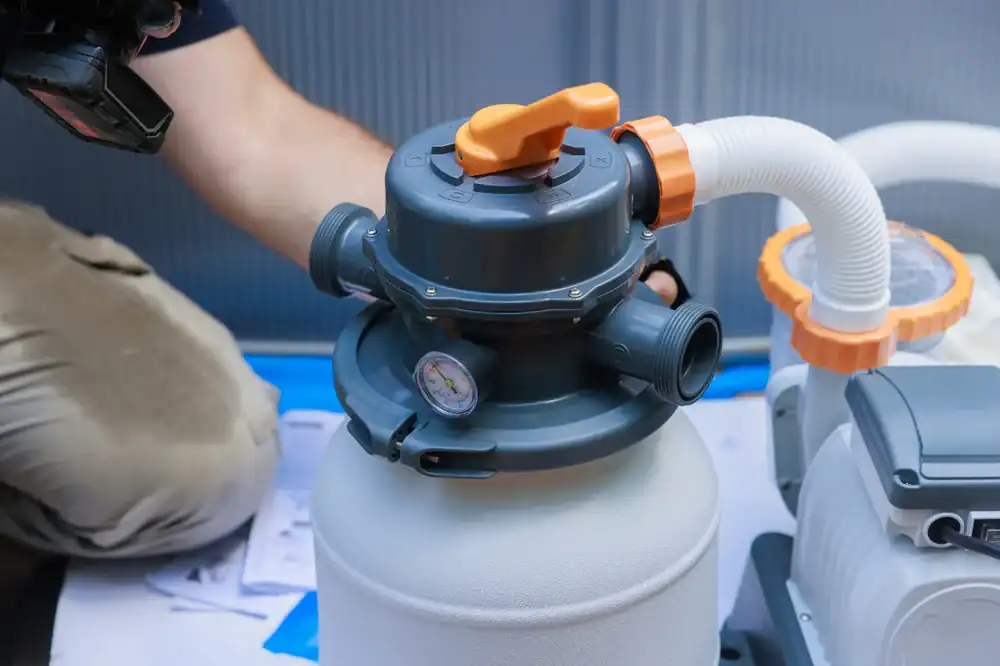
Pool automation means using connected technology to control and monitor your pool equipment from your smartphone, tablet, or voice assistant. Instead of walking outside to flip switches or adjust dials, you manage everything from one app. Remote pool monitoring gives you complete visibility into your pool’s status whether you’re at work, on vacation, or just inside watching TV.
The technology isn’t new, but what’s changed in 2026 is how affordable and reliable these pool automation systems have become. Early systems required expensive installations and often had compatibility issues. Now, most smart pool controllers work with existing equipment and can be installed without rewiring your entire pool pad.
The real driver behind automation’s popularity isn’t just convenience. It’s cost savings and pool energy efficiency. Variable speed pumps controlled by smart systems can cut your energy consumption by 30 to 70 percent. For a Coffee County, GA homeowner running a pool through Georgia’s extended warm season, that translates to $80 to $300 monthly savings on electricity alone. When you factor in reduced chemical costs from precise automated dosing and fewer emergency repairs from early equipment alerts, most pool automation systems pay for themselves within two to four years.
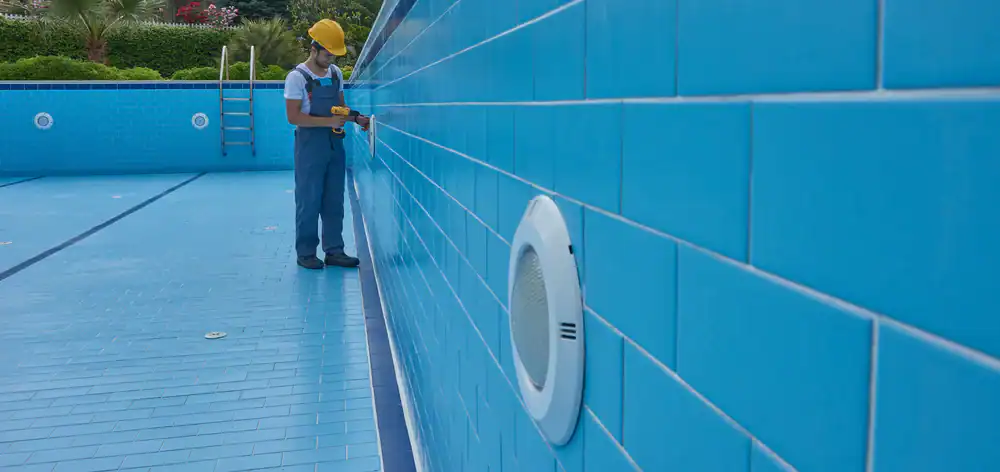
A smart pool controller acts as the brain of your entire pool automation system. It connects to your pump, heater, lights, and other equipment, then lets you manage all of it through a centralized app or control panel. Think of it as the command center for everything happening in your pool.
The setup typically includes a main control unit installed near your existing equipment pad, wireless connectivity to your home network, and sensors that monitor water temperature and equipment performance. Once installed, you can create schedules for filtration cycles, set temperature preferences, and control lighting without ever touching a physical switch. Remote pool monitoring means checking your pool’s status from anywhere with cell service.
What makes these controllers “smart” is their ability to optimize operations automatically. Instead of running your pump at full speed for eight hours straight, the system adjusts speed based on actual needs. It can run slower during off-peak energy hours to save money, then ramp up when you’re planning to swim. Some systems even integrate with local weather forecasts to adjust heating schedules, so you’re not wasting energy warming your pool before a cold snap.
The major brands in 2026 include Pentair IntelliCenter, Jandy AquaLink, and Hayward OmniLogic. Each offers smartphone apps with intuitive interfaces that make pool management genuinely simple. You can check your pool’s status from work, adjust settings while traveling, or use voice commands through Alexa or Google Home to turn on your spa jets while you’re cooking dinner. That level of integration makes pool automation feel like a natural extension of your smart home rather than another complicated system to learn.
Installation costs for a basic pool automation system typically run between $3,500 and $7,500, including professional setup. If you want full smart home integration with outdoor lighting, music, and advanced features, expect $6,000 to $10,000. That might sound steep until you calculate the monthly energy savings. A single-speed pump running during peak hours costs roughly $80 to $150 per month in Georgia. Switching to automated variable speed operation drops that to $20 to $35 monthly. Over two years, you’ve recovered your investment just from electricity savings.
The other benefit that’s harder to quantify but equally valuable is peace of mind. Real-time equipment monitoring means you get alerts if something’s wrong before it becomes a $1,200 pump replacement. You’ll know if your filter pressure is climbing, if your heater isn’t reaching temperature, or if water levels drop unexpectedly. Those notifications prevent the kinds of problems that ruin weekends and drain bank accounts. For Coffee County, GA pool owners who travel for work or take extended vacations, remote pool monitoring eliminates the stress of wondering whether everything’s running properly back home.
Robotic pool cleaners have been around for years, but the 2026 models represent a genuine leap forward in pool automation. We’re talking about machines with AI-powered navigation that can identify debris types, optimize cleaning paths, and operate completely independently for days at a time. These aren’t the random-bumping robots from five years ago.
The older generation of robotic cleaners basically bumped around your pool randomly until they eventually covered most surfaces. Modern units use cameras, sonar, or gyroscopic mapping to create a digital layout of your pool. They know where they’ve been, where they need to go, and which areas collect the most debris. Some models can even detect leaves, rocks, and other debris from up to two meters away and adjust their path in real time to capture it. That’s the kind of smart technology that actually makes a difference in how clean your pool stays.
What separates premium robotic pool cleaners from basic models comes down to three factors: navigation intelligence, cleaning coverage, and maintenance requirements. Entry-level units under $500 will clean your pool floor adequately but often miss walls and waterlines. Mid-range models between $500 and $1,000 add wall-climbing capability and programmable schedules. Premium models above $1,000 include waterline scrubbing, larger debris capacity, and integration with your pool automation system.
The cordless trend is worth mentioning because it’s getting a lot of attention in 2026. Battery-powered cleaners eliminate the tangled cord problem that’s plagued robotic cleaners for years. However, the technology isn’t quite there yet. Cordless models have significantly less suction power and shorter run times compared to corded versions. For most Coffee County, GA pools dealing with leaves, pollen, and Georgia clay dust, corded models still deliver better results. Don’t let marketing hype push you toward cordless if your priority is actually getting your pool clean.
One feature that genuinely changes the ownership experience is automated scheduling. Instead of manually dropping your cleaner in the pool and retrieving it when finished, newer models can be programmed to run every day, every other day, or every third day. Some even include docking stations that recharge the unit and rinse the filter basket automatically. You literally set it once and forget about it. That’s pool automation at its best.
The time savings here are substantial. Manual pool cleaning typically takes 30 to 60 minutes several times per week. A robotic pool cleaner handles that work while you’re at the office, asleep, or anywhere else. Over a year, you’re reclaiming 50 to 100 hours that would have been spent pushing a vacuum pole around your pool. For busy Coffee County, GA families, that time adds up fast.
Want live answers?
Connect with a Deep Waters Pools expert for fast, friendly support.
Chemical balance is where most pool owners struggle. Test strips give inconsistent readings. Liquid test kits require interpretation. And even when you get accurate numbers, figuring out how much of which chemical to add involves math that nobody wants to do on a Saturday morning. It’s one of those tasks that everyone puts off until the water starts looking questionable.
Automated chemical dispensers remove that entire headache. These devices continuously monitor pH, chlorine levels, and other parameters, then dispense precise amounts of chemicals to maintain perfect balance. No more guessing. No more algae blooms because you waited too long between treatments. No more burning eyes from over-chlorination. Just consistently clean, balanced water that’s ready whenever you want to swim.
The technology works through sensors submerged in your pool that take readings every few minutes. That data feeds to a control unit that manages chemical feeders or salt chlorine generators. When pH drifts out of range, the system adds the correction automatically. When chlorine levels drop, it generates or dispenses more. All of this happens without you lifting a finger. It’s pool automation applied to the most tedious part of pool ownership.
Automated chemical dispensers range from $800 for basic chlorine feeders to $2,500 for comprehensive monitoring and dosing setups. Salt chlorine generators, which produce chlorine from dissolved salt, run $1,200 to $2,000 installed. These are separate costs from your main smart pool controller, though most integrate seamlessly once installed. Think of it as building your pool automation system in layers based on what matters most to you.
The financial case for chemical automation comes from three sources. First, you use fewer chemicals overall because dosing is precise rather than the “dump and hope” method most homeowners employ. That typically saves $30 to $60 monthly on chemical purchases. Second, you avoid the expensive cleanup from chemical imbalances. A single algae bloom costs $300 to $500 to remediate. Stained plaster from improper pH can require resurfacing that runs into thousands. Third, balanced water extends the life of your pool surfaces and equipment by preventing corrosive damage.
Beyond the money, there’s the practical reality that most pool owners simply don’t test their water as often as they should. Life gets busy. You skip a week. Then two weeks. By the time you notice the water looks cloudy, you’re dealing with a problem instead of preventing one. Automated chemical dispensers don’t forget. They don’t get busy. They maintain your water quality consistently, which means your pool is always ready when you want to use it. That’s the kind of convenience that changes how you think about pool ownership.
The systems also provide historical data through their apps as part of your remote pool monitoring setup. You can see trends in your water chemistry, track how much chlorine your pool uses during different seasons, and identify patterns that might indicate equipment issues. That level of visibility helps you make better decisions about maintenance and upgrades. For Coffee County, GA pool owners who want to understand what’s actually happening with their pool rather than just reacting to problems, this data proves invaluable.
Energy costs represent the single largest ongoing expense for pool owners in Coffee County, GA. Georgia’s long swimming season means pumps, heaters, and other equipment run far more months out of the year compared to northern climates. If you’re still operating old single-speed equipment, you’re likely spending $1,000 to $1,800 annually just on electricity for your pool. That’s money leaving your account every month for something that could be running far more efficiently.
Variable speed pumps controlled through pool automation systems change that equation dramatically. These pumps can operate at different speeds depending on what’s needed at any given time. Filtration doesn’t require full power. Neither does running water features or heating. By automatically adjusting to the minimum speed necessary for each task, variable speed pumps use 50 to 80 percent less energy than old single-speed models. The pool energy efficiency gains are measurable and immediate.
The Department of Energy has recognized this efficiency advantage. Many utility companies offer rebates for upgrading to variable speed pumps, sometimes covering $200 to $300 of the installation cost. Combined with the monthly savings, you’re looking at payback periods of 18 to 24 months. After that, it’s pure savings every month. For a Coffee County, GA homeowner, that could mean an extra $800 to $1,400 staying in your pocket every year.
Automated heating control delivers similar benefits. Instead of leaving your heater on all day hoping the pool reaches the right temperature by evening, smart pool controllers can calculate exactly when to start heating based on current temperature, desired temperature, and your heater’s output capacity. Some even factor in weather forecasts, skipping heating cycles if rain is expected. This intelligent scheduling prevents wasted energy and ensures your pool is comfortable when you actually plan to use it. No more heating an empty pool all day because you forgot to adjust the timer.
LED lighting controlled through pool automation adds another efficiency layer. Older incandescent pool lights consume 300 to 500 watts. LED equivalents use 30 to 50 watts while producing the same or better illumination. When you can schedule these lights through your automation system or control them remotely, you eliminate the common problem of accidentally leaving pool lights on overnight. Over a swimming season, that’s another $50 to $100 in savings.
The cumulative effect of these pool energy efficiency improvements is substantial. Homeowners who upgrade from older manual systems to full pool automation with variable speed pumps, LED lighting, and smart heating typically see their pool-related energy costs drop by 40 to 60 percent. For a Coffee County, GA pool that previously cost $150 monthly to operate, that’s $60 to $90 in savings every single month during swim season. Over a five-year period, you’re looking at $3,600 to $5,400 in electricity costs that you simply didn’t have to pay. That’s real money that can go toward family vacations, home improvements, or anything else more enjoyable than utility bills.
The right pool automation setup depends on what’s frustrating you most about pool ownership right now. If it’s time spent on maintenance, start with a quality robotic pool cleaner and basic scheduling controls. If it’s high energy bills, prioritize a variable speed pump with smart pool controllers. If it’s chemical management, an automated chemical dispenser delivers the biggest impact. You don’t need everything at once to see real benefits.
Most homeowners begin with one or two components, then add others as they see the results. The key is ensuring whatever you install can integrate with additional smart features later. That means choosing pool automation systems from established manufacturers with proven track records and ongoing support. You want technology that will still be supported and updated five years from now, not orphaned equipment that can’t connect to anything else.
Professional installation matters more than most people realize. These systems need to communicate with your existing equipment, connect to your home network reliably, and be configured correctly to deliver the promised benefits. A skilled installer ensures everything works together properly from day one, saving you the frustration of troubleshooting connectivity issues or dealing with equipment that doesn’t perform as expected. This is especially true for Coffee County, GA pool owners who want remote pool monitoring that actually works when they’re away from home.
The pool industry has reached a point where automation isn’t a luxury feature reserved for high-end installations. It’s become the practical choice for anyone who wants to spend less time maintaining their pool and more time actually using it. The technology works, the costs have come down, and the pool energy efficiency savings are real. For Coffee County, GA homeowners looking to modernize their pool routine in 2026, smart-tech upgrades represent one of the best investments you can make in your property and your quality of life. We can help you evaluate which pool automation options make the most sense for your specific situation and handle the installation process from start to finish.
Summary:
Share: