
Hear from Our Customers
Most pool owners in Huffer aren’t doing anything wrong they’re just working with incomplete information. A test strip tells you a number. It doesn’t tell you why the number is wrong, what caused it to shift, or what it’s quietly doing to your pool’s surface while you wait and see. That’s the gap professional water testing fills.
Here’s what changes when you get a full chemistry picture: your chlorine actually works. Not because you added more, but because the pH and cyanuric acid levels are in the right range to let it do its job. In South Georgia’s summer sun, unprotected chlorine can break down in a matter of hours. If your stabilizer level is off, you’re essentially pouring money into the pool and watching it disappear before the afternoon is over.
Coffee County’s spring pollen season adds another layer that most generic pool advice doesn’t account for. The pine-heavy wiregrass landscape around Huffer drops an aggressive pollen load into pools every spring and that organic material spikes chlorine demand fast. A professional chemistry analysis catches that shift early, before it turns into an algae problem that takes days and a lot more product to fix. Knowing exactly what’s in your water means you’re correcting the right thing, not just reacting to what you can see.
We’re based in Douglas the Coffee County seat, and the closest professional pool service to Huffer. That’s not a coincidence. This area is home base, not a service territory on a map. The team that answers the phone is the same team that shows up at your pool, and we’ve been working with gunite and concrete pools across Coffee County and into Huffer for over thirty years.
That history matters for water testing because building pools and testing pools aren’t separate skills they’re connected. When you understand how a gunite surface was constructed, you understand exactly what the water chemistry needs to be to protect it. Calcium hardness that’s too low will slowly eat the plaster. Too high, and you get white mineral scaling that clouds the water and stains the finish. Knowing where those lines are comes from decades of experience, not just a certification course.
We’re fully licensed and insured, and the work is straightforward no upselling, no mystery, no recommendation to buy three products when one will do. Just a clear read of your water and an honest explanation of what it means.
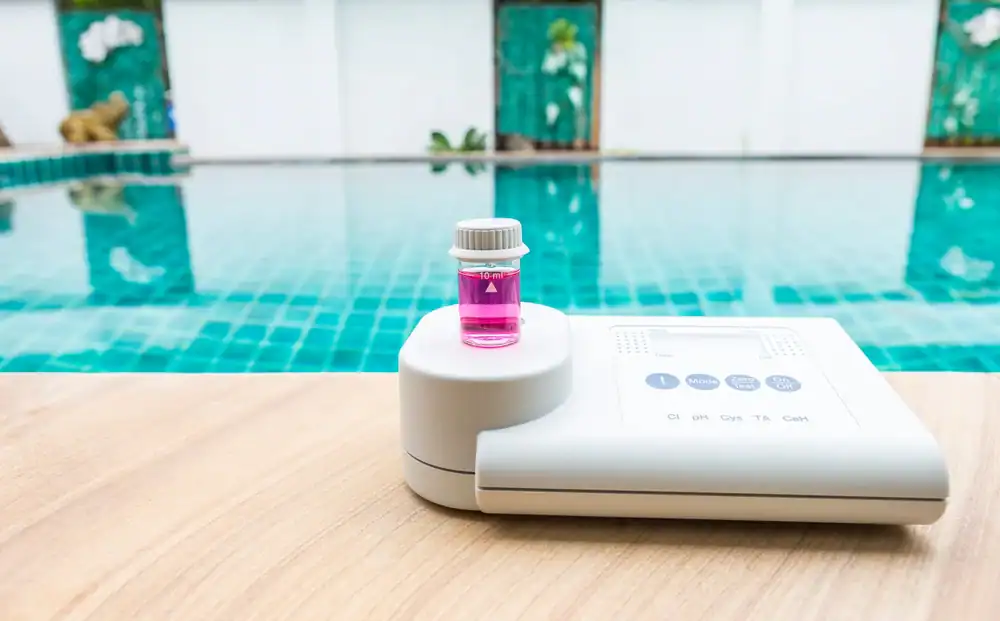
It starts with a full digital water analysis not a color-matching strip you hold up to a chart in the sun. Digital testing measures every parameter to a precise reading: free chlorine, combined chlorine, pH, total alkalinity, calcium hardness, cyanuric acid, and total dissolved solids. Each one affects the others, and a professional test reads them as a system rather than a list of isolated numbers.
Once the analysis is complete, you get a clear breakdown of what’s in range, what’s off, and what it means for your pool. If your pH is sitting above 7.8, your chlorine is running at roughly half its effective strength even if the chlorine number looks fine on its own. If your calcium hardness is low, your water is actively pulling minerals from your pool’s surface to compensate. These are the kinds of connections that don’t show up on a basic test strip, and they’re the reason pools in Huffer stay cloudy or keep going green despite regular chemical additions.
From there, the recommendation is specific: what to add, how much, and in what order. In South Georgia, timing matters too heavy summer rain events are common in Coffee County, and a significant storm can shift your chemistry within 24 hours. Knowing your baseline before and after those events is how you stay ahead of problems instead of chasing them.
Ready to get started?
A complete water test from us covers the full chemistry picture. That means free chlorine and combined chlorine because the difference between the two tells you whether your sanitizer is actually working or just sitting in the water as chloramines, which cause eye irritation and that sharp chemical smell people often mistake for too much chlorine. It also means total alkalinity, which acts as a buffer for your pH and is one of the most commonly overlooked reasons pH won’t hold steady.
Calcium hardness testing is included because it’s non-negotiable for the concrete and gunite pools that we build and service across Coffee County. The local municipal water supply in Douglas comes in at approximately 6 grains per gallon hardness and Huffer residents on private well water may be pulling from a different mineral profile entirely depending on their aquifer. Either way, your fill water’s starting chemistry directly affects what’s happening in your pool, and a professional test accounts for that.
Cyanuric acid the stabilizer that protects chlorine from South Georgia’s intense UV exposure is also measured. At higher concentrations, test strips can’t accurately read CYA levels, which means you could be over-stabilized and not know it. Over-stabilization locks chlorine in a state where it can’t sanitize effectively, a condition sometimes called “chlorine lock.” The full digital analysis catches this where strips miss it, and the correction is straightforward once you know what you’re dealing with.
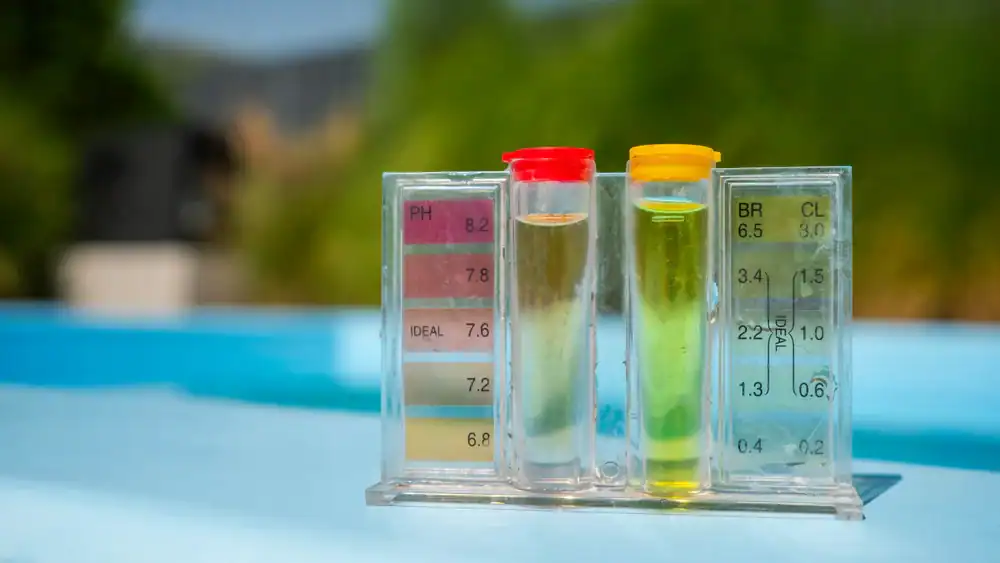
This is one of the most common frustrations pool owners in Coffee County deal with, and the answer almost always comes down to pH. When your pool’s pH climbs above 7.8, chlorine loses a significant portion of its sanitizing power sometimes close to half. So you can have a chlorine reading that looks completely normal and still have water that isn’t being sanitized effectively. Add South Georgia’s summer heat into the equation, and algae can take hold quickly even in a pool that was treated the day before.
The other common culprit is cyanuric acid. If your stabilizer level is too low, the intense UV exposure in this part of Georgia breaks down chlorine faster than you can add it. If it’s too high, the chlorine gets chemically locked and can’t work properly. Both situations look the same from the outside a pool that keeps going green but they require completely different corrections. A full chemistry analysis identifies which problem you’re actually dealing with, so you’re fixing the root cause instead of treating the symptom over and over.
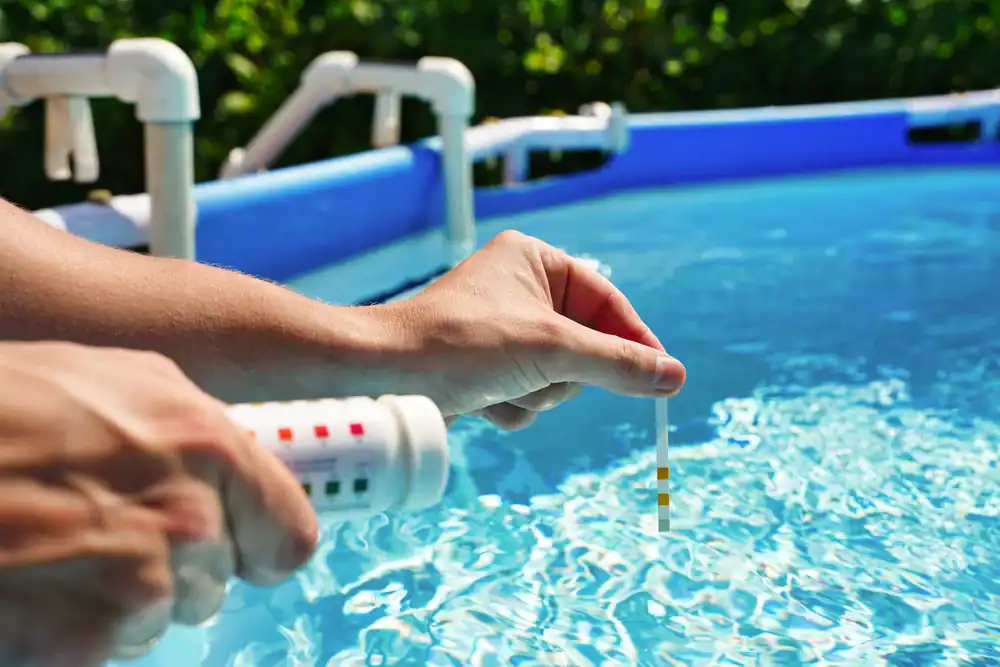
Free in-store testing is a sales tool, not a diagnostic service. The goal is to identify something you need to buy, and the recommendation almost always involves purchasing product. The testing itself is also typically done with reagent drops or strips that are subject to user interpretation, lighting conditions, and the limitations of color-matching by eye.
Digital water analysis measures each parameter electronically, producing a precise numerical reading rather than a visual approximation. It catches things that strip-based testing routinely misses combined chlorine levels, accurate cyanuric acid readings at higher concentrations, and metal content that causes staining. More importantly, the results are interpreted together as a system. A professional reading doesn’t just hand you a printout; it explains what each number means in relation to the others and tells you exactly what needs to be corrected and why.
During peak summer months in Coffee County roughly June through August weekly professional testing is the right baseline for most pools. The combination of intense UV, high heat, heavy bather load, and frequent afternoon thunderstorms creates chemistry conditions that can shift fast. A pool that’s balanced on a Monday can be measurably off by Friday after a couple of rain events and a full weekend of use.
For pools that see heavy use or are exposed to significant organic load which in the Huffer area can include agricultural dust, pollen, and debris from surrounding pine and farmland more frequent checks may be warranted. The practical answer is that you want to test before a problem becomes visible, not after. By the time your water looks cloudy or starts showing color, the chemistry has typically been off for at least a day or two. Catching the shift early is always cheaper and faster to correct than recovering from a full imbalance.
Calcium hardness is one of the most overlooked parameters in residential pool care, and it has a direct impact on the physical condition of your pool’s interior surface. Water that is low in calcium below roughly 200 ppm for a plaster or gunite pool becomes what’s called “aggressive.” It’s looking for calcium to reach equilibrium, and if there isn’t enough in the water, it will pull it from the nearest available source: your pool’s plaster or concrete finish. Over time, this causes etching, pitting, and a rough texture that accelerates algae attachment and is expensive to repair.
On the other side, water that’s too high in calcium above 400 ppm tends to deposit that calcium back out as scale. You see it as white, chalky buildup on the waterline, on fittings, and inside equipment. For gunite and shotcrete pools, which are the dominant pool type we build and service in Coffee County, keeping calcium hardness in the right range is a long-term surface protection issue, not just a comfort one. A professional test gives you the exact number and tells you how far off you are before any damage occurs.
It does, and more quickly than most people expect. South Georgia’s summer thunderstorm pattern brings frequent, sometimes heavy rainfall from June through August. When a significant amount of rain enters your pool in a short period, it dilutes the chemicals already in the water dropping chlorine levels, lowering total alkalinity, and shifting pH downward. That combination creates exactly the conditions algae needs to establish itself, often within 24 to 48 hours of a storm event.
Rain also introduces organic material pollen, dust, debris that increases chlorine demand on top of the dilution effect. In the Huffer area, where pools sit in a rural, pine-forested agricultural landscape, a storm can carry a meaningful amount of organic load into the water in a single event. The practical takeaway is that after any significant rain not just at your regular testing interval it’s worth checking your chemistry. Catching the post-storm shift early is a quick correction. Missing it for a few days often means a much larger one.
Home testing whether you’re using strips or a basic drop kit gives you a partial picture. It’s useful for routine monitoring between professional visits, but it has real limitations that matter in a climate like South Georgia’s. Test strips can’t accurately measure cyanuric acid at higher concentrations, can’t distinguish between free and combined chlorine, and can’t detect metals or measure total dissolved solids. In a rural area like Huffer where some residents are on private well water, metal content and mineral variation are genuine factors that basic home tests won’t catch.
The other limitation is interpretation. Knowing that your pH is 7.6 and your chlorine is 2 ppm doesn’t automatically tell you why your water is still cloudy, or why the chlorine reading keeps dropping faster than it should. A professional analysis reads all the parameters together and connects the dots giving you an explanation, not just a number. For Coffee County pool owners who’ve been testing regularly and still dealing with recurring problems, that’s usually exactly where the answer is hiding.