Not sure if your pool needs resurfacing or just a good cleaning? Here are the signs that tell the real story — and what to do when you spot them.
You’re out back, looking at your pool, and something just feels off. Maybe the surface looks dull and stained no matter how much you clean it. Maybe your kids are coming inside with scrapes on their feet. Or maybe you spotted a crack last fall and have been quietly hoping it wouldn’t get worse.
These aren’t just cosmetic annoyances. They’re your pool telling you it needs attention. And the longer you wait, the more expensive that conversation gets. Here’s how to read the signs clearly — and what your options actually look like when you’re ready to act.
Most pool surfaces don’t fail overnight. They wear down gradually — through years of South Georgia heat, heavy chemical use, and a swim season that runs nearly half the year. By the time something looks obviously wrong, the underlying surface has usually been struggling for a while.
The good news is that the warning signs are consistent and readable. Once you know what to look for, you can catch problems early enough to resurface rather than replace — and that distinction alone can save you tens of thousands of dollars.
The most common sign is rough texture. If walking along the bottom of your pool feels like sandpaper, or if swimmers — especially kids — are coming out with scrapes on their feet and legs, the plaster has worn past the point of comfort. A healthy pool surface should feel smooth. When it doesn’t, no amount of brushing or chemical adjustment will fix it. The surface itself is the problem.
Right alongside that is staining. Not the kind of surface discoloration you can scrub off with a brush and some elbow grease — the kind that’s settled into the plaster itself and won’t budge. Dark patches, rust-colored streaks, and blotchy discoloration that reappears within days of cleaning are all signs that the surface has degraded to the point where it’s absorbing stains rather than resisting them. In Coffee County, where spring pollen is relentless and algae pressure runs high from May through September, staining tends to accelerate faster than it would in a drier climate.
Flaking and peeling are harder to ignore. If you’re finding chunks of plaster on the pool floor, or you can see patches where the surface is visibly separating from the shell underneath, that’s delamination — and it only moves in one direction. Left alone, it spreads. The rough, exposed areas become breeding grounds for algae and make the pool progressively harder to maintain.
Cracks are the sign that tends to worry homeowners the most — and rightly so. Some surface cracks are cosmetic, but others indicate movement in the shell itself, which can lead to leaks. If you’ve noticed your water level dropping faster than evaporation alone would explain, or if you can see cracks that seem to be growing, it’s worth having someone take a look before the problem goes structural.
The last two signs are subtler but just as telling. If you’re fighting algae constantly — spending money on chemicals week after week and still ending up with a green pool days later — a rough, porous surface is likely the real culprit. Algae clings to degraded plaster in ways it simply can’t on a smooth, sealed surface. And if your pool just looks old and faded, that matters too. A pool that was once a backyard centerpiece and now looks like something you’re embarrassed to show guests isn’t just an aesthetic problem — it’s a sign that the surface has reached the end of its useful life.
Standard white plaster typically lasts seven to twelve years under good conditions. Upgrade to a quartz aggregate finish and you’re looking at fifteen to twenty-five years. Pebble finishes — the most durable option available — can last twenty to thirty years or more with proper care.
Those are national averages, though. In Coffee County, the numbers tend to run shorter on the lower end. Summers here regularly push past ninety degrees from May through September, which causes chlorine to burn off faster and demands more frequent chemical adjustments. When water chemistry swings — which it does constantly in our region’s heat and humidity — plaster takes the hit. High acidity etches the surface. High alkalinity causes scaling. Neither is gentle on standard plaster, and both happen regularly when pools aren’t monitored closely.
Add in the region’s sandy loam soils, which shift seasonally and can create minor movement in a pool’s shell over time, and you have a set of conditions that genuinely accelerates surface wear compared to what you’d see in a drier, more stable climate. A pool built in Coffee County in the late 1990s or early 2000s has almost certainly reached or passed the point where resurfacing should be on the table — even if it’s still holding water and functioning.
That’s worth sitting with for a moment. A lot of homeowners assume that because their pool is technically operational, the surface must be fine. But surface degradation and structural failure are two different things. You can have a pool that holds water just fine while the plaster is actively flaking, staining, and creating conditions that make the pool harder and more expensive to maintain every single season. Waiting doesn’t make that problem smaller. It makes the repair more involved and the surface harder to work with when the time finally comes.
Want live answers?
Connect with a Deep Waters Pools expert for fast, friendly support.
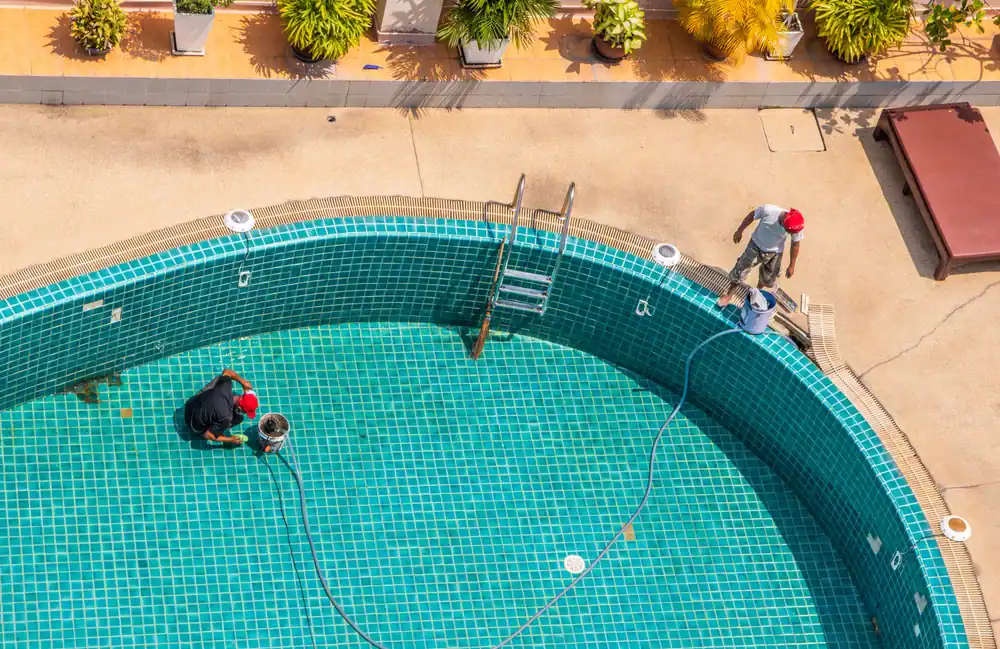
Resurfacing is one of those services that sounds complicated until someone walks you through it plainly. At its core, it means removing the old surface material, inspecting and repairing the shell underneath, and applying a fresh finish that restores the pool’s look, feel, and function.
The whole project typically takes seven to fourteen days, depending on pool size, material choice, and weather. Your pool will need to be fully drained for the work to happen, which is why fall and winter are the smartest times to schedule it in Georgia — the pool is already sitting unused, and you’ll be ready to swim again by the time warm weather returns.
The process starts with a full drain and a thorough inspection of the shell. This step matters more than most homeowners realize. Applying a new surface over unaddressed cracks, hollow spots, or areas of delamination is one of the most common ways resurfacing jobs fail prematurely. Any structural issues — cracks, leaks, areas where the old plaster has separated from the shell — need to be repaired before new material goes on. Skipping that step is how you end up redoing the job two years later.
Once the shell is in good shape, the old surface is ground or chipped away and the underlying concrete is prepared to accept the new material. This is skilled, physical work that requires experience with cement and concrete — not just the ability to apply a finish coat. The prep work is where the longevity of the new surface is actually determined.
Then comes the application itself. Depending on what material you’ve chosen, this involves hand-applying plaster, aggregate, or pebble finish across the entire pool shell. The application has to be even, properly mixed, and done by people who know what they’re doing — inconsistencies in thickness or texture show up immediately and can cause uneven wear over time.
After application, the surface needs to cure before the pool is refilled. Rushing this step is another common shortcut that leads to early failure. Once the pool is filled, the startup chemistry has to be carefully managed for the new surface — the water balance during the first few weeks after resurfacing has a significant impact on how long the finish holds up.
We’ve been doing this work in Coffee County for years, and the thing that separates a resurfacing job that lasts twenty years from one that needs attention in five is almost always the prep work and the startup process — not the material itself. Anyone can apply plaster. Not everyone takes the time to do it right from the ground up.
This is the question we get most often once homeowners decide they’re ready to move forward, and it’s worth answering honestly rather than steering you toward the most expensive option.
Standard white plaster is the most affordable choice upfront — roughly four dollars per square foot — and it works well when it’s properly applied and well-maintained. For a pool that gets moderate use and has a consistent maintenance routine, plaster is a reasonable choice. The trade-off is longevity. In South Georgia’s climate, a plaster surface may need attention again in seven to ten years, and possibly sooner if water chemistry runs out of balance during a stretch of heavy summer use.
Pebble finishes cost more — closer to ten dollars per square foot — but the lifespan difference is significant. A quality pebble surface can last twenty to thirty years with proper care. For Coffee County homeowners who have already replastered once or twice, the math starts to favor pebble pretty quickly. You’re not just paying for a better-looking finish. You’re buying a surface that’s genuinely more resistant to the chemical fluctuations, algae pressure, and heat that South Georgia pools deal with every summer. Pebble also holds up better against the rough treatment that comes with heavy family use — it’s a harder, more durable surface by nature.
Quartz aggregate falls in between — typically lasting fifteen to twenty-five years and offering a smoother feel than pebble with better durability than standard plaster. It’s a strong middle-ground option for homeowners who want longevity without the texture of a pebble finish.
On the cost side overall, most resurfacing projects run between six thousand and fifteen thousand dollars depending on pool size and material. A full pool replacement, by comparison, runs twenty-five thousand to seventy-five thousand dollars. For pools with a structurally sound shell — which most Coffee County pools have, even when the surface is well past its prime — resurfacing is almost always the right financial call. Homes with recently resurfaced pools tend to sell for around seven percent more than comparable properties with aging surfaces, so there’s a real return on investment beyond just the enjoyment factor.
The honest answer to “which surface is right for me” depends on your pool’s history, your maintenance habits, and how long you plan to stay in your home. That’s a conversation worth having before you commit to anything.
If anything in this page sounded familiar — the rough texture, the stains that won’t quit, the crack you’ve been watching — you’re not alone. Most Coffee County homeowners who reach out to us have been sitting on these signs for at least one season, sometimes longer. The hesitation makes sense. It’s a real investment, and it’s hard to know who to trust or what you actually need.
What we’d tell you is this: the earlier you catch surface problems, the more straightforward the fix. A pool that needs resurfacing today is a manageable project. A pool where surface damage has been left to compound for several more seasons can become something more involved.
We specialize in inground cement pools — the exact type most likely to need this kind of work — and we’ve been doing it in Coffee County, GA for years. If you’re trying to figure out what you’re looking at and what it would take to fix it, reach out to us. We’ll give you a straight answer.
Summary:
Share: