
Hear from Our Customers
Most pool problems in Pridgen aren’t a mystery they’re just misdiagnosed. The pool looks fine on Monday, turns cloudy by Wednesday, and by Friday you’re dumping in more chemicals hoping something sticks. That cycle doesn’t end until you know exactly what your water is doing, not just what a color strip guesses.
South Georgia’s summers are genuinely brutal on pool chemistry. UV intensity here can wipe out unprotected chlorine in under two hours, and when temperatures sit in the low 90s for weeks at a time, algae doesn’t give you much warning before it takes over. If your chlorine is technically “in range” but your pH has drifted above 7.8 which happens easily in this heat that chlorine is working at roughly half its normal strength. That’s not a chemical problem. That’s a testing problem.
There’s also the well water factor. A lot of homes out this way top off their pools from a private well, and South Georgia groundwater carries iron and manganese that can throw off your chemistry from the start. Professional digital water analysis accounts for what’s actually in your water not what a standard chart assumes.
We’re based in Douglas about ten to fifteen miles south of Pridgen on US 441 and have been serving Coffee County pool owners for years. We were founded in 2014, but the experience behind our work runs over thirty years deep in gunite construction, plumbing, and pool chemistry. That’s not a marketing line. It means the person reading your water test has actually built pools like yours and understands what happens to a plaster or pebble finish when the chemistry runs wrong for too long.
We’re licensed, insured, and locally owned. There’s no franchise behind our name, no call center fielding your questions. When you reach out, you’re talking to the same team that will show up, run the test, and walk you through what it means. For a community like Pridgen where you’ve probably been handling things yourself because the options felt limited that kind of direct accountability makes a real difference.
It starts with a water sample pulled from your pool at the right depth, not just skimmed off the surface. Where and how the sample is collected matters more than most people realize, and it’s the first place a quick in-store test usually cuts corners.
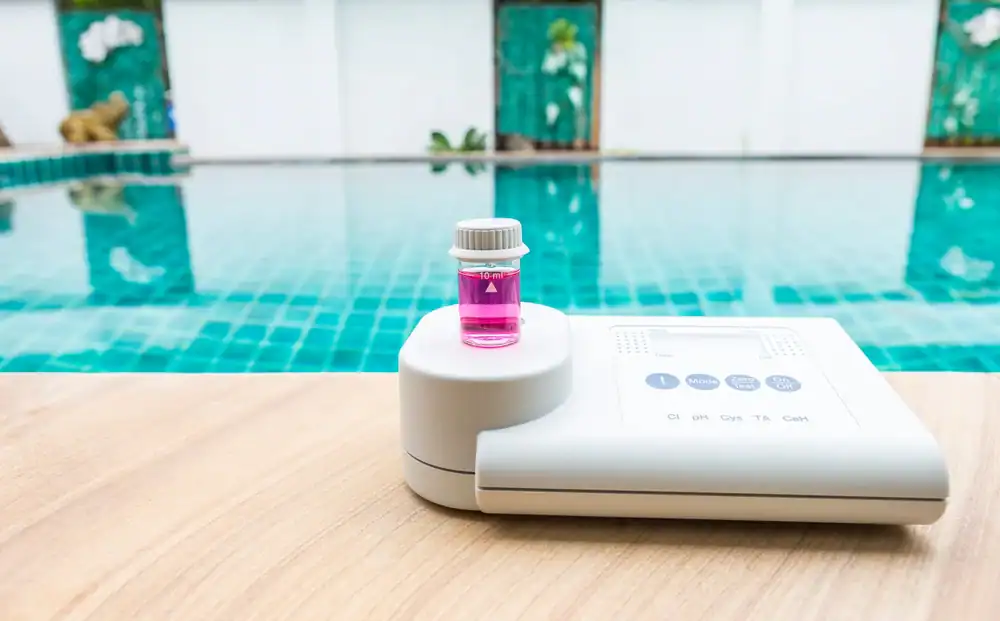
From there, the sample goes through digital analysis equipment that measures every relevant parameter: free chlorine, total chlorine, pH, total alkalinity, calcium hardness, cyanuric acid, total dissolved solids, and metals. Each of those numbers tells a different part of the story. Free chlorine tells you what’s actively sanitizing. Total chlorine includes the used-up chlorine that’s no longer doing anything. The gap between those two numbers combined chlorine is what causes that sharp chemical smell people often mistake for too much chlorine. It’s actually the opposite.
Once the full picture is in front of you, the results get translated into plain language. Not a printout of numbers you have to decode on your own an actual explanation of what’s off, why it matters, and what needs to happen next. In Coffee County’s climate, where a single summer storm can shift your chemistry overnight and spring pollen season spikes your chlorine demand for weeks, having that clarity on a regular basis is what keeps a pool from becoming a problem.
Ready to get started?
A professional water test from us covers the full range of what actually affects your pool not just the basics. pH and total alkalinity get checked together because they work together. Calcium hardness gets measured because water that’s too soft will pull calcium directly from your plaster or gunite surface, and the damage that causes isn’t cosmetic. Cyanuric acid levels get tested because CYA builds up in outdoor pools over time, and once it climbs too high, it starts suppressing your chlorine’s ability to sanitize a condition that test strips can’t accurately detect and that’s especially common in pools that get heavy sun exposure all summer.
Metals testing matters out here too. If you’re filling or topping off your pool with well water which is common on rural Coffee County properties you may be introducing iron or manganese that causes staining and interacts unpredictably with your other chemicals. Knowing that upfront changes how you treat the water.
The end result isn’t a bag of chemicals and a vague recommendation. It’s a clear picture of where your pool’s chemistry stands, what’s causing the problem you’ve been dealing with, and a straightforward plan to correct it. We handle water testing as part of a full-service operation so if the test points to a surface issue, an equipment problem, or a filtration concern, the same team that read your water can address what’s underneath it.
Green water in a South Georgia summer almost always comes down to one of three things: chlorine that’s been destroyed by UV before it could do its job, pH that’s drifted high enough to make whatever chlorine you have largely ineffective, or cyanuric acid that’s built up to the point where it’s actually suppressing sanitization. Any one of those issues will produce algae. All three together which is more common than people realize in Coffee County’s heat can turn a pool green in under 48 hours.
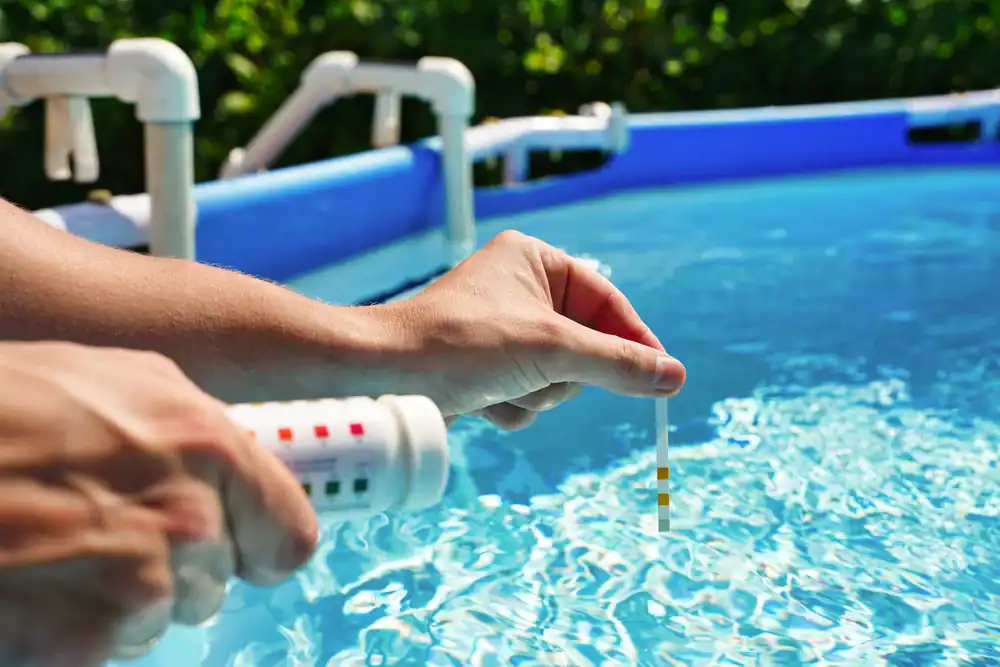
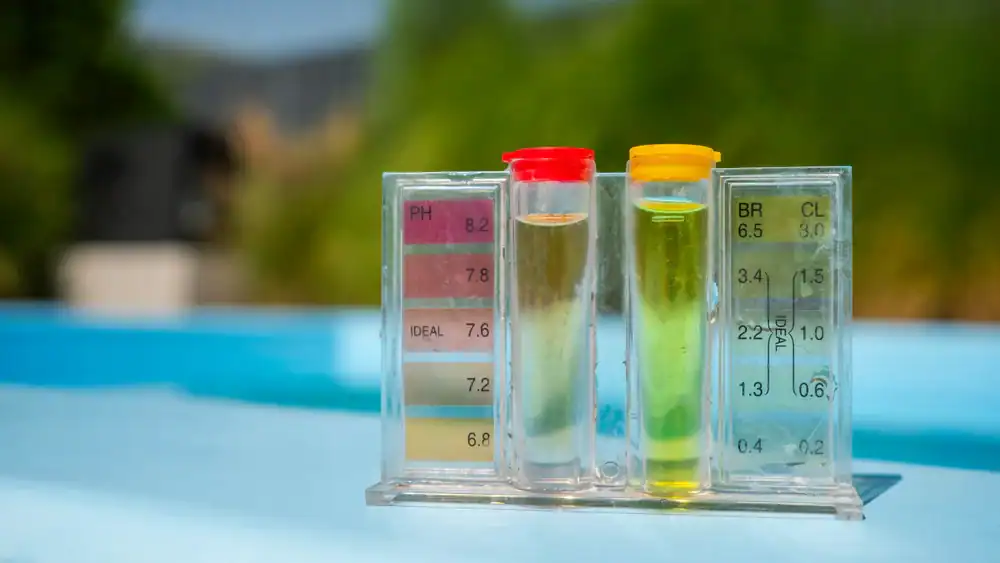
The frustrating part is that test strips won’t catch most of this. They can’t accurately measure high CYA levels, they don’t distinguish between free and combined chlorine, and they’re sensitive enough to surface conditions that a reading taken in direct sunlight can be off by a meaningful margin. A digital water analysis gives you the actual numbers behind what’s happening and once you know which of those three issues is driving the problem, fixing it is straightforward. Treating the symptom without knowing the cause is what keeps people stuck in the same cycle every summer.
During peak summer June through August a professional test once a month is a reasonable baseline, with additional testing after any significant weather event. South Georgia gets around 50 inches of rain a year, and a heavy thunderstorm or a tropical system passing through can dilute your chemicals, drop your pH, and set up conditions for an algae bloom within a day or two. For Pridgen homeowners, catching that shift early is far cheaper than recovering from it after the fact.
Basic at-home testing with strips is fine for monitoring between professional tests, but it shouldn’t replace them. Strips give you a rough read on pH and chlorine, but they miss the parameters CYA, calcium hardness, combined chlorine, metals that tend to be the root cause of recurring problems. Think of professional testing as the diagnostic and at-home strips as the monitoring tool. Both have a role, but only one of them tells you what’s actually going on.
Yes, and it’s one of the more underappreciated issues for rural pool owners in Coffee County. South Georgia’s groundwater particularly in the coastal plain geology that runs through this part of the state can carry elevated levels of iron and manganese. Those minerals don’t just sit harmlessly in your pool. Iron can cause brownish or rust-colored staining on pool surfaces that looks like an algae problem but won’t respond to algae treatment. Manganese can cause dark purple or black staining. Both can interact with chlorine in ways that reduce its effectiveness and create discoloration.
If you’re topping off your pool with a well, the starting chemistry of that water may be significantly different from what any standard treatment protocol assumes. A professional water test that includes metals testing will tell you exactly what you’re working with, so your treatment plan is based on your actual water not a generic baseline built around municipal supply. Getting that baseline established early in the season saves a lot of guesswork later.
Cyanuric acid usually called CYA or stabilizer is added to outdoor pools to protect chlorine from being destroyed by UV radiation. In South Georgia’s sun, that protection is genuinely necessary. Without it, chlorine can be depleted by up to 90% in under two hours of direct sunlight. So CYA serves a real purpose, and most outdoor pools have some level of it.
The problem comes when CYA levels get too high. Once CYA climbs above 80 to 100 parts per million, it starts binding to chlorine in a way that makes the chlorine less effective at sanitizing even though it still shows up on a test strip as present. This is sometimes called chlorine lock. The pool reads as having chlorine, but the chlorine isn’t actually doing much. The only reliable fix at that point is a partial water drain and refill, which dilutes the CYA back to a workable level. A digital water test measures CYA precisely, which is the only way to know if this is what’s behind a pool that won’t stay clean no matter how much chlorine you add.
It can, and it’s a slow enough process that most people don’t notice until the damage is already done. Water that’s low in calcium generally below 200 parts per million is chemically aggressive. It wants to be in balance, and if it can’t find calcium in the water, it will pull it from the nearest available source. In a plaster or gunite pool, that source is the pool surface itself.
The result is etching a rough, pitted texture that starts subtle and gets progressively worse. It can also accelerate deterioration of grout lines and equipment components. On the flip side, calcium hardness that’s too high causes scaling: white, chalky deposits on surfaces and in equipment that are harder to remove the longer they’re left. The target range is roughly 200 to 400 parts per million, and staying in that window is one of the more important things a regular water test checks. For us a team that has built and resurfaced gunite pools across Coffee County for decades this isn’t abstract. We’ve seen what happens to surfaces when the chemistry runs wrong, and it’s one of the reasons we take calcium hardness testing seriously.
The main difference is what the test is designed to do. A pool store test is typically built around identifying which products you need to buy that day. The results aren’t necessarily wrong, but the recommendations that follow tend to be product-driven and the testing equipment used in many retail settings isn’t as precise as dedicated digital analysis tools.
A professional water test from us is built around diagnosing your pool’s actual chemistry and giving you a clear, written picture of every parameter including the ones that don’t have a product to sell against them, like combined chlorine levels or the relationship between your pH and your chlorine’s real-world effectiveness. You get numbers, not just a color match. You get an explanation of what those numbers mean together, not just individually. And because we’re a full-service pool company rather than a retail operation, the recommendation at the end of a test is about solving your problem not moving inventory. For Pridgen homeowners who’ve made the drive to Douglas, spent money on chemicals, and come home to the same issue a week later, that difference is usually exactly what was missing.